Editor’s Note
This article examines Coinbase’s recent proposal for reforming U.S. anti-money laundering regulations, highlighting the ongoing debate between fostering financial innovation and ensuring robust compliance. The views expressed are the author’s own.
Recently, Coinbase, one of the largest cryptocurrency trading platforms in the United States, submitted a 30-page policy recommendation to the U.S. Treasury Department, calling for a thorough reform of anti-money laundering (AML) regulations that have been in place for decades. Its core argument—”When bad actors innovate, good actors must innovate too”—has quickly sparked widespread discussion both within and outside the cryptocurrency industry. Coinbase argues that in the face of increasingly complex digital asset crimes, greater reliance should be placed on technological innovation rather than simply strengthening law enforcement. As an institution long committed to maintaining the integrity of the financial system, the Hong Kong Anti-Money Laundering Alliance believes that Coinbase’s proposal touches on a core issue of the global AML system: how to encourage financial innovation while ensuring a robust and effective regulatory framework to prevent the expansion of risk exposure.
We acknowledge that technology is an indispensable ally in the fight against money laundering. However, while embracing innovation, we must carefully assess its potential risks and guard against any attempts to weaken core regulatory principles under the guise of “innovation.” This article will provide an in-depth analysis of the rationale and potential risks of Coinbase’s proposal from a regulatory professional perspective. It will also explore a balanced approach to future digital asset AML by drawing on Hong Kong’s practical experience in global virtual asset regulation.
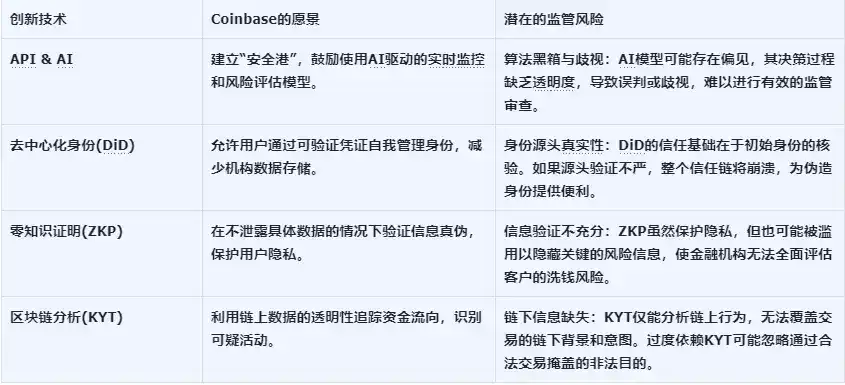
Coinbase’s proposal primarily revolves around four major technological innovations: Application Programming Interfaces (APIs), Artificial Intelligence (AI), Decentralized Identity (DiD) and Zero-Knowledge Proofs (ZKP), and blockchain-based transaction analysis (KYT). Its core demand is to establish “Regulatory Safe Harbors” for financial institutions that adopt these innovative technologies, to reduce their compliance burden and encourage technological application.
This view reflects the reality of financial services in the digital age. However, the establishment of “safe harbors” must be based on extremely prudent and clear conditions. If the standards are too lax, it could lead to the following risks:
In the wave of global virtual asset regulation, Hong Kong has chosen a prudent and forward-looking path. Since June 1, 2023, Hong Kong has formally implemented a mandatory licensing regime for Virtual Asset Service Providers (VASPs), bringing all centralized cryptocurrency trading platforms under the comprehensive supervision of the Securities and Futures Commission (SFC). This framework does not sacrifice regulatory certainty and rigor in pursuit of innovation, providing a model worthy of global reference.
Unlike Coinbase’s approach of seeking “safe harbors,” Hong Kong’s regulatory philosophy is “same business, same risks, same rules.” This means that regardless of the innovative technologies a VASP employs, its core AML/CFT obligations—including Customer Due Diligence (CDD), ongoing transaction monitoring, Suspicious Transaction Reporting (STR), and compliance with the Financial Action Task Force (FATF)’s “Travel Rule”—must be strictly and fully implemented.
The Hong Kong SFC has clearly stated in its regulatory framework that when VASPs adopt new technologies, they must demonstrate to regulators the reliability, security, and compliance of their technologies, and establish sound governance and oversight mechanisms. For example, when using AI for transaction monitoring, platforms must be able to explain the logic of their algorithms to regulators, verify their effectiveness, and take responsibility for the final decisions. This approach does not stifle innovation but guides it to develop on a responsible track.
Coinbase’s proposal serves as a wake-up call for global regulators: in the rapidly evolving field of digital assets, clinging to outdated rules could indeed lead to regulatory failure. We support using technology to enhance the efficiency and precision of AML work. However, the core principles of AML—Know Your Customer (KYC), risk assessment, and behavior monitoring—must not be compromised by the guise of technology.
We call for any reform of the AML system to adhere to the following principles:
1. **Technology-Neutral, Risk-Based:** Regulation should focus on the risks of financial activities themselves, not the technological form of their implementation. Whether traditional banks or crypto platforms, they should be subject to regulation commensurate with their risk levels.
2. **Clear Responsibility, Not Reliance on “Safe Harbors”:** Financial institutions should always be the primary party responsible for fulfilling AML obligations. Regulators can provide guidance but should not establish vague “safe harbors” to exempt or reduce an institution’s core responsibilities.
3. **Strengthen International Cooperation, Fill Regulatory Gaps:** As Coinbase points out, non-compliant offshore entities are a major source of risk. Regulatory bodies of various countries should strengthen cooperation under the framework of international organizations like FATF to jointly combat cross-border money laundering activities.
The Hong Kong Anti-Money Laundering Alliance will continue to closely monitor the latest developments in global digital asset regulation and work closely with the industry and regulators to promote the establishment of a healthy financial ecosystem that can both embrace innovation and effectively prevent risks. We believe that only through a prudent balance between innovation and compliance can the digital asset industry achieve a sustainable future.
**References**
[1] Coinbase. (2025, October 17). Response to Treasury RFC on Innovative Methods to Detect Illicit Activity Involving Digital Assets. https://assets.ctfassets.net/sygt3q11s4a9/2JiDDSZgdu1zwNlwkLgE24/12b9465b1b96198a702288555713dbd3/Coinbase_Response_to_Treasury_RFC_on_Innovative_Methods_To_Detect_Illicit_Activity_Involving_Digital_Assets__1_.pdf