Editor’s Note
This article highlights a significant milestone in rural development and construction technology. The inauguration of India’s first 3D-printed concrete rural home in Roorkee, under the PMAY-G scheme, represents a potential leap forward in addressing housing needs with innovative, faster, and more sustainable building methods.
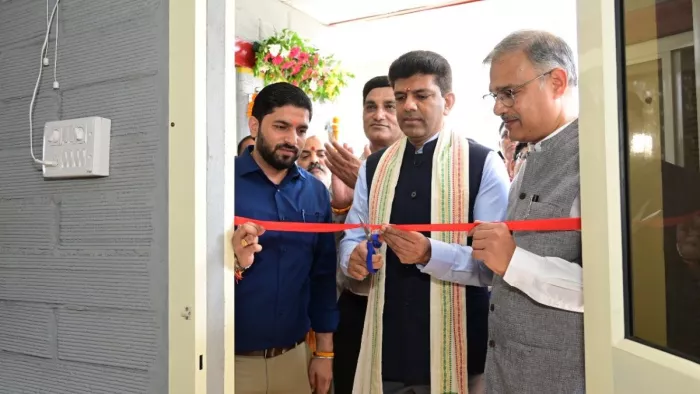
Union Minister of Rural Development Chandrashekhar Pemmasani inaugurated the first 3D concrete printed rural housing unit in Roorkee. This project falls under the Pradhan Mantri Awas Yojana-Gramin (PMAY-G).
Dr. Chandrashekhar Pemmasani, Union Minister of State for Rural Development and Communications, inaugurated the country’s first 3D concrete printed rural house at the Central Building Research Institute (CBRI) in Roorkee under the PMAY-G scheme. He stated that the 3D concrete printed rural house under PMAY-G is a significant step towards the government’s vision of “Developed India @ 2047”.
He added that today’s 3D printed house is a symbol of a developed India and a significant milestone in India’s rural housing journey. It reflects the government’s commitment to providing safe, affordable, and resilient homes for every rural family.
Dr. Pemmasani highlighted the role of CSIR-CBRI in developing innovative, affordable, and disaster-resilient solutions for rural housing and sanitation. He underscored the institute’s contributions, such as the initial compilation of rural housing typologies, which has now become a digital repository of over 250 disaster-resilient housing types.
He mentioned that the two-pit pour-flush toilet technology has been implemented in over 50 million rural households under the Swachh Bharat Mission. He also noted non-erodible mud plaster and other low-cost measures. He appreciated the full-scale earthquake and fire testing facilities at CBRI.
Subsequently, he visited the Dr. Billings Exhibition Gallery, where he inspected solar air conditioner and water heater technology developed by Chief Scientist Dr. Chandan Swaroop Meena. This innovation provides energy-efficient heating and space conditioning solutions, promoting clean energy while reducing carbon emissions.
Additionally, he toured the National Earthquake Engineering Test Facility, Fire Research Test Facility, and Construction Technology Demonstration Park. He planted a ‘Sindoor’ plant in the institute’s lawn and also released the rural housing compilation “Rudraksh”.
Roorkee: ‘Rural House’ refers to the house constructed under PMAY-G. It is designed for rural families with a simple and affordable layout according to the scheme’s criteria. Its cost is approximately 1.8 lakh rupees, and the area is 25 square meters. According to information received from the institute, India’s first 3D printed house was inaugurated at IIT Madras in 2021, but that was an urban prototype.
Meanwhile, CBRI Roorkee has developed India’s first 3D printed PMAY-G rural house. It utilizes a sustainable mix incorporating agro-industrial waste like fly ash and rice husk ash. This is the first time 3D printing is being used directly in rural housing construction, combining speed, affordability, and green materials for widespread use in villages.