Editor’s Note
This article examines a landmark Supreme Court case concerning the scope of presidential authority to impose tariffs, a legal challenge with profound implications for the separation of powers and international trade policy.
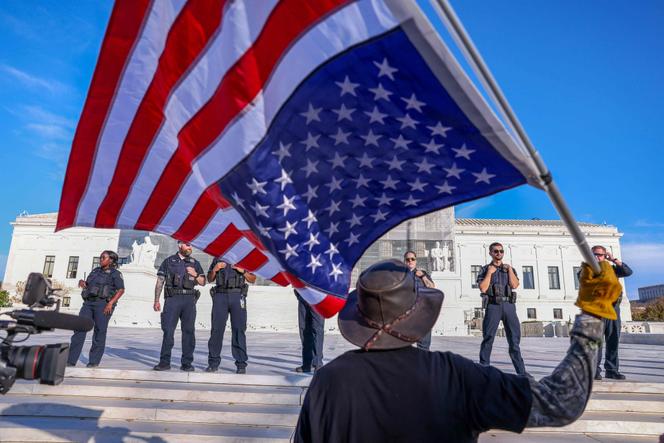
During an anti-Trump protest in front of the Supreme Court in Washington on November 5, 2025.
TASOS KATOPODIS/GETTY IMAGES NORTH AMERICA/AFP
Donald Trump, with his characteristic emphasis, had himself defined the stakes of the case occupying the Supreme Court on this November 5th:
even a matter of
And, to say the least, after experiencing a bad election night on Tuesday, the American president spent a no less complicated day on Wednesday.
The highest court in the United States dissected, for nearly three hours, the arguments of the White House lawyer, who was defending the president’s ability to wage his trade war against the rest of the world as he sees fit. Donald Trump’s so-called “reciprocal” tariffs, imposed on almost all countries on the planet, were declared illegal by a federal judge in September. The judge contested the use of a 1970s economic emergency statute, misappropriated by the executive branch. Under the same reasoning, the tariffs imposed on China, Mexico, and Canada, in the name of fighting fentanyl trafficking, have been overturned.