Editor’s Note
This article explores the murky 17th-century origins of the Hope Diamond, tracing its journey from India to Europe and the enduring curse legends that began with its first recorded owner.

The Hope Diamond entered the historical record in 1666, when the French gem merchant Jean-Baptiste Tavernier acquired it in India. At that time, the stone weighed about 112 carats and was known as the “Tavernier Blue.” There are various legends about how Tavernier obtained the diamond, including one that suggests he stole it from the eye of a statue of the Hindu goddess Sita, triggering a curse. Although there is no evidence that Tavernier suffered immediate consequences, his life was marked by difficulties.
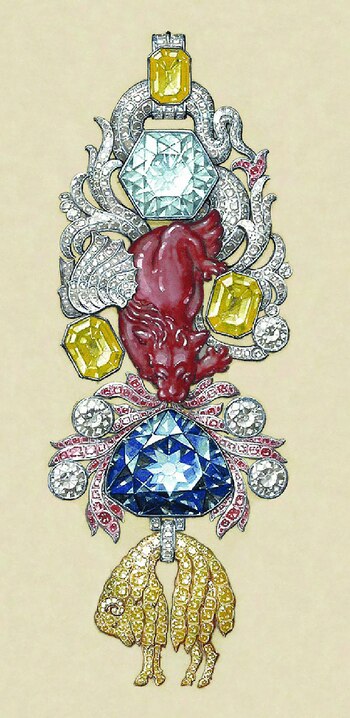
The diamond passed into the hands of Louis XIV of France, who had it cut, reducing its weight to 67 carats. Renamed the “French Blue” or “Diamond of the Crown,” it became part of the royal jewels. After the death of Louis XIV, his successors also used it, but the diamond’s fortune took a drastic turn during the French Revolution. Louis XVI and his wife, Marie Antoinette, who inherited the jewel, were executed in 1793, fueling the perception that the diamond brought misfortune.
After the Revolution, the diamond disappeared for about 20 years, reappearing in London in 1812. At that point, it had been recut and had lost part of its original weight. It was acquired by the British banker Henry Philip Hope, whose surname became forever associated with the stone. Although the Hope family enjoyed the jewel for several decades, they faced serious financial problems and had to sell the diamond in 1901.
In the 20th century, the diamond changed hands repeatedly. Among its owners was Evalyn Walsh McLean, a wealthy American heiress who acquired it in 1910 despite warnings about its supposed curse.
Her nine-year-old son died in a traffic accident, her husband faced problems with alcoholism and infidelity, and her daughter died from an overdose. Although McLean denied believing in the curse, these tragedies solidified the diamond’s dark fame.

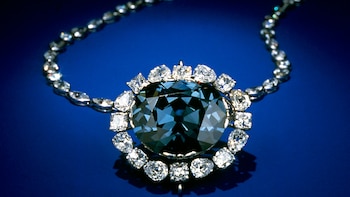
After McLean’s death in 1947, the jewel was acquired by jeweler Harry Winston, who ultimately donated it to the Smithsonian in 1958. Today, the Hope Diamond is displayed as one of the museum’s centerpiece attractions, drawing thousands of visitors each year.
The supposed “calculation” behind the misfortunes related to the Hope remains a subject of debate. While some consider the misfortunes of its owners to be mere coincidences, others believe its history is proof of a curse associated with its origin. However, what is indisputable is that the diamond has left an indelible mark on popular culture and the history of jewelry.
With its exhibition at the Smithsonian, the Hope has left behind the years of change and tragedy, but its legend lives on. Whether as an example of exceptional craftsmanship or as a reminder of the stories that the love of luxury can bring, this gem continues to be a symbol of fascination and mystery.