Editor’s Note
This article highlights a significant growth trajectory for the global jewelry manufacturing and precious metal processing equipment market. According to Global Market Insights Inc., the sector is projected to expand from USD 1.57 billion in 2025 to USD 2.74 billion by 2034, reflecting a compound annual growth rate of 6.3%. This forecast underscores the robust demand and evolving technological landscape within the industry.
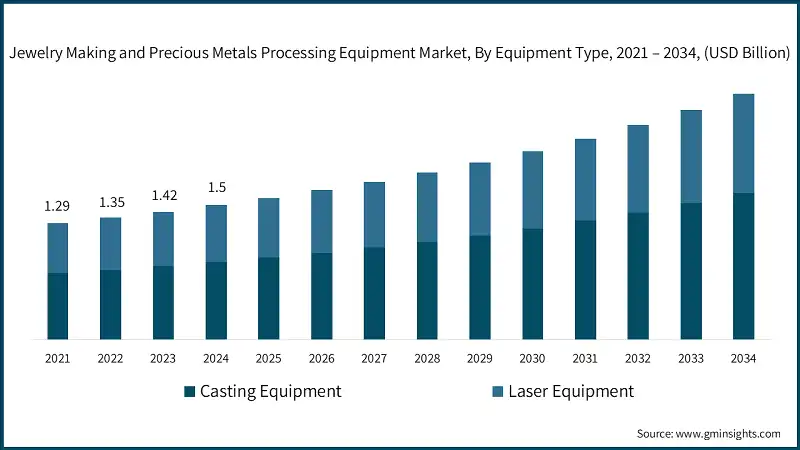
According to a recent study by Global Market Insights Inc., the global jewelry manufacturing and precious metal processing equipment market size was estimated at USD 1.5 billion in 2024. The market is projected to grow from USD 1.57 billion in 2025 to USD 2.74 billion in 2034, registering a CAGR of 6.3%.
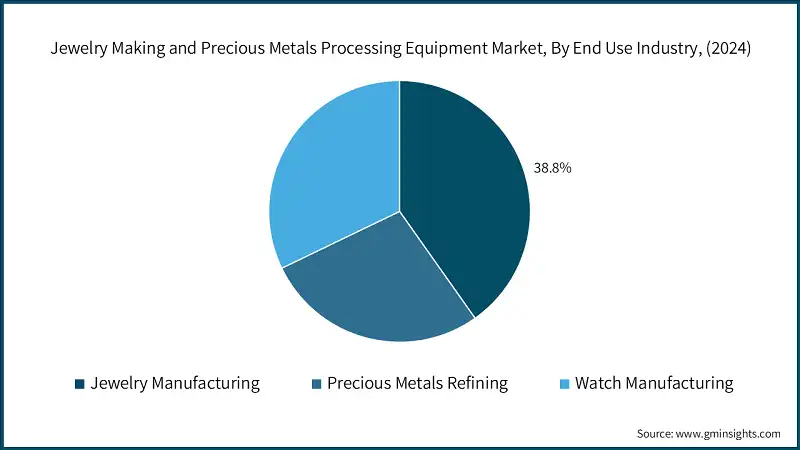
The precious metal processing equipment and jewelry manufacturing sector is experiencing rapid growth due to several factors. The most significant factor is the increasing demand for high-quality and customized jewelry. Individuals, particularly younger users and affluent members in both developed and emerging economies, prefer jewelry that reflects their identity, lifestyle, or culture. There is a growing need for small-scale, high-precision production, and consequently, manufacturers are implementing cutting-edge technologies to deliver precise designs.
Advanced technologies such as laser cutting and vacuum casting with CNC machines have improved manufacturing and minimized material waste, while product quality has increased with enhanced production speed. Automation and computer-aided design software like CAD/CAM programs and 3D printing technology are also improving, enabling faster creation of jewelry prototypes and product customization. These technologies help reduce labor costs and allow designers to produce complex designs with consistent quality.
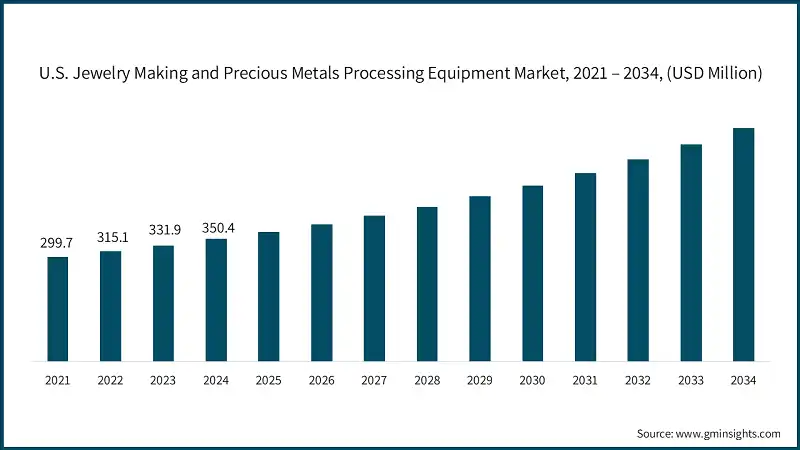
The APAC region dominates the market with its robust production base, efficient human resources, and strong demand in both domestic and foreign markets. India, China, and Thailand are renowned for their mass-produced and custom jewelry production. The region benefits from low labor costs, government incentives, and cultural values that favor jewelry spending.
In 2023, India’s manufacturing sector accounted for 17.4% of its GDP, while China’s manufacturing sector contributed 27.7% to its GDP in the same year, highlighting the strength of their industrial bases. High incomes and urbanization in APAC also support the demand for new, high-quality models. Furthermore, most Western brands export to APAC for production, which continues to cement the region’s status in the international market.