Editor’s Note
In this interview, Mariana Gallo, a strategic lead at a major consumer goods company, underscores the critical importance of consumer-centricity and uncompromising quality in product development and supply chains. Her insights serve as a vital reminder for businesses aiming to reach and responsibly serve millions.
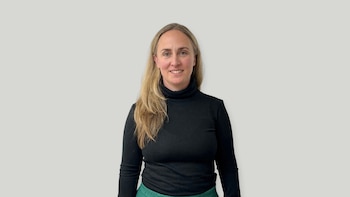
Mariana Gallo is the strategic and operational lead at a leading multinational consumer goods company.
Mariana asserts. She also highlights the non-negotiable value of quality, which must permeate all links of the supply chain and beyond, in this interview with Movant Connection.
What does it mean to lead an operation that is present in the daily lives of millions of people?
When you are present in 70% of the households in a country, you have something called responsibility. It is an enormous responsibility to reach so many people with your products. I divide it into two parts: on one hand, there is the responsibility of being in mass consumption, with products that enter the human system. That demands quality, processes, and standards above all else.
And on the other hand, there is the commitment to the consumer. Today, any company—large, medium, or small—that does not put the consumer at the center when launching or relaunching something has no business. Consumers change all the time. They seek different experiences and want to interact differently with brands.
We have a department dedicated exclusively to that: listening, detecting trends, analyzing data, and translating them into concrete proposals. Whoever knows how to capture those signals and transform them into a product succeeds. It’s that clear.
What role does logistics play in that process? And how is it linked to an international operation?
We don’t just talk about product logistics. We talk about an “end-to-end” model: from when the product is born until it reaches the home. Every step has to be one of excellence and be traceable. In our business, for example, key inputs, potable water, gas, and certified plants are needed. From the start, everything has to function with very high standards, and that is maintained at every stage, until it reaches the consumer.
The product must be protected, treated with care. Whether when it leaves the plant, when it is transported inland, or when it arrives at a neighborhood warehouse. The quality has to remain intact. Even more so when we talk about items that enter the human body, such as beverages.
What is the international connection behind production like?
We operate with a plant in Uruguay that produces a key concentrate for the entire region, where components arrive from China, India, Argentina… and from there, products go out to many countries. This global connection demands working “just in time” with orders that change in real time. If sales increase in one country, the plant and logistics have to respond quickly, even with materials that come from anywhere in the world.
The world today is one. This microphone I’m speaking with might have plastic from Argentina, but also components that are only manufactured in China. This integration forces us to act with responsibility, as logistics also has to leave a positive footprint.
What happens when those global standards meet complex local logistical realities?
The standard is non-negotiable. There may be difficulties—a truck that is delayed, a distribution point that doesn’t respond as it should—but quality has to be maintained. It is non-negotiable. The product has to arrive exactly as it left the plant. And that is the responsibility of everyone in the chain.
How do you innovate in a category that seems to have everything invented?
When a category is mature, with many competitors and few clear differences, innovation doesn’t always come from the recipe. Yes, you can add lemon juice or change the packaging. But the most powerful thing today is the way you communicate.
New generations come in with other cultural patterns, other demands. So, innovating is also finding a different way to tell what you do. Generation Z, for example, wants segmentation, connection, authenticity. That is another way to innovate.
When referring to the handling and management of mass consumer products, and even more so for those that enter the human body, Mariana states that
What challenges does leading operations in different countries in the region imply?
The main challenge is to adapt. You can’t enter with your own bias. You have to look at the macro and then go down to the micro. Going directly to solve a problem without understanding the context is probably a mistake.
I manage operations in two countries, Argentina and Uruguay, which culturally may seem similar but have very different political and economic realities. The solution for one doesn’t work exactly the same for the other. That’s where a concept we use a lot comes in: “glocal”, the global and the local at the same time.
Think globally, act locally.
What place does female leadership occupy in that process today?
According to a recent audit, in the top thousand companies in the country, only 17.8% of board positions are held by women. Are we better companies with that representation? I don’t think so. And I’m not just saying that from my place as a woman. I say it because it has been proven that the best ideas emerge when there is real diversity: of gender, thought, experience. Those differences improve results.
And how is sustainability connected with all this?
For us, sustainability is present from the product’s birth. In logistics, efficiency is key.
We seek to make the impact as positive as possible. For example, we use wind energy in all local plants and work with recycled resins in packaging to maintain a virtuous cycle.
