Editor’s Note
This report highlights a critical question of liability when valuables go missing from bank lockers. While banks often cite agreements limiting their responsibility, customers reasonably expect security for their assets. The incident underscores the need for clear contractual terms and robust safeguards in such financial arrangements.
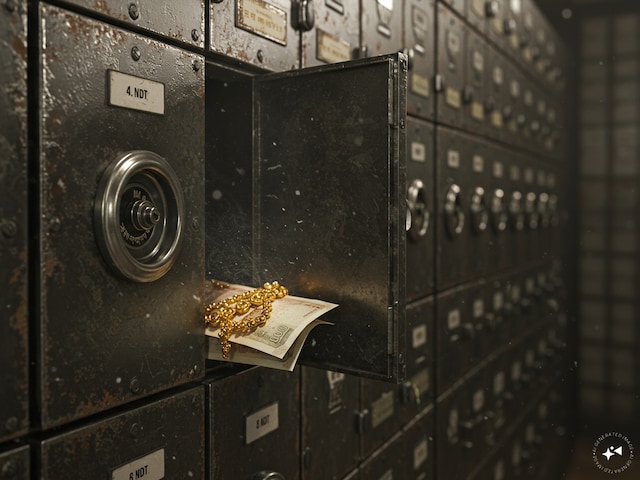
A woman in Bengaluru found her locker at the State Bank of India empty, with 145 grams of gold and diamond jewellery missing. She has filed a complaint with the bank, demanding compensation. This raises the question: if valuables are stolen or go missing from a bank locker, who is responsible—the bank or the customer?
In India, locker facilities operate under the guidelines of the Reserve Bank of India (RBI) and the rules of individual banks. The RBI issued new guidelines in 2021.
– The bank does not keep a record of the items stored in a customer’s locker, nor does it have the right to know what is inside.
– However, if there is any tampering or theft involving the locker, the bank assumes responsibility.
– If valuables are stolen from a locker due to the bank’s mistake or negligence, the bank must compensate the customer for the loss.
According to the RBI, the bank’s compensation is capped at “100 times the annual locker rent.” For example, if the annual locker rent is ₹3,000, the bank can pay a maximum compensation of ₹3,00,000.
If the bank’s mistake or negligence is not proven in the theft, the bank is not held responsible. The bank investigates any such incident and does not pay compensation if no negligence on its part is found.
– File an FIR with the police.
– Submit a written complaint to the bank.
– Request CCTV footage of the locker visit from the bank.
– Lodge a complaint with the RBI Ombudsman if the bank’s response is unsatisfactory.
– The customer stores their items in the bank locker; the bank does not know what is inside and never asks about it.
– A locker agreement is signed between the customer and the bank.
– Locker operation follows a dual-lock system: one key is with the customer, and a master key is with the bank.
– Responsibility is shared, but the bank promises to provide security.
The annual rent for a bank locker depends on two factors:
1. Locker size: Small, Medium, Large, or Extra Large.
2. Branch location: Metro, City, Semi-Urban, or Rural.
Estimated SBI Locker Annual Rent (2025 rates):
| Size | Metro/City | Semi-Urban | Rural |
|—————|——————|—————–|—————-|
| Small | ₹2,000–₹3,000 | ₹1,500–₹2,500 | ₹1,000–₹2,000 |
| Medium | ₹4,000–₹6,000 | ₹3,000–₹5,000 | ₹2,500–₹4,000 |
| Large | ₹8,000–₹12,000 | ₹6,000–₹10,000 | ₹5,000–₹8,000 |
| Extra Large | ₹14,000–₹20,000 | ₹10,000–₹16,000 | ₹8,000–₹12,000 |
Additionally, 18% GST is applicable. Rent is paid annually in advance via debit from a bank account or cash/cheque. Late fees apply if rent is not paid on time.
According to RBI’s 2021 guidelines:
– If the locker vault is damaged due to fire or flood and the bank had taken all necessary safety measures in advance (e.g., fire alarms, waterproof vaults, insurance), the customer will not receive compensation for the loss.
– If the bank’s negligence is proven (e.g., fire alarm not working, poor maintenance of the vault), the bank will be held responsible and must pay compensation.
– Yes, items kept in bank lockers can be insured. However, it is the customer’s responsibility to insure them. Banks themselves do not insure the contents of lockers.
– Customers can purchase jewellery insurance from any insurance company, which may cover items stored in lockers. However, not every bank permits insurance for locker contents. Banks like SBI, ICICI, and HDFC charge locker rent but do not allow insurance.
According to SBI and most banks’ rules, customers have a set number of free visits per year. After that, a charge is levied per additional visit. For example, for a small locker, customers can make a certain number of visits per year; beyond that, an additional visit fee of ₹100 plus GST is charged per visit. Typically, banks offer 12 free visits per year for all types of lockers.
The article does not provide specific information on this point.