Editor’s Note
The future of the world’s second-largest diamond, discovered in Botswana last year, remains a subject of global interest. As reported, the Belgian firm now in possession of the stone confirms it has received numerous inquiries, including the possibility of it becoming a museum exhibit.
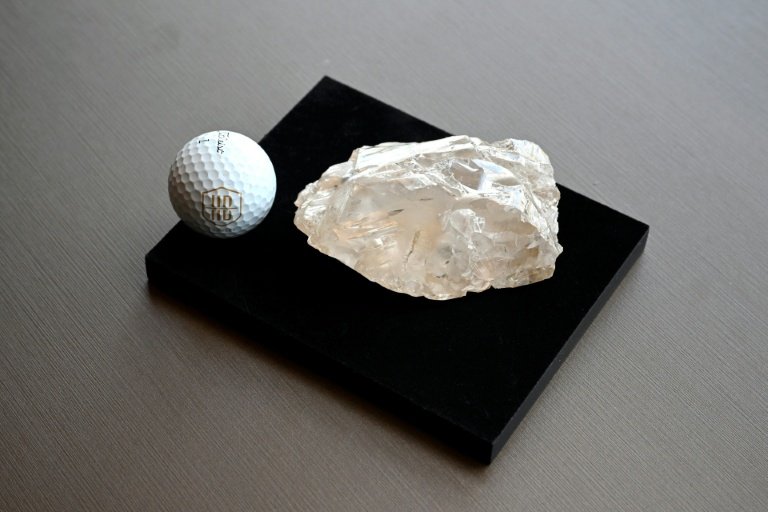
A year after its discovery in southern Africa’s Botswana, the world’s second largest diamond, now in the hands of a firm from Antwerp, Belgium, could end up in a museum, the company explained to AFP on Monday.
While refusing to detail these expressions of interest, HB Antwerp assures it has received many, “from all over the world,” according to its communications director, Margaux Donckier.
she adds while presenting the precious stone to an AFP team.
The Motswedi, the world’s second largest diamond at 2,488 carats and weighing half a kilogram, was extracted in the summer of 2024 from the Karowe mine in northeastern Botswana, Africa’s top diamond producer.
The mine is owned by Canadian mining company Lucara, which has partnered with HB Antwerp for the latter to handle the transformation and marketing of any stone exceeding 10.8 carats.
For a year, the Belgian company has boasted of having acquired at least three rough diamonds exceeding 1,000 carats, presented as proof that Antwerp remains a premier hub for diamond cutting and polishing despite international competition.
To estimate the value of the Motswedi, it still needs to be analyzed by scanner, a technique allowing for a first assessment of the impurities it contains, explains Ms. Donckier.
she says. Its name means “water source or underground water flow” in the Tswana language.
Before its discovery in August 2024, the largest diamond unearthed in Botswana was a 1,758-carat stone also extracted by Lucara in 2019 and named Sewelo, meaning “rare discovery” in Tswana.
As large as a tennis ball, it was purchased by the Louis Vuitton house, the flagship brand of luxury giant LVMH, for an undisclosed price.
The record for the largest diamond ever discovered is still held by the Cullinan, extracted in 1905 from a mine in South Africa, estimated at 3,106 carats.