Editor’s Note
New anti-money laundering regulations from China’s central bank will require dealers in precious metals and jewelry to report all cash transactions exceeding 100,000 yuan starting August 1. This marks a significant expansion of financial oversight into high-value physical asset markets.
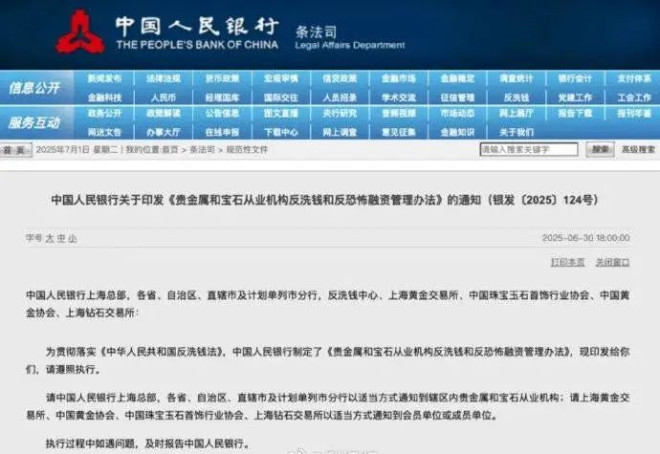
Recently, the People’s Bank of China issued the “Administrative Measures for Anti-Money Laundering and Counter-Terrorist Financing for Precious Metals and Jewelry Industry Institutions,” stating that for single transactions or daily cumulative amounts of 100,000 yuan (including 100,000 yuan) or equivalent foreign currency cash transactions, industry institutions must submit large transaction reports to the China Anti-Money Laundering Monitoring and Analysis Center within five working days from the date of the transaction. These measures will take effect from August 1.
According to the “Measures,” “Industry institutions conducting cash transactions of 100,000 yuan or more (including 100,000 yuan) or equivalent foreign currency must perform anti-money laundering obligations in accordance with these Measures.” “For single transactions or daily cumulative amounts of 100,000 yuan (including 100,000 yuan) or equivalent foreign currency cash transactions, industry institutions must submit large transaction reports to the China Anti-Money Laundering Monitoring and Analysis Center within five working days from the date of the transaction.”
The “Administrative Measures” also stipulate that industry institutions must follow the “Know Your Customer” principle, conducting customer due diligence based on customer characteristics and the nature of transaction activities, as well as money laundering risk conditions. Specific situations include: single transactions or daily cumulative amounts of 100,000 yuan (including 100,000 yuan) or equivalent foreign currency cash transactions; reasonable suspicion that customers and their transactions involve money laundering activities; doubts about the authenticity, validity, or completeness of previously obtained customer identity information.
According to the definition in the “Administrative Measures,” precious metals refer to gold, silver, platinum, etc., and their currencies, standard bars, products, intermediate products, and refined raw materials; jewelry refers to diamonds, jade, and other natural gemstones of various types, raw materials, and finished jewelry and products in physical form.
The precious metals and jewelry trading venues mentioned in the above measures include legally approved centralized trading venues such as the Shanghai Gold Exchange and the Shanghai Diamond Exchange. The precious metals and jewelry industry self-regulatory organizations mentioned in these Measures include the China Gold Association, the China Jewelry and Jade Jewelry Industry Association, and other national or regional organizations legally established to carry out self-regulation in the precious metals and jewelry industry.
Furthermore, the “Measures” require that for single transactions or daily cumulative amounts of 100,000 yuan (including 100,000 yuan) or equivalent foreign currency cash transactions, industry institutions must submit reports within five working days after the large cash transaction occurs. Any suspicious transactions, regardless of amount, must be reported promptly. Customer identity information and transaction records must be preserved for at least 10 years. Special preventive measures target three types of entities: terrorist organization lists, United Nations sanctions targets, etc. Once discovered, services must be immediately stopped, and fund transfers restricted. The Measures also clarify that group-type institutions need to coordinate anti-money laundering work, and overseas branches must implement these provisions within the scope permitted by the laws of their host countries.
According to a Beijing Business Daily report, in September 2017, the People’s Bank of China issued the “Notice on Strengthening Anti-Money Laundering and Counter-Terrorist Financing Work in Precious Metals Trading Venues” (hereinafter referred to as the “Notice”), which defined the situation requiring submission of large transaction reports to the China Anti-Money Laundering Monitoring and Analysis Center as “single-day, single-transaction cash transactions of 50,000 yuan or equivalent foreign currency of 10,000 US dollars.” In this “Administrative Measures,” the threshold amount for submitting large transaction reports has been raised from 50,000 yuan to 100,000 yuan.
According to the “Administrative Measures,” the industry institutions subject to the new regulations refer to merchants legally engaged in precious metals and jewelry spot transactions within the territory of the People’s Republic of China. So which institutions specifically are to be included in the management?
In feedback on the “Administrative Measures for Anti-Money Laundering and Counter-Terrorist Financing for Precious Metals and Jewelry Industry Institutions (Draft for Comments),”. the People’s Bank of China mentioned that the qualification of an industry institution as a subject is judged based on its business scope. As long as the business scope covers the specified business types, it belongs to the category of industry institutions. In practice, some enterprises’ precious metals and jewelry-related spot transactions are only a small-scale or auxiliary part of their business, which does not affect their qualification as industry institutions.
According to a Guangzhou Daily report, an insider in the gold sales industry indicated that, in addition to financial institutions, various business forms such as gold and jewelry sales and pawn shops, whose business scope covers precious metals and jewelry spot transactions, should all perform anti-money laundering obligations as required and submit information for “cash” transactions exceeding 100,000 yuan.