Editor’s Note
This article discusses a recent advertising controversy involving Swatch Group. The company has issued an apology in response to public criticism in China over an image deemed culturally insensitive. The incident highlights the critical importance of cultural awareness in global marketing campaigns.
A controversial advertisement image deemed discriminatory, featuring a model making a “slanted eyes” gesture, has likely worsened the situation for Swiss watch giant Swatch Group, whose performance was already declining in the Chinese market.
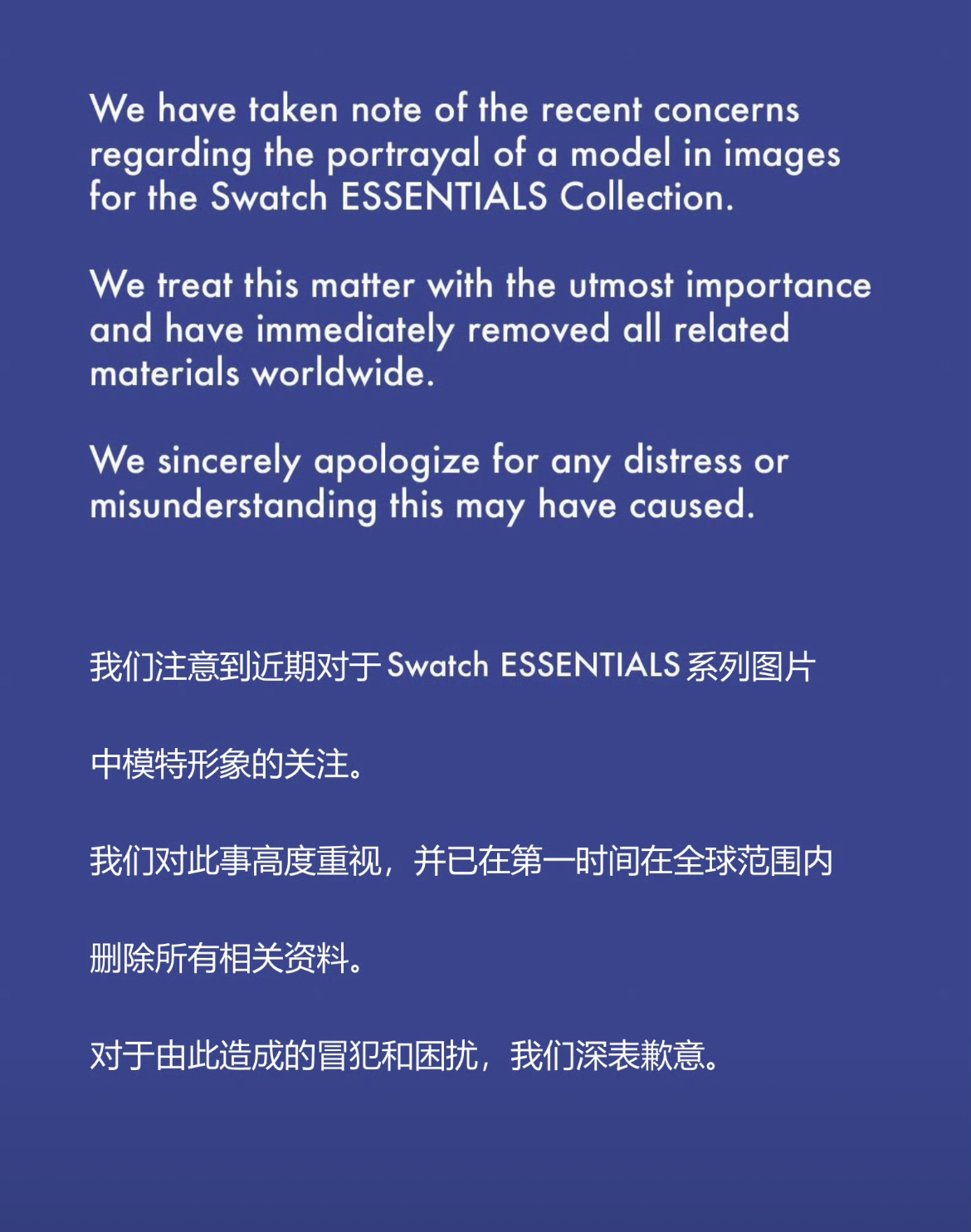
On August 16, the official account of the Swatch brand issued an apology statement regarding the “model image suspected of insulting China” incident. The statement said the company has noted recent attention to the model’s image in the Swatch ESSENTIALS series pictures, takes it very seriously, and has immediately deleted all related materials globally. It expressed deep apologies for the offense and trouble caused.
The incident originated from a promotional image recently released by Swatch, in which a model posed with a “slanted eyes” expression. This gesture is considered racially discriminatory, sparking strong protests from many Chinese consumers. International brands have previously faced controversy and brand image damage multiple times due to similar advertisements suspected of discrimination.
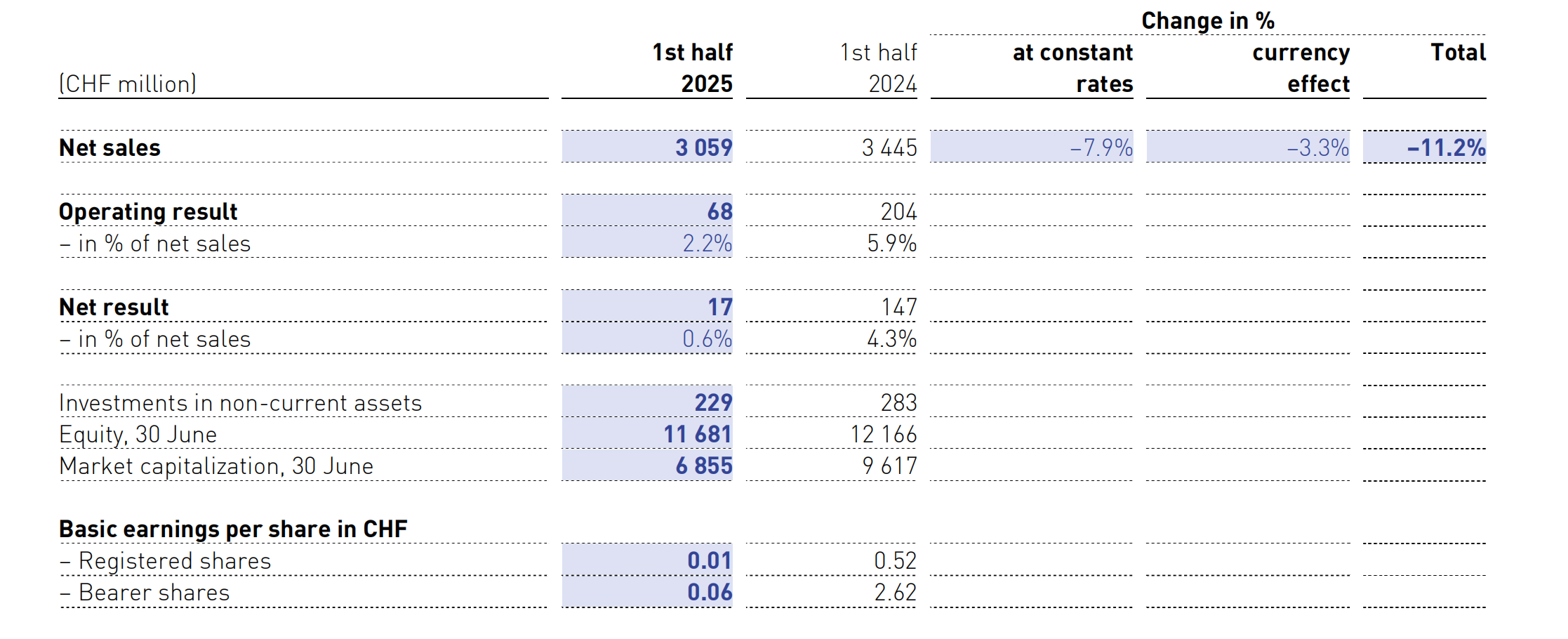
Swatch Group faced severe performance pressure in the first half of the year. The latest financial report for the first half of 2025 shows the company achieved sales of 3.059 billion Swiss francs, a year-on-year decrease of 11.2%. Net profit plummeted by 88% from 147 million Swiss francs in the same period last year to 17 million Swiss francs. The net profit margin was only 0.6%, far below the 4.3% of the same period last year.
Swatch Group attributed the main reason for the sales decline to a significant drag from the Chinese market. Financial report data shows that during the reporting period, wholesale business revenue in the Chinese market fell by over 30% year-on-year (partly due to third-party store closures), and directly operated store sales also recorded a 15% drop. The group also disclosed that over the past 18 months, the Chinese market’s share of the group’s total sales has dropped from 33% to 24%.
This performance slump contrasts sharply with Swatch Group’s previous deep reliance on the Chinese market. As one of the core revenue pillars in recent years, the Chinese market contributed net sales of 2.63 billion Swiss francs in 2023, accounting for 33.3% of the group’s total revenue, with a year-on-year growth of 10.9% that year. However, in 2024, the group’s full-year sales were 6.735 billion Swiss francs, a decrease of 15% year-on-year, with sales in the Chinese market plummeting by 30% year-on-year, although its share still reached 27%.

On the other hand, while the U.S. market performed strongly in the first half, achieving double-digit growth with brands like Omega, Longines, Tissot, and Swatch growing 10% to 30%, its growth prospects are threatened by impending high tariffs. The Trump administration’s consideration of imposing tariffs as high as 39% on Swiss imports could trigger a new round of price increases. Analysis points out that Swatch Group’s rapid growth in the U.S. market in the first half was partly due to the current low-tariff environment and advance consumption driven by potential price hike expectations.
However, Swatch Group also stated that the e-commerce business and inventory reduction situation in China are currently improving, and performance in the second half of the year is expected to recover slightly.
Swatch is not the only watch brand facing a performance chill in 2025. Recent data from the Federation of the Swiss Watch Industry shows that in the first six months of this year, while Swiss watch export value was basically flat year-on-year at 12.9 billion Swiss francs, the number of exported watches plummeted by 420,000 units, a decrease of 5.7%, hitting a record low. The entire luxury industry is undergoing a severe test: LVMH saw both revenue and profit decline in the first half; Kering’s revenue fell sharply by 16% year-on-year, with net profit nearly halved; Hermès maintained growth, but the pace has significantly slowed. Industry analysis points out that Swatch’s difficulties in the Chinese market reflect a structural upheaval in the global luxury consumption ecosystem. Chinese consumers, once the industry’s growth engine, are undergoing a profound transformation in their consumption philosophy. In the watch and jewelry sector, smartwatches and hard assets like gold are becoming strong competitors to traditional watches.
Independent fashion consultant Wang Ning analyzed that high-end watches, like Hermès handbags and other luxury goods, combine consumption and investment functions. However, in the current environment of a sluggish luxury market and high gold prices, consumers tend to buy gold with better value retention. For example, Lao Feng Xiang Gold just released a profit forecast announcement showing that sales performance in the first half of 2025 may reach 14.3 billion yuan, a year-on-year increase of 252%, with adjusted net profit possibly reaching 2.36 billion yuan, a year-on-year increase of 292%.
Furthermore, the fashion and social attributes of watches are also weakening. Swatch, which once positioned itself as “fashion on the wrist” and was popular in the mass market, is gradually losing favor with young consumers. A consumer born in the 1970s, Ms. Liao, admitted that buying a new Swatch watch 20 years ago was something worth “showing off,” but now her daughter prefers smartwatches, “she thinks they are more practical.” Swatch’s Tmall official flagship store shows its watches are priced between 450 and 2000 yuan. One of the best-selling watches is priced at 745 yuan, with the product page showing “over 20,000 people added to cart” and more than 100 units sold in 30 days. Wang Ning pointed out that Gen Z’s consumption mindset has changed significantly. Young people’s consumption tends to be “de-logoed,” and they are more willing to pay for experiences like travel, camping, sports, and skiing. “For the younger generation, watches are no longer a necessity in social circles.”
The traditional watch industry also faces strong冲击 from smart wearable devices. Data from International Data Corporation (IDC) shows that in the first quarter of 2025, global smartwatch shipments reached 34.81 million units, a year-on-year increase of 4.8%. Shipments in the Chinese market grew 25.3% year-on-year to 11.4 million units. The rise of local brands like Xiaomi and Huawei further squeezes the living space of traditional watch brands. Taking Xiaomi’s Tmall flagship store as an example, a smartwatch priced at 569 yuan has sold over 200,000 units.
Zhou Ting, Dean of Yaok Research Institute and a luxury industry expert, believes the luxury industry has entered the second half. While there will be opportunities for brands in the future, the key lies in their ability to adapt to changes and embrace trends. It is reported that Swatch plans to launch innovative concept products this summer using Artistic Intelligence technology to achieve personalized customization, attempting to find new growth points amidst the changes.