Editor’s Note
This article discusses a significant downturn in precious metals markets, with gold and silver prices experiencing sharp declines. The piece also notes corresponding reactions in related equity sectors. Market movements can be volatile, and readers are advised to consult multiple sources and consider professional guidance for investment decisions.

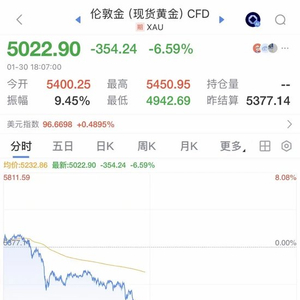
Gold prices experienced a dramatic reversal. On January 30, international gold prices plummeted, with spot gold falling from a high of $5,450 per ounce all the way down, once breaking below $5,000, marking a maximum decline of 8%.
Simultaneously, international silver prices also took a sharp downturn, with spot silver falling below the $100 mark, at one point dropping over 17%.
On the same day, the A-share gold concept sector saw a wave of limit-down declines. Stocks like Yunnan Copper, Baiyin Nonferrous, Jiangxi Copper, Zhongjin Gold, Shandong Gold, Sichuan Gold, Zhaojin Mining, and Western Mining experienced widespread limit-downs.
Gold jewelry prices from multiple major brands also saw significant corrections. On January 30, Chow Sang Sang quoted 1,662 yuan per gram, Chow Tai Fook quoted 1,685 yuan, Lao Feng Xiang quoted 1,620 yuan, and Lao Miao Gold quoted 1,668 yuan. On the 29th, the per-gram price for many brands’ gold jewelry was as high as over 1,700 yuan.
An elderly man who came to sell gold experienced this scene. He said he brought nearly 30 grams of gold to sell, but due to the instantaneous price drop, the total price difference could reach nearly 800 yuan. Because the price gap was too large from his psychological expectation, he ultimately decided to “wait and see.”
A gold store clerk explained that the quoted price is only a reference and will fluctuate based on real-time market conditions after inspection.
According to Jimu News, at 14:00 on January 30, the gold bar price in Shenzhen’s Shuibei market was 1,204 yuan per gram, with a buyback price of 1,152 yuan. At 18:29 on the 29th, the gold bar price was 1,265 yuan per gram, with a buyback price of 1,218 yuan. In less than a day, the price per gram of gold dropped by about 60 yuan.

Regarding the saying “the crazier the gold price rises, the harder it falls,” Wang Yanqing, Chief Precious Metals Analyst at CITIC Futures, told the Daily Economic News reporter,
On the main factors determining the future trend of gold prices, Zhang Chi, former Chief Strategist at Guojin Securities and Fund Manager at Hunan Wantai Huarui Investment Fund, analyzed for the reporter that volatility at historical highs for gold prices is inevitable. The future requires attention to whether the major factors supporting gold prices change.
Wang Yanqing further stated.
Joni Teves, Precious Metals Strategist at UBS, recently commented on global precious metals regarding topics like how much higher gold can go:
On January 29, Wang Lixin, CEO of the World Gold Council in China, stated at the media release of the 2025 full-year “Global Gold Demand Trends Report” that diverse voices always exist in the market, which is normal given different investors’ risk appetites, strategic goals, and analytical perspectives.
Wang Lixin believes the key is to recognize the underlying logic and long-term role of gold in an investment portfolio.
On the same day, the World Gold Council’s 2025 full-year “Global Gold Demand Trends Report” (hereinafter referred to as the “Report”) showed that global gold demand reached a record high of 5,002 tonnes in 2025. Global gold investment demand increased to a milestone level of 2,175 tonnes, becoming the main driver pushing 2025’s total gold demand to a new historical record.
The “Report” analyzes that safe-haven demand and asset diversification are the core drivers of robust gold investment demand. Persistently high geopolitical and geo-economic risks, a weaker US dollar, high stock valuations, coupled with market expectations for Fed rate cuts, played key roles in 2025. The rapid surge in gold prices also injected additional momentum into gold investment demand, attracting all types of investors.
From the structure of investment demand, the “Report” shows that globally, investors seeking safe havens and diversification flooded into gold ETFs, with a net annual increase of 801 tonnes. Notably, over half of the global gold ETF annual demand increase in 2025 came from North American funds (446 tonnes), with Asian gold ETF fund holdings growth ranking second globally (215 tonnes). Among them, China’s gold ETF holdings more than doubled for the year (133 tonnes), and total gold ETF Assets Under Management (AUM) surged by 243%, both setting new historical records.
Simultaneously, physical gold investment demand remained strong, with global bar and coin demand reaching 1,374 tonnes. China’s physical gold investment demand also performed remarkably. Throughout 2025, Chinese investors cumulatively purchased 432 tonnes of gold bars and coins, a 28% increase from 2024, setting a new annual historical record.
The World Gold Council analysis indicates that besides the momentum of rising gold prices, escalating geopolitical and trade tensions throughout 2025 drove increased safe-haven gold buying, supporting investment demand. Additionally, consecutive announcements of gold purchases by the People’s Bank of China (PBOC) further boosted investor confidence. Furthermore, the gold value-added tax reform policy introduced in November provided an additional boost in the fourth quarter, prompting investment-oriented consumers to shift from gold jewelry to gold investment products.
the “Report” believes. Against the geopolitical backdrop, safe-haven buying demand is unlikely to change in the short term, and wealth preservation needs are further highlighted in a low-interest-rate environment. If the PBOC maintains its gold purchasing pace, it will provide additional support for gold investment demand. Furthermore, regulatory policy adjustments in 2025, allowing Chinese insurance companies to pilot entry into the gold market, will provide long-term structural support. By the end of 2025, six insurance companies had joined the Shanghai Gold Exchange, paving the way for institutional gold allocation.