Editor’s Note
This article examines the “resource curse” paradox facing the Democratic Republic of Congo, a nation of immense geological wealth that remains mired in underdevelopment. It explores the contrast between potential and reality in one of the world’s most resource-rich yet impoverished countries.
Geological scandal, resource curse, hypothetical wealth… These are terms development experts use to describe the Democratic Republic of Congo (DRC), due to the immense scale of its mineral wealth, which contrasts sharply with its struggle for development.
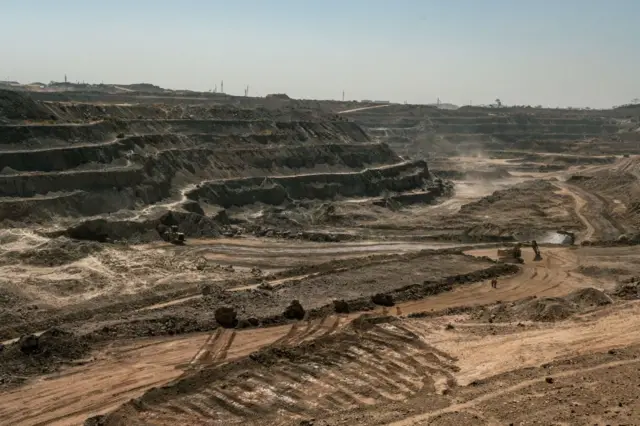
This vast sub-Saharan African territory, alone equivalent in size to Western Europe, is endowed with exceptional natural resources. These include cobalt and copper, significant hydroelectric potential, vast arable land, incredible biodiversity, and it hosts the world’s second-largest tropical rainforest.
The DRC is a global reserve of cobalt and copper, essential for the electrification of energy and transport, used in electric vehicle batteries, solar panels, and wind turbines. According to a United Nations study, these are critical resources for manufacturing batteries that could facilitate the world’s transition away from fossil fuels.
According to the United Nations Environment Programme (UNEP), the country holds 70% of the world’s cobalt reserves, representing 3.5 million metric tons of this mineral.
The DRC is also a storehouse of timber, oil and gas, gold, and diamonds. However, numerous studies show that this country, one of the world’s richest regions in biodiversity, suffers from the very wealth it contains.
The DRC is said to be a geological scandal or that its subsoil wealth has become a curse because the country itself, or at least its population, does not benefit from it.
The proof is that today, the country is plagued by numerous conflicts surrounding the exploitation of these deposits, notably the recent offensives by the rebel group M23, which ultimately captured the city of Goma last weekend.
Furthermore, within the country, a population lives in poverty despite these riches.
The DRC is among the poorest countries in the world. According to the United Nations Human Development Index (HDI), in 2021, the DRC ranked 179th out of 191 countries and territories plagued by extreme poverty.
In 2024, approximately 73.5% of Congolese live on less than $2.15 per day, and about one in six people living in extreme poverty in sub-Saharan Africa resides in the DRC, according to World Bank data.

This institution sets the DRC’s Human Capital Index (HCI) at 0.37, below the sub-Saharan African average of 0.40.
It adds that the main factors behind this score are the low survival rate of children under five, the high rate of child stunting, and the poor quality of education.
The Bretton Woods institution listed many other situations that contrast with the immense wealth the country possesses.
The race for minerals has triggered and fueled violent conflicts in the Democratic Republic of Congo, with a humanitarian crisis that the country continues to experience to this day.