Editor’s Note
As digital platforms reshape commerce, this interview with auctioneer Jean-Pierre Osenat offers a timely reflection on the value of physical spaces and in-person experiences in the art market.
INTERVIEW
“We have become dependent on these digital channels.”
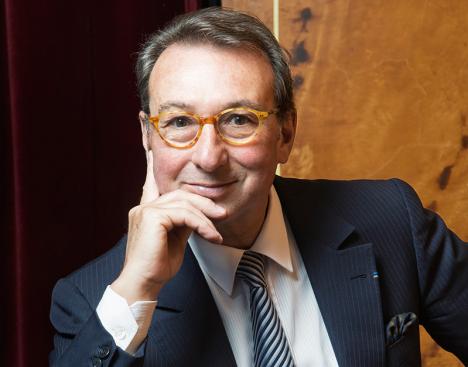
Jean-Pierre Osenat, an auctioneer, advocates for limiting online sales and preserving physical auction rooms and public exhibitions.
Auctioneer Jean-Pierre Osenat, who trained for four years under the eminent art historian Maurice Rheims, is celebrating 50 years in the profession this year. Based in Fontainebleau since 1978, where his house has built a reputation for Napoleonic memorabilia, he also operates auction rooms in Versailles since 2019 and in Paris since 2023.
President of the National Union of Voluntary Sales Houses (Symev) since 2011 – a position he also held from 2003 to 2006 – he served as deputy mayor for culture in Fontainebleau and has been a member of the Art Market Observatory since 2003.
What is your view on the current state of the art market?
“When a client wants to part with a chest of drawers bought for €10,000 and is told it’s now worth only €2,000, they conclude the art market is in crisis. This assessment is false. Looking at all specialties, the market is experiencing steady growth; it seems more dynamic than ever, and the enthusiasm for art is clearly present: just look at the crowds in museums. However, it’s no longer possible to work like in 1975, when objects flowed to us spontaneously, often through inheritances or personal connections. In the past, auctioneers always found 19th-century furniture, clocks… in estates to fuel their regular sales. This is increasingly less the case.”
Three years after the 2022 law, what changes have you observed?
“The most significant evolution is a change in mindset. The former Council was not part of auctioneers’ DNA. It was seen as a disciplinary and training body, a kind of distant jurisdiction whose function we hardly understood and to which we were not connected. Today, the Council of Sales Houses has made a major shift by including auctioneers among its members, who bring their valuable expertise and support. As for President Édouard de Lamaze, he embodies a more professional and constructive approach. He wisely decided to reduce membership fees and, by moving the headquarters, helped rationalize the Council’s expenses.”
What role do digital sales play in your activity?
“We organize monthly online-only sales in Chailly-en-Bière, consisting of 400 to 500 lots (mostly under €2,000), which are very successful, with an international sales rate close to 70% – a new trend particularly focused on Eastern European countries. Sectors like wine or fashion are also involved in this type of sale – a format representing about 10% of our activity – but I don’t want them to grow further. In my view, it’s crucial for auctioneers to preserve their auction rooms and offer public exhibitions so clients can see the objects. If everything moves online, it’s conceivable that objects remain with sellers, sales happen without prior exhibition, and eventually, they could do without us.”
Since the pandemic, auction platforms have significantly increased their reach. It’s not uncommon to see up to 2,000 registered online participants, compared to 40 or 50 people in the room. Today, 60% of our clients participate via the internet – the rest split between the room and phones. No exceptional object escapes the attention of platforms, wherever it is in the world. In this sense, we have become dependent on these digital channels, as well as on social networks – to the point that we have hired a full-time community manager.
Do you practice private treaty sales?
“No, it’s not part of my ethos, and few clients ask me for it. This practice is more the domain of Anglo-Saxon houses, which have sophisticated CRM software. I’m more interested in seeing some houses enrich their activity through cultural initiatives. I have always defended this idea. In Fontainebleau, but even more in Versailles and Paris, we organize book signings, conferences, meetings with curators… These events are an opportunity to expand our clientele, and this trend strengthens year after year.”
What developments would you like for the profession?
“The key element is competence, which undeniably requires quality continuing education. I would like a specialist to come and explain the potential of artificial intelligence in our field, without it replacing our human expertise, of course.”
“Regarding provenance research, it is essential for major objects – a threshold should be set – because buyers won’t want to acquire an asset without certainty, for example, that it hasn’t been looted. However, it seems unnecessary to force auctioneers to ask their clients for the exact origin of every object, because in 90% of cases, the seller themselves doesn’t know. By trying to do too well, we risk weakening an already very active market.”
How do you view the current year?
(Note: The article ends here; the final question was not answered in the provided text.)