Editor’s Note
As synthetic diamonds gain prominence, the timeless symbol of love faces new competition. This article explores how consumer choices are evolving in the modern jewelry market.
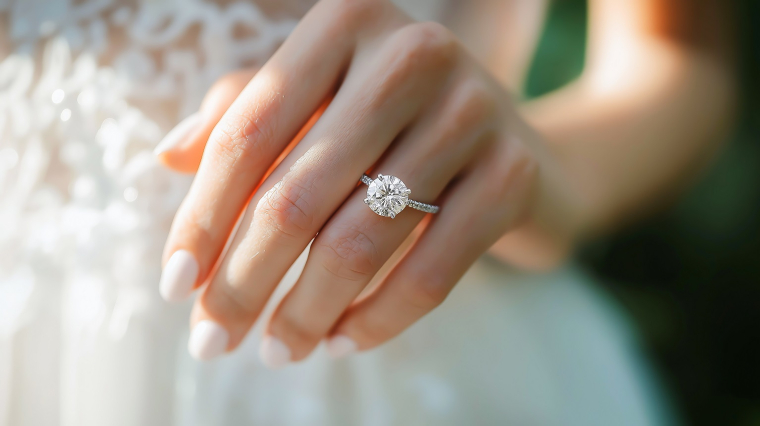
42% of French people declare wanting to buy a diamond “at least once in their life”. (credit: Adobe Stock / AI-generated photo)
This Valentine’s Day, you might be planning to buy a diamond… and your jeweler might well offer you a synthetic diamond. It has been the symbol of eternal love since the clever slogan by diamond company De Beers in 1947, “A diamond is forever”. And when you love, you don’t count…
But it turns out that today, the natural diamond “solitaire” is no longer “alone” in its market. Since its development in 1954 by American chemist Tracy Hall, the synthetic diamond has indeed become a serious competitor. So seductive that in 2018, the company De Beers itself succumbed. After years of disdain for these artificial stones, which it reserved for industry… it started offering them in jewelry!
Chemically, like natural diamonds, synthetic diamonds form through the crystallization of carbon, subjected to extreme heat and pressure conditions. Only the origin and location of this phenomenon differ. The natural diamond was born 2.5 billion years ago, deep within the Earth. Its rival, obtained in a laboratory in a few weeks, is the pure product of human hands.
Semantically, a terminology battle has begun, and two narratives are clashing today. The natural diamond commands respect by relying on values of infinity and rarity; the synthetic diamond offers an alternative narrative, invoking a form of green alchemy. Praising “the magic combining science and nature,” as some brands do, seems judicious. Driven by ecological and ethical values, this narrative comforts buyers who feel guilty at the idea of buying a natural diamond.
Economically, it must be said that the stakes are high… In 2020, a quantitative study estimated that 42% of French people declared wanting to buy a diamond “at least once in their life”. This proportion even climbs to 65% among 25-34 year olds.
During my doctoral research on storytelling phenomena, I investigated this sector which seemed not to escape accusations of “greenwashing”. These new issues on responsible consumption constitute one of the major axes addressed by the Lifestyle Research Center of emlyon, which studies new consumption phenomena through research with field actors.
During my investigation, I understood that the success of synthetic diamonds was built in counterpoint to the persistent excesses of natural diamonds.
First, it does not seem reserved for an elite, displaying prices 30 to 40% cheaper. A marketing manager of one of the most renowned high jewelry houses specified to me:
Secondly, the synthetic diamond does not come from open-pit mines that generate real ecological scandals. To find a few carats of natural diamonds, millions of tons of ore must be extracted in fragile areas, which considerably deteriorates natural ecosystems. The soils, bays, and banks that have been excavated remain disturbed for decades before flora and fauna regain their balance.
Unlike its older brother, the synthetic diamond is not tainted by the failure of the Kimberley Process (an international negotiation forum bringing together representatives of states, industry, and civil society) established about twenty years ago to regulate the traceability of the diamond industry. Renounced in 2011 by the non-governmental organization (NGO) Global Witness, which was its originator, the KP is now in the sights of humanitarian associations like Amnesty International.
The Unita movement in Angola, the two wars in Congo, and the mafia spiral of Liberia and Sierra Leone have indeed tarnished the historical sector. The invasion of Ukraine by Russia, the largest extractor of natural diamonds, is reactivating criticism today.
Consequently, the synthetic diamond does not suffer from a bad image in public opinion, while that of the natural diamond is cracked. Certainly, exactly half a century ago, Hollywood served as a showcase for natural diamonds: in 1953, Marilyn Monroe sang “Diamonds are a girl’s best friend”. But in 2006, the film “Blood Diamond” revealed the horror of working conditions in diamond mines. Deeply marked by his role, Leonardo Di Caprio is today a virulent spokesperson against natural diamonds. Since 2014, he has even been a shareholder of Diamond Foundry, a major producer of synthetic diamonds in the United States.
So, faced with the risk of public disaffection, the traditional sector intends to show that once observed under a magnifying glass, the synthetic diamond, too, does not offer only shining facets.
Globally, the Natural Diamond Council uses its slogan to display its ambitions for reconquest: “Only natural diamonds”. In France, the Collectif Diamant, which brings together the reference organizations of the sector, relays the study by Trucost, the world leader in environmental risk assessment.
These campaigns aim to shine a spotlight on the hidden side of synthetic diamonds.