Editor’s Note
This article highlights a significant shift in consumer demand, particularly among younger generations, toward sustainable and ethically sourced jewelry. As the market adapts, this trend presents both a challenge and an opportunity for the industry.
Consumer preferences are shifting toward sustainable and ethically sourced jewelry, creating a major driver for the market. According to a report by the United Nations Environment Programme, over 60% of global consumers now consider sustainability a key factor in their purchasing decisions. This trend is particularly prominent among younger demographics, with Nielsen reporting that 73% of Millennials actively seek eco-friendly products. The Responsible Jewellery Council notes that certifications for ethical sourcing have increased by 40% since 2019, reflecting heightened awareness and demand. Furthermore, the U.S. Department of Commerce highlights that recycled gold now constitutes approximately 30% of the global supply chain, driven by environmental concerns. Brands adopting transparent practices are gaining a competitive edge, as evidenced by a 25% rise in sales for companies promoting sustainability, according to a study by Bain & Company. This shift underscores the growing importance of ethical considerations in shaping consumer behavior.
Despite growing demand for sustainable jewelry, limited awareness of ethical practices remains a significant challenge for the industry. The United Nations Global Compact reports that only 20% of consumers fully understand the implications of ethical sourcing in jewelry production. This knowledge gap is particularly evident in developing regions, where educational initiatives are scarce. The Canadian government’s Natural Resources department highlights that less than 10% of artisanal miners are part of certified ethical programs, leaving a vast segment of the supply chain unregulated. Additionally, the African Development Bank notes that misinformation about recycled metals and lab-grown diamonds often leads to consumer skepticism, hindering adoption. Brands face the dual challenge of educating consumers while ensuring transparency in their operations. Without widespread awareness, achieving meaningful progress toward sustainability and ethical practices becomes increasingly difficult, posing a long-term obstacle for the industry.
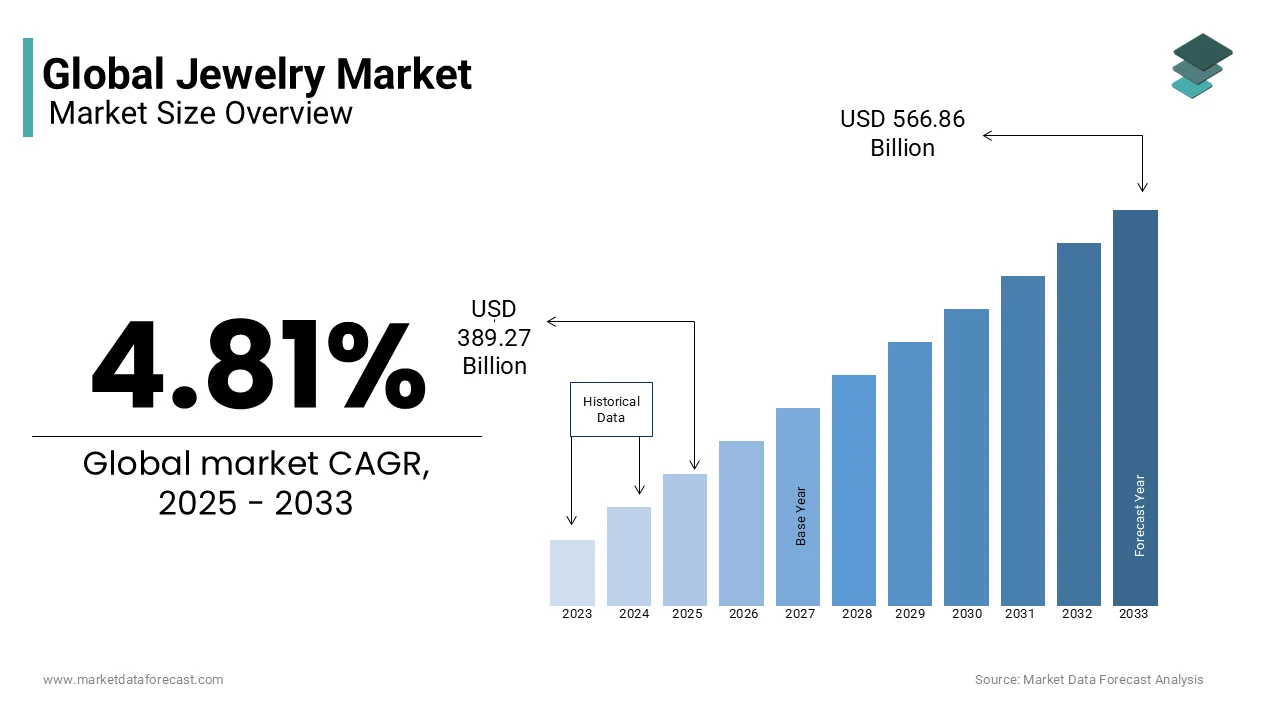
The global Jewelry market size was valued at USD 371.41 billion in 2024 and is expected to reach USD 566.86 billion by 2033 from USD 389.27 billion in 2025. The market is projected to grow at a CAGR of 4.81%.
Jewelry serves as expressions of personal style, markers of cultural heritage, and symbols of emotional milestones such as engagements, weddings, and religious ceremonies. Beyond its aesthetic appeal, it holds intrinsic value as both a wearable art form and a store of wealth and particularly in regions where gold and diamonds are deeply embedded in societal traditions. In 2023, the global fascination with jewelry continues to evolve is driven by shifting demographics, technological advancements and evolving perceptions of luxury.
Additionally, sustainable practices are gaining traction, with a 2022 survey by McKinsey & Company revealing that 60% of consumers are willing to pay a premium for ethically sourced jewelry. These figures illustrate the interplay between tradition, innovation, and consumer values, shaping the contemporary landscape of the jewelry industry.
The growth of disposable incomes in emerging economies serves as a significant driver for the jewelry market. As per the International Monetary Fund, countries like India and China have witnessed an average annual GDP growth rate of over 5% in recent years, leading to increased consumer spending on luxury goods, including jewelry. The World Bank highlights that household consumption in these regions has risen by nearly 30% over the past decade, with jewelry accounting for a substantial portion of discretionary spending. For instance, in India, gold jewelry demand surged by 15% in 2022, driven by higher rural incomes and urban affluence. Similarly, China’s middle class, projected to reach 700 million by 2030 according to McKinsey & Company, is fueling demand for diamond and platinum-based products. This economic upliftment enables consumers to prioritize culturally significant purchases, bolstering the global jewelry industry.