Editor’s Note
As the 2025 holiday season approaches, consumers in the UK, US, and Germany are navigating a complex retail environment. This article explores the emerging trends, highlighting how shoppers are becoming more strategic—balancing budgets with a desire for quality and meaningful celebrations.
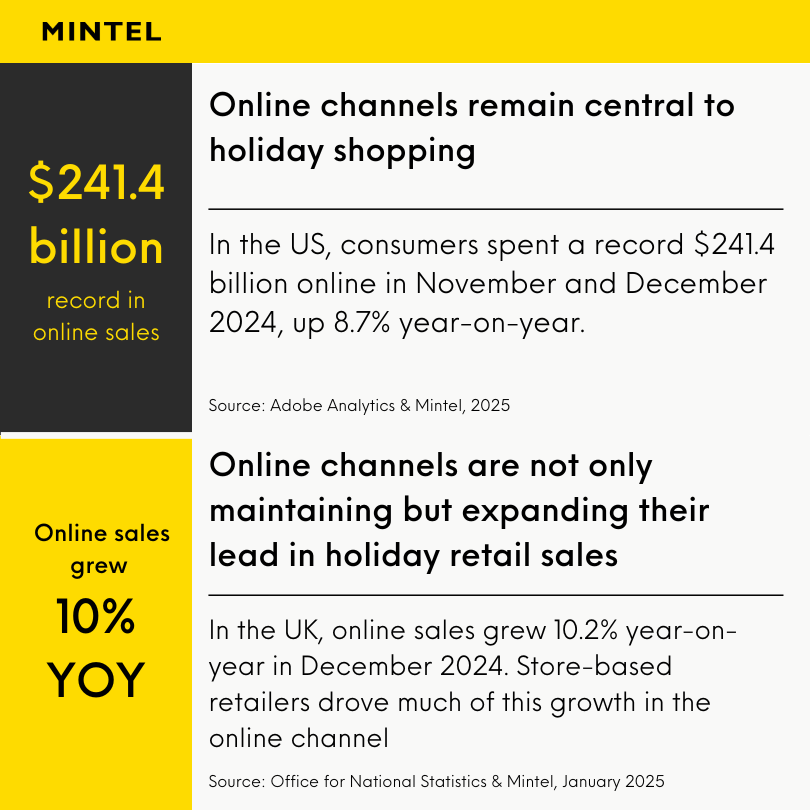
As we look toward the 2025 holiday season, the retail landscape presents a mixed but evolving picture. While economic uncertainty continues to influence consumer mindsets, improving financial situations in some markets is signalling a brighter outlook. This is causing shoppers to become more strategic with their purchases, balancing budget-conscious behaviours with a desire for meaningful celebrations and quality gifts. This sets the stage for a dynamic period of seasonal shopping across key global markets.
Read on to explore our analysis of the upcoming holiday shopping consumer behaviour in the US, UK, and Germany. We will unpack the key Christmas consumer trends for 2025 and provide insights into what retailers can expect.
The outlook for holiday shopping in 2025 reflects a blend of cautious optimism and persistent financial pragmatism across the UK, US, and Germany. While financially secure and younger groups in each country are showing more positivity and a willingness to spend, the dominant sentiment this year is shaped by value-seeking and deal-driven shopping behaviours.
Optimism for Christmas 2025 is on the rise, especially among younger and higher-income households.
However, concerns about the cost of living and tax rises persist, which have caused confidence to dip slightly in late 2025 compared to earlier in the year. Still, overall financial confidence remains higher than in 2024.
North American consumers’ confidence is steady but cautious. Nearly all adults intend to shop this holiday season, but
Most shoppers are more deliberate than before, whereby they compare prices, participate in sales, and set clear budgets to maximise value.
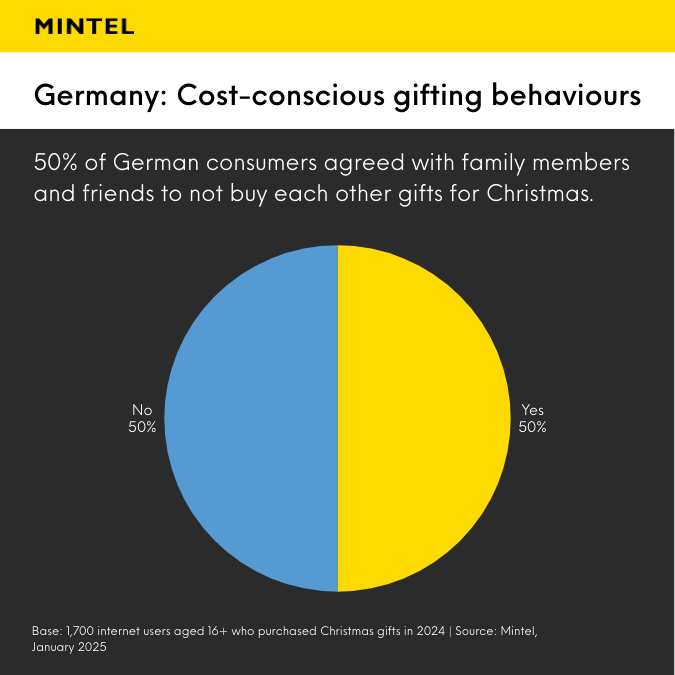
The majority of German consumers are prioritising affordability. In 2024, three in five consumers opted for cheaper gifts, and Mintel analysts predict this trend to grow in 2025. Among those feeling financially strained,
This contrasts sharply with adults aged 16-34, where over three in ten intend to spend more on Christmas gifts than last year.
As Christmas 2025 nears, consumers are more price-conscious than ever, yet they are still eager to embrace the joy of the gifting season. Let’s explore how shoppers are balancing tight budgets with their desire to give, and what this means for retailers’ holiday retail marketing strategies.
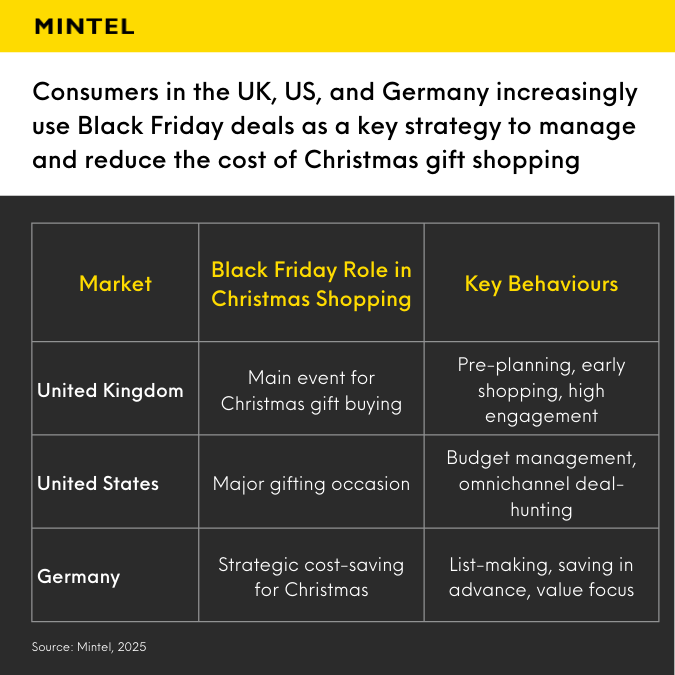
Consumers increasingly use Black Friday deals as a crucial tool for Christmas gift shopping, and use the event to plan, save and maximise budgets.
In the UK,
Black Friday has distorted the traditional December peak as we used to know it, with many shoppers starting their Christmas shopping in November. In 2024,
which Mintel analysts predict to rise this year, highlighting a move from impulse buys to strategic, budget-driven shopping.
US shoppers mirror this pattern. Black Friday and Cyber Monday are now deeply embedded in North American holiday shopping culture, with many consumers using these events to buy the bulk of their Christmas gifts.
For retailers, this underscores the need for value-led messaging to capture and retain holiday shoppers.
In Germany, Black Friday enables consumers to shop strategically ahead of Christmas.
This demonstrates how promotional periods help consumers stretch their budgets and plan purchases in advance.
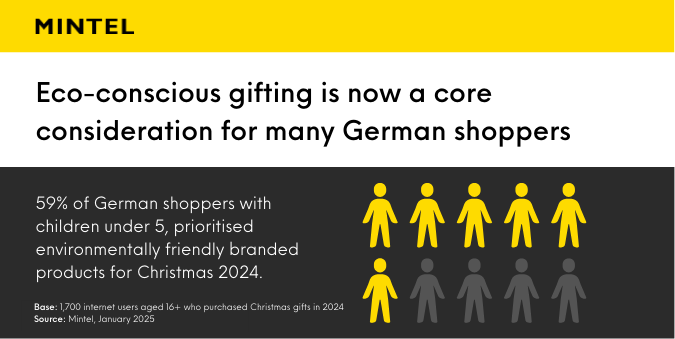
Shoppers are increasingly participating in gift reduction, either by focusing on buying fewer, higher-quality gifts or by engaging in schemes like Secret Santa. This trend is driven not only by financial pressures but also by growing sustainability concerns and a desire for more meaningful gifting in a society defined by over-consumption.
In the UK:
and participation rises among younger consumers living with family. Retailers can cater to this by creating dedicated in-store and online sections for group gifting with clear price brackets and suggestions for different recipients.
In the US:
To capitalise on this momentum, retailers are responding with greener product ranges, eco-friendly packaging, and campaigns such as “Green Friday,” which encourage mindful and sustainable purchasing.