Editor’s Note
This article examines how Indian garment exporters like Pearl Global are adapting to US tariff pressures while strategically preparing for new trade opportunities with the UK and EU.

Gurugram-based Pearl Global Industries, an end-to-end clothing vendor and garment supplier, is navigating a challenging US tariff environment while positioning itself to benefit from upcoming free trade agreements with the UK and the European Union. Pallab Banerjee, MD and Group President of Pearl Global, stated that the uncertainty surrounding a 25% penalty tariff on Indian exports to the US remains a significant headwind.
Banerjee explained that the tariff situation has rendered Indian operations ‘not a sustainable’ model for the US market in the long term.
The company’s Indian business currently contributes about 25-27% of the total topline. To mitigate the US tariff risk, Pearl Global has been actively diversifying its markets, resulting in its exposure to the US market falling to just under 50%.
Despite the tariff disadvantage, some production continues in India, particularly for products with a “strong handwriting” and those utilising India-specific textiles and fabrics. However, for these items, the company has to offer discounts to offset the tariff impact for US buyers.
Banerjee reiterated, pointing to the company’s focus on growing its presence in other markets like Japan, Australia, and the UK.
The company is particularly optimistic about the potential benefits from new trade agreements.
Banerjee said. He noted that while the UK and European markets, which constitute about 25% of the group’s business, are currently serviced heavily from Bangladesh due to its tariff advantages, an FTA would bring India on par.
In anticipation of this, some customers have already started placing orders in India. Banerjee expects the UK FTA to be finalised anytime between now and March, and anticipates positive news on the EU FTA in January 2026, which he believes will be a “good move for India” and could trigger significant growth.
Detailing the company’s capital expenditure plans, Banerjee mentioned a ₹110 crore capex in Bangladesh and a ₹20 crore capex in India. The investment in Bangladesh is allocated for a new greenfield facility and a laundry, capitalising on the country’s strengths in denim manufacturing. In India, the company has invested in states like Bihar, Odisha, and Vizag.
he added.
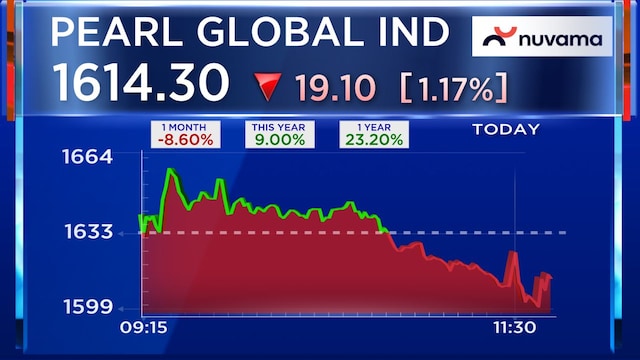
Financially, Pearl Global aims for asset turns of three to four times or higher and is focused on maintaining its Return on Capital Employed (ROCE) at around 20%. Pearl Global Industries’ current market capitalisation is ₹7,430 crore. The stock is currently trading at ₹1,613.80 as of 12:15 pm on the NSE and has gained 23% over the last year.