Editor’s Note
This article explores the lesser-known marvel of Cartier’s Mystery Clock, a creation that masterfully blends exquisite craftsmanship, jewelry artistry, and innovative horology. While the brand is famed for iconic pieces like the “Tank” watch and “Tutti Frutti” jewelry, the Mystery Clock stands as a unique testament to its enduring spirit of innovation and mysterious allure.

What comes to mind first when you hear the name Cartier? Is it the exquisite high-end jewelry “Tutti Frutti” adorned with abundant gemstones, or the iconic “Tank” with its rectangular case? Both are undoubtedly masterpieces.
However, the creation that most astonishes people and continues to exude a mysterious charm is arguably the Mystery Clock. This work, which fuses exquisite craftsmanship, the beauty of jewelry, and innovative watchmaking technology, has continued to captivate people’s hearts for over a century since its birth.
In 1912, then-head Louis Cartier commissioned watchmaker Maurice Couët to create Cartier’s own Mystery Clock based on the idea of French magician Jean-Eugène Robert-Houdin. The hands are fixed between multiple transparent crystal plates, while the movement components like gears are hidden in the base.
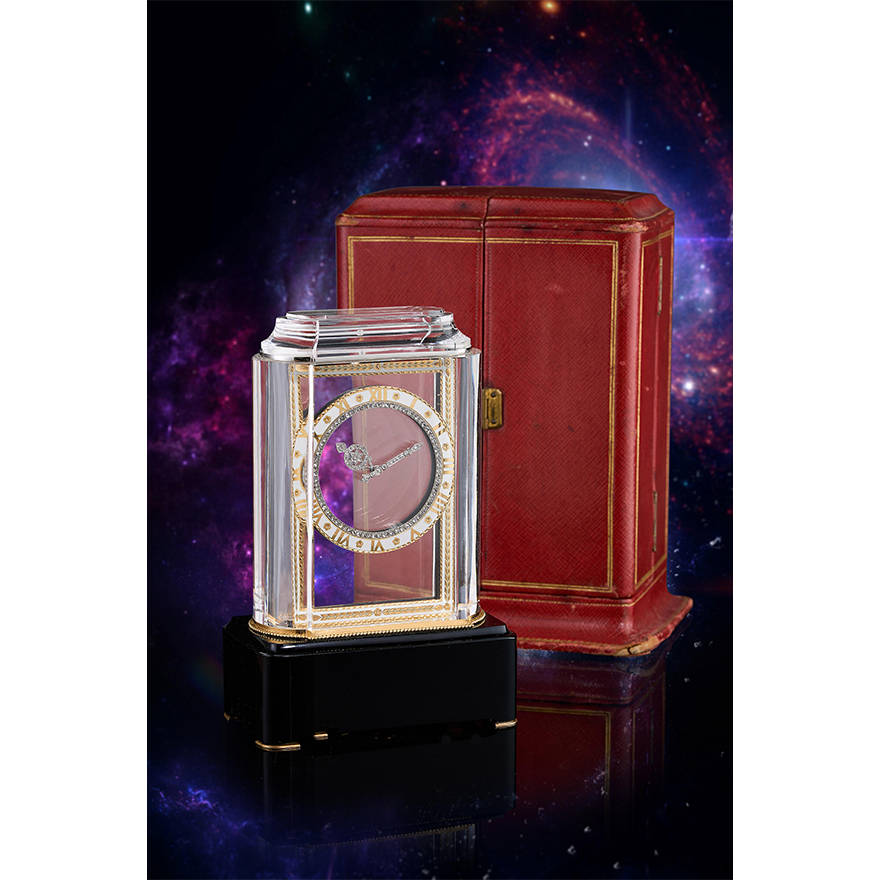
When the movement operates, the gear train slightly rotates the crystal plates, making the hands appear to float in mid-air as they indicate the time. Upon its release, it was fervently embraced by the upper class. It is said that even the Countess of Greffulh, hailed as “the most beautiful woman in Europe,” and American financial magnate J.P. Morgan became captivated by it. In 1925, the high-fashion magazine ‘Gazette du Bon Ton’ praised it as a “miracle in the history of horology.”
Traditionally, Cartier’s Mystery Clocks were for royalty, nobility, and socialites, rarely attracting the interest of watch collectors. However, in recent years, the scope of collecting has broadened to include works like the Mystery Clock, which possess uniqueness and historical significance.
The production number of Mystery Clocks is extremely limited, and each one is a crystallization of craftsmanship. There are pieces adorned with cloisonné enamel, others incorporating Chinese jade, and even designs inspired by Japanese torii gates. All possess elements sought by modern collectors.
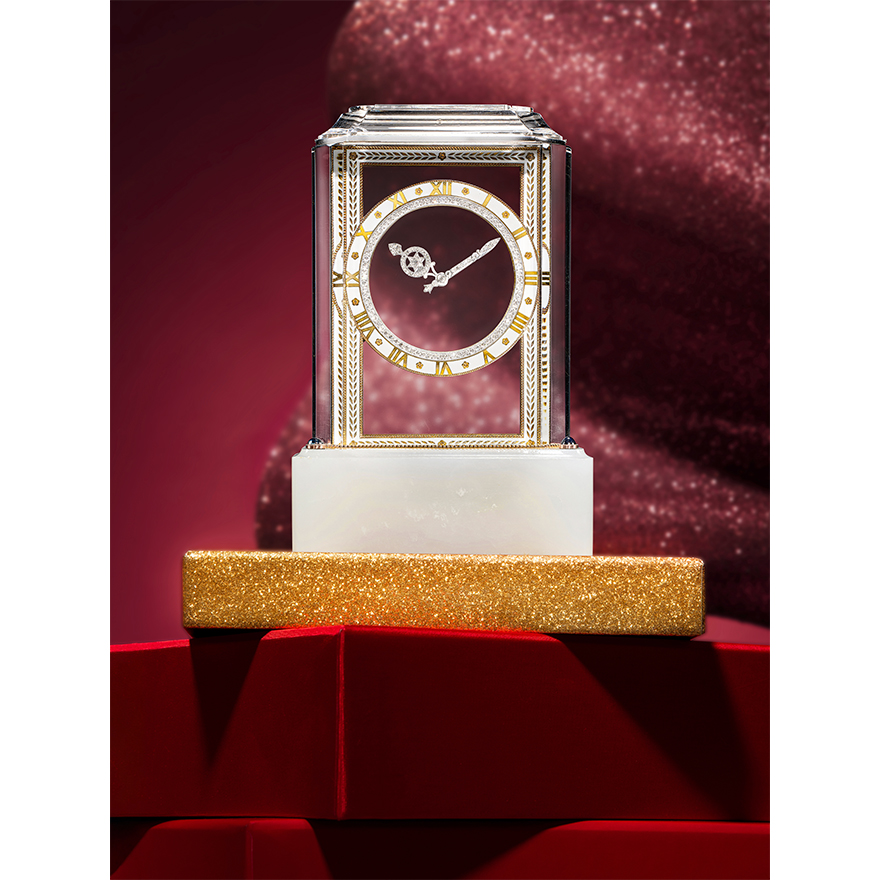
During a recent visit to London, UK, I viewed a Cartier exhibition at the Victoria & Albert Museum. At the center of the display, the “Model A” Mystery Clock particularly caught the eye.
“Model A” refers to the series produced in the earliest period, sharing the same lineage of design as the first Mystery Clock. At the time, they were specially commissioned only for royalty and nobility; Queen Mary, consort of King George V of the United Kingdom, also owned one. Thus, Model A is not merely a craftwork but an object bearing history and culture.
In 2022, a first-generation Model A from 1928 was auctioned at Bonhams Hong Kong, selling for 6.87 million Hong Kong dollars (approximately 133,415,400 yen, based on 1 HKD = 19.42 yen as of October 15, 2025, inclusive of fees). This set a new auction record for the model, proving that Mystery Clocks have become coveted items for top collectors.
In November 2025, a Model A Mystery Clock will be offered again at a Bonhams Hong Kong watch auction. Its appearance is almost identical to the piece I saw at the Victoria & Albert Museum. It features a white onyx base adorned with gold, platinum, and enamel decorations, with the hands densely set with diamonds.
Its condition is also impeccable. For true collectors, watch collecting is not for ostentation but an act of gaining a moving experience through the work. That emotion stems from exquisite handiwork, fantastical mechanisms, or historical memory. Rather than lining up numerous watches on a shelf, pouring one’s heart into a single museum-grade piece may bring deeper satisfaction.