Editor’s Note
The global online jewellery market is projected to grow significantly this decade, offering a substantial opportunity for established exporters. This article examines the growth trajectory and key drivers for India’s gem and jewellery sector.
According to Zion Market Research, the global online jewellery market is expected to nearly triple by 2032, growing 189% from US$45.33 billion in 2023 to US$130.86 billion. This presents a major opportunity for Indian exporters to tap into a larger consumer base. India, renowned for its exceptional craftsmanship, has long been a global hub for gems and jewellery. The sector’s rapid expansion is further driven by innovations in logistics, government initiatives and strategic partnerships – fuelling India’s rise as a gem and jewellery export powerhouse.
India’s gem and jewellery exports have reached remarkable heights, contributing around $14 billion annually to the economy. As Sabyasachi Ray, Executive Director of the Gem and Jewellery Export Promotion Council (GJEPC), mentioned in an exclusive interview with Indian Transport & Logistics News (ITLN):
This ambitious growth trajectory is fuelled by logistics innovations and the concerted efforts of stakeholders to overcome historical hurdles.
The gem and jewellery sector has traditionally faced logistical challenges, particularly for small and medium-sized enterprises (SMEs). Complex customs procedures, inadequate infrastructure and a lack of integration between logistics providers and government systems have historically hindered the export process.
As Nitin Khandelwal, Regional Director of GJEPC Jaipur, highlighted in a keynote at IIJS Signature and IGJME Signature 2025:
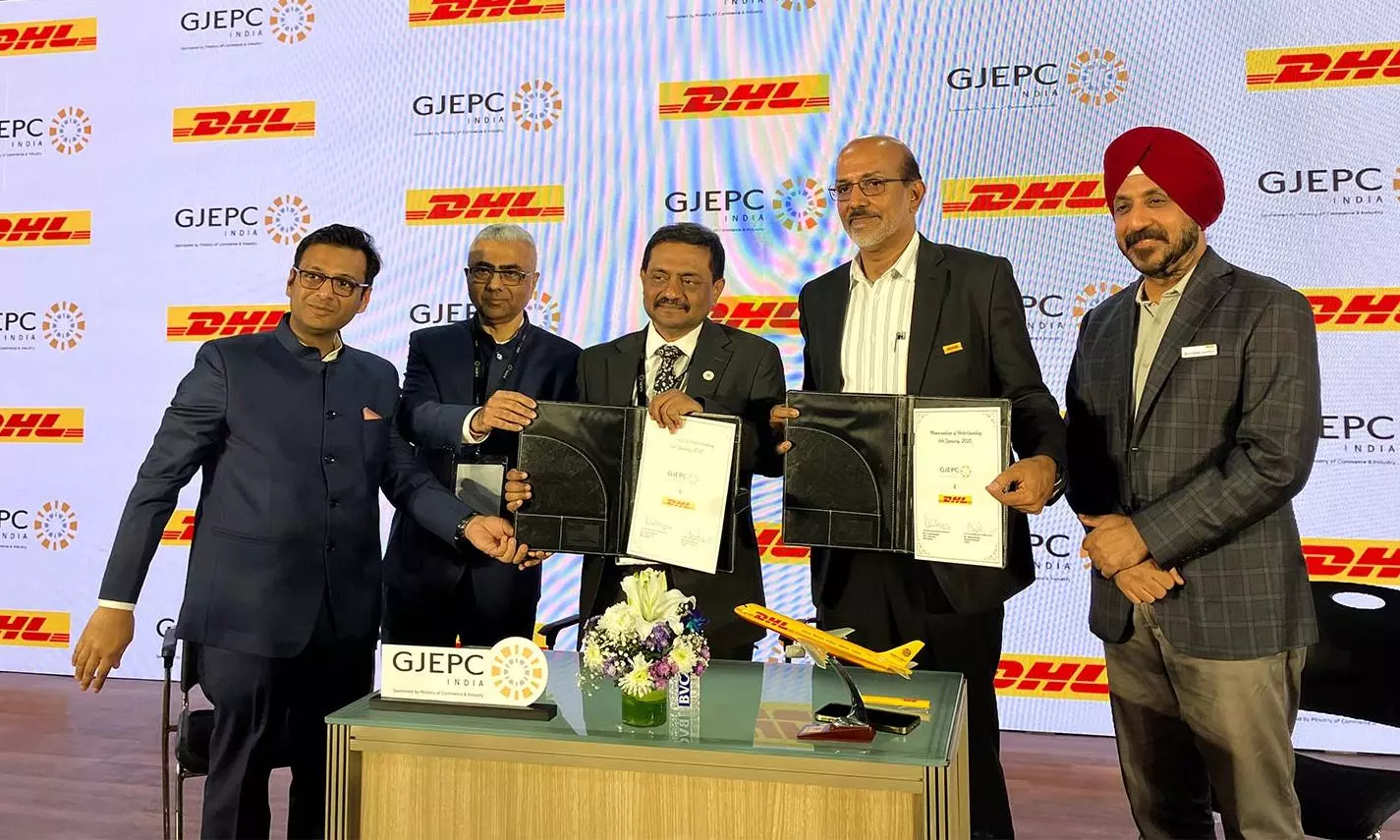
Recent partnerships between organisations such as GJEPC and logistics players like DHL Express are paving the way for more streamlined exports. The signing of a Memorandum of Understanding (MoU) on January 6, 2025, at IIJS Signature and IGJME Signature 2025 in Mumbai, between GJEPC and DHL Express marked a critical milestone in this journey.
Speaking at the MoU signing, R.S. Subramanian, Senior Vice President of South Asia, DHL Express, emphasised the potential of such collaborations:
Through such partnerships, logistics providers are offering comprehensive solutions—from pickup and customs clearance to delivery in international markets—helping Indian exporters access over 200 countries.
Logistics service providers are boosting India’s $1.4 billion gem & jewellery exports, with exports via e-commerce alone set to reach around $2 billion in five years.
Moreover, the development of logistics hubs and fulfilment centres ensures that exports are handled with precision and care, minimising risks associated with high-value shipments.