Editor’s Note
This article explores the rapid growth of India’s artificial jewellery market, driven by shifting fashion trends, increased spending power, and social media influence. Once reserved for special events, these affordable accessories are now becoming a staple of everyday wear.
The market for artificial jewellery in India is expanding rapidly. An increasing number of people are growing fond of fashionable yet affordable accessories. Imitation jewellery, which was initially a niche segment, is now popular with many individuals in cities and towns. Evolving fashion preferences, along with greater purchasing power and the influence of social media, have contributed to this trend. As a result, artificial jewellery is being worn daily and not just during special occasions.
E-commerce assists brands in reaching the younger generation, which is highly concerned about style. It also provides tailor-made designs and new fashions, which offline stores may not be able to offer. Moreover, the fact that artificial jewellery is affordable, available in a wide variety of options, and readily accessible encourages more people in India to purchase it. This has turned India into a powerful player in the global costume jewellery industry. India’s skilled workforce, cost-effective production, and evolving consumer base are key drivers of the artificial jewellery market.
The broader gems and jewellery business exported Rs. 2,43,162 crore (US$ 28.5 billion) in FY25, indicating strong global demand for India’s ornament craftsmanship.
The artificial jewellery market in India is expected to expand at a compound annual growth rate (CAGR) of 11.4% from 2025 to 2029, reaching Rs. 10,280 crore (US$ 1.16 billion). Its growth is largely driven by the rising demand for affordable fashion accessories, increased online purchases, and shifting preferences of younger consumers.
Government initiatives are also playing a crucial role in supporting this growth. The Maharashtra state cabinet has approved a dedicated policy allocating Rs. 13,800 crore (US$ 1.56 billion) for the gems and jewellery sector from 2025 to 2050. The policy aims to boost the sector’s exports to Rs. 2,65,860 crore (US$ 30 billion) within five years, attract Rs. 1,00,000 crore (US$ 11.28 billion) in investments, and generate five lakh new jobs. Additionally, Tamil Nadu is establishing a modern jewellery park in Coimbatore to assist craftsmen impacted by high gold prices and low order volumes.
These developments indicate a promising future for the artificial jewellery market in India, where local demand, exports, and government assistance are contributing to steady growth.
India’s artificial jewellery sector has evolved from a domestic staple to a prominent player in the global market. In FY25, the country exported Rs. 1,154 crore (US$ 136 million) worth of imitation jewellery.
The United States (US), Spain, and the United Kingdom (UK) are the major purchasers, collectively receiving the majority of the exports. Other key markets include the United Arab Emirates (UAE), Netherlands, Canada, Australia, France, Italy, and Nigeria, each with their own preferences, boosting demand for Indian artificial jewellery. In April 2025, exports to the US, Spain, and the UK were approximately Rs. 34 crore (US$ 3.88 million), indicating high demand in these countries.
India exported 5,048 consignments of artificial jewellery to 625 customers worldwide between June 2024 and May 2025, a 12% increase over the previous year. The US, the UAE, and the UK were the leading destinations.
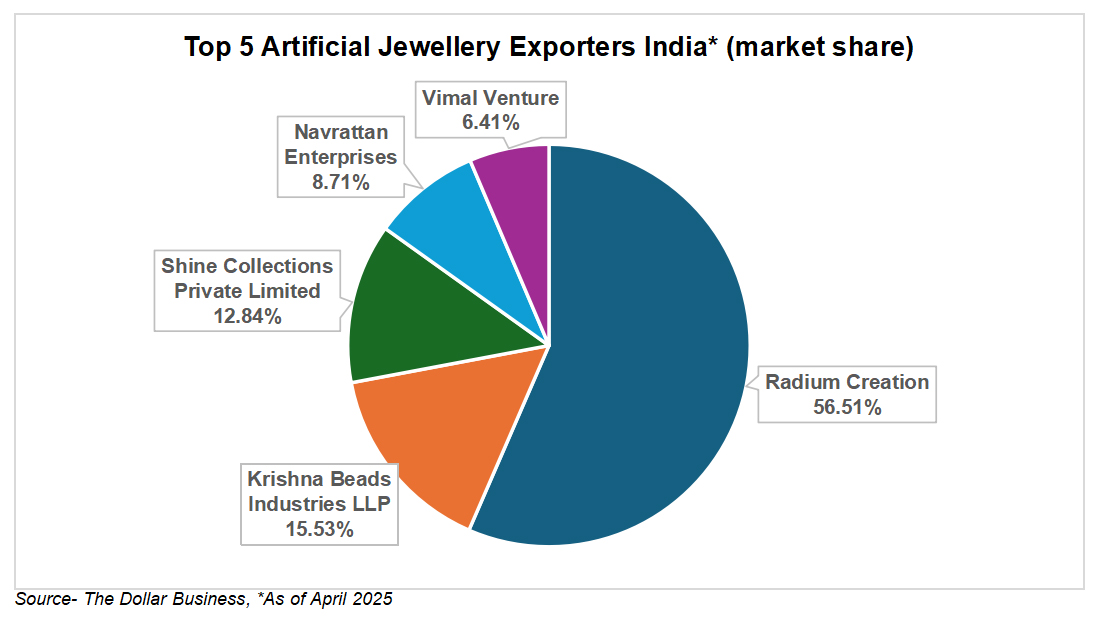
According to The Dollar Business, the five leading exporters in April 2025 were Radium Creation (56.51%), Krishna Beads Industries LLP (15.53%), Shine Collections Private Limited (12.84%), Navrattan Enterprises (8.71%), and Vimal Venture (6.41%). They are collectively increasing India’s market share in the global artificial jewellery market with numerous stylish and eco-friendly designs.