Editor’s Note
This article highlights the significant scale and operational efficiency of India’s National Food Security Act (NFSA). With nearly 789 million beneficiaries receiving free foodgrains, the program is supported by substantial buffer stocks exceeding mandated norms. The ongoing digital transformation of the Public Distribution System, including new mobile applications, aims to enhance transparency and accessibility for citizens.
- As of October 2025, 78.90 crore beneficiaries are receiving free foodgrains under the National Food Security Act (NFSA).
- As of 1 July 2025, the central pool held 377.83 Lakh Metric Tonnes (LMT) of rice and 358.78 LMT of wheat, compared to stock norms of 135.40 LMT and 275.80 LMT respectively.
- Digital reforms in the Public Distribution System (PDS), such as the Mera Ration 2.0 App and the Ann Mitra Mobile App.
Food security is ensuring that all people, at all times, have physical, social, and economic access to sufficient, safe, and nutritious food that meets their dietary needs and food preferences for an active and healthy life. Achieving this requires not only adequate production of food but also its equitable distribution.
The government launched the National Food Security Mission (NFSM) in 2007-08 to increase production. Its objective was to increase the production of rice, wheat, and pulses through area expansion and productivity enhancement, restore soil fertility and productivity, create employment opportunities, and enhance farm-level economy. In 2014-15, NFSM was expanded to include coarse cereals, focusing on productivity, soil health, and farmer income. In 2024-25, with a renewed dual emphasis on food production and nutrition, it was renamed the National Food Security and Nutrition Mission (NFSNM). Under NFSNM, States and Union Territories provide support to farmers such as crop production and protection technologies, crop system-based demonstrations, production and distribution of certified seeds of newly released varieties/hybrids, integrated nutrient and pest management techniques, and capacity building of farmers through training during the crop season.
While NFSM/NFSNM ensures high foodgrain production for the central pool, the National Food Security Act (NFSA), 2013 guarantees their equitable distribution. NFSA legally entitles 75 percent of the rural population and 50 percent of the urban population to subsidized (currently free) foodgrains through the Targeted Public Distribution System (TPDS), while also ensuring that vulnerable households receive adequate food and nutrition.
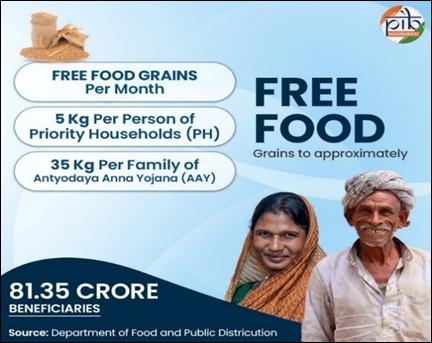
The National Food Security Act (NFSA), 2013 aims to meet the food requirements of up to 75 percent of the rural population and 50 percent of the urban population, which amounts to 81.35 crore persons as per the 2011 Census.
While families under the Antyodaya Anna Yojana (AAY), who are the poorest of the poor, are entitled to 35 kg of foodgrains per family per month, Priority Households (PHH) are entitled to 5 kg of foodgrains per person per month at specified subsidized (currently free) prices as per Schedule-I of the Act.
The Central Government had decided to provide free foodgrains to AAY families and PHH beneficiaries under NFSA from 1 January 2023. The period of free foodgrain distribution has been extended for five years from 1 January 2024. Its estimated financial outlay is Rs. 11.80 lakh crore, which is fully funded by the Central Government.
As of October 2025, 78.90 crore beneficiaries are receiving free foodgrains under the Act.
Eligible families under the National Food Security Act are entitled to receive foodgrains through the Targeted Public Distribution System.