Editor’s Note
A new CRISIL report indicates the Israel-Iran conflict has not yet materially disrupted global trade for Indian firms, but warns that an escalation could create sector-specific challenges. The analysis underscores the importance of monitoring geopolitical uncertainty.

CRISIL Ratings has stated in its new report that the ongoing conflict between Israel and Iran has not had any significant impact on the global trade of Indian corporations so far. However, if the situation deteriorates and uncertainty increases in the coming times, some industry sectors could be affected. The impact, however, will vary across different sectors.
The report states that India’s direct trade with Israel and Iran is not substantial. India’s main export to Iran is Basmati rice, while trade with Israel involves various goods, including fertilizers, diamonds, and electrical equipment, among others.
Increased uncertainty in the Middle East could disrupt energy supply. Specialty chemicals, paints, aviation, and tire sectors could also feel the impact. Sectors like fertilizers and diamonds may be affected as well. If uncertainty persists for a long time, the cost of freight via air and sea routes for exports and imports, as well as insurance premiums, could increase.
A significant increase in crude oil prices will have varying direct or indirect impacts on different sectors. Upstream oil-producing companies will benefit from higher oil prices as they will earn more revenue while their costs remain the same. For downstream refining companies, rising costs could reduce their operating margin, as their ability to increase retail fuel prices is limited.
In FY 2025, India exported 14% of its Basmati rice to Iran and Israel. However, since Basmati is a staple food, the impact on its demand will be limited. Given India’s capacity to export to other Middle Eastern countries, the US, and Europe, the risk is low. However, if the crisis prolongs, there could be payment delays from countries in the affected region.
For diamond polishers in India, Israel is primarily a trading hub. Last fiscal year, about 4% of India’s total diamond exports went to Israel. Additionally, about 2% of rough diamond imports came from Israel. Polishers also have alternative trading centers like Belgium and the United Arab Emirates (UAE). Their end buyers are in the US and Europe, which will help mitigate any adverse impact on this sector.
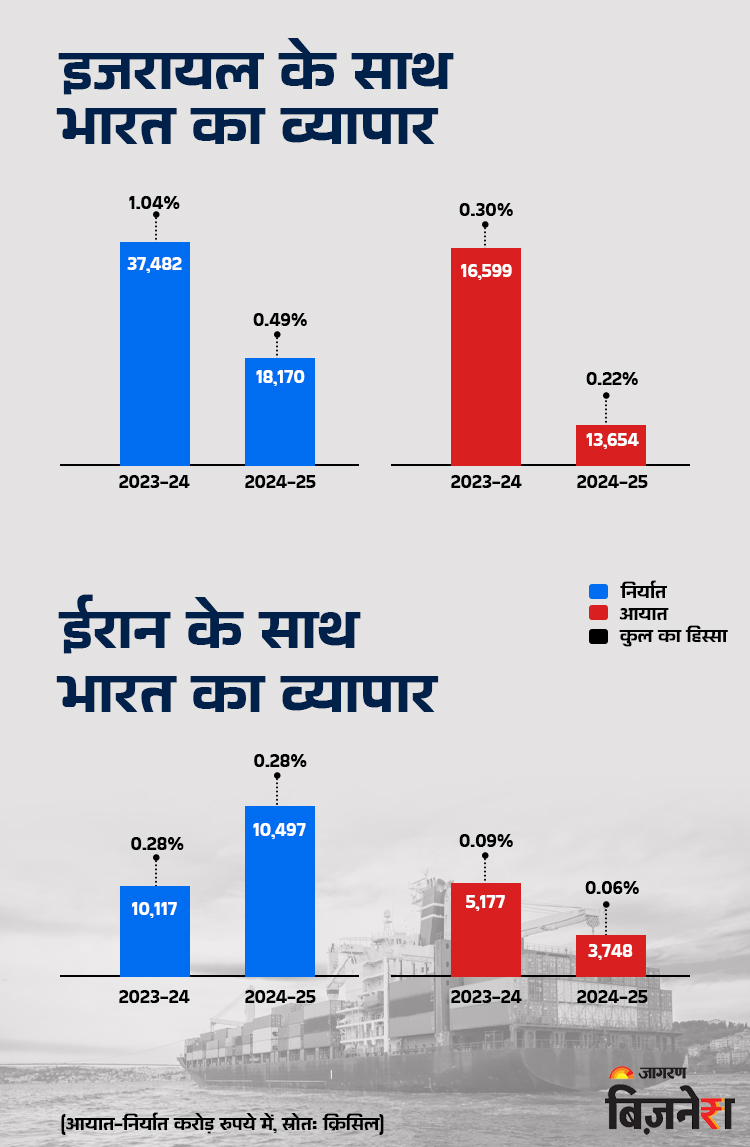
Israel is a major producer of Muriate of Potash (MoP). Last fiscal year, India imported about 7% of its MoP from Israel. However, MoP’s share in India’s fertilizer consumption is less than 10%. India also has the option to purchase MoP from other countries. Therefore, the risk for India is low here as well.
About 30% of the operating costs for specialty chemical companies are linked to crude oil. Their ability to pass on increased input costs to customers will also be limited. This sector has been facing continuous dumping from China for the past two fiscal years and also has issues of weak demand. The sector had only recently begun to return to normalcy.
The paint sector may see some pressure on margins, as about 30% of its production cost is linked to crude oil. Due to competition, companies cannot increase product prices in line with rising input costs. This will affect their profitability to some extent.
Fuel accounts for 35 to 40 percent of airlines’ operating expenses. If fuel becomes expensive, this cost will also increase. Additionally, fuel costs for airlines will rise due to increased travel time from airspace closures or diversions. However, sustained good demand means a significant drop in their margins is unlikely.
About half of the tire sector’s operating costs are linked to crude oil. About 60-65% of this sector’s business comes from the replacement market, with the rest from car manufacturers. Tire companies can easily raise prices in the replacement market, but passing on cost increases to car companies takes time. During this period, their margins are likely to be affected.
About 70-80% of the production cost for packaging and synthetic textile firms is linked to crude oil. Given the better demand-supply situation, passing on costs to customers will be relatively easier for them as well, although it may take some time.

Overall, due to strong balance sheets, the immediate impact on most Indian companies is expected to be limited. However, if the war situation persists for a long time, the impact could increase due to rising oil prices and supply chain disruptions. This will also increase inflation.