Editor’s Note
This article highlights a notable trend in Japan’s retail sector, where jewelry stores are experiencing a sharp decline in bankruptcies, largely attributed to the surge in gold prices. The data suggests the industry is on track for its most stable year in two decades.

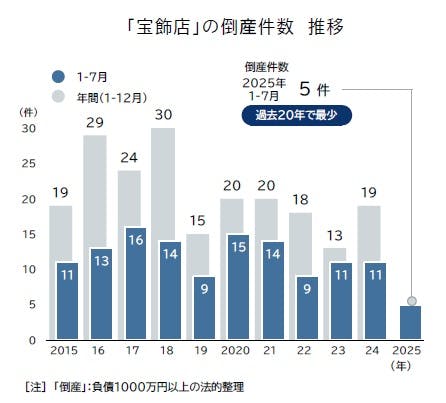
The jewelry store industry is performing well. The number of bankruptcies (involving liabilities of 10 million yen or more, and involving legal reorganization) among jewelry stores and similar ‘jewelry shops’ that occurred from January to July 2025 remained at just 5 cases, significantly lower than the same period in 2024 (11 cases). If this pace continues, the annual total is expected to be the lowest in the past 20 years.
The management of jewelry stores has been supported by increased sales to affluent domestic and international customers, rising demand for second-hand jewelry, and rising international precious metal prices. Looking at the profit and loss trends of jewelry stores for fiscal year 2024, 50.5% of companies saw ‘increased profits’ compared to the previous fiscal year, exceeding half and marking the highest percentage in the past 20 years. While the combined proportion of companies with ‘decreased profits’ (18.9%) and ‘losses’ (26.1%)—categorized as ‘deteriorating performance’—accounted for about half at 45.0%, this figure fell to the 40% range for the first time in 19 years, highlighting the strong performance of jewelry stores.
Against the backdrop of rising stock and real estate prices, sales of high-end fashion jewelry grew, primarily targeting affluent individuals and visitors to Japan. Furthermore, demand for sales of second-hand luxury brand items was strong, particularly for tourists from Asian regions, and buy-and-sell operations were also robust. Even in online sales, which typically have lower average customer spending compared to in-store sales, demand for affordable and stylish items like silver accessories was strong, driven by social media advertising and word-of-mouth effects, especially among younger generations.
In particular, purchasing demand for precious metals such as gold—trading at historically high levels—as well as silver and platinum, increased as investment assets, contributing to improved performance. For jewelry stores mainly dealing in bullion sales and precious metal buy-and-sell, although purchase prices for precious metals like gold and diamonds rose, price pass-through progressed due to strong demand. In many cases, while sales volume remained similar to the previous period, sales revenue increased significantly.
On the other hand, gold prices fluctuate based on international situations and monetary policies. Furthermore, continued price increases for jewelry products due to rising material costs, such as pearls, coupled with a saving mindset amid high inflation, have led to a decline in purchasing appetite in the domestic market. Competition is also intensifying with flea market apps where second-hand brands are traded at lower prices. Even inbound tourism, which has supported jewelry store performance, is reportedly showing a declining trend in customer numbers, particularly visitors from China, suggesting the strong momentum may be approaching a turning point.
Strategies to develop new customer segments through diverse sales channels are drawing attention. These include hosting events for affluent customers and inbound tourists, expanding the lineup of ‘affordable’ casual products priced under 100,000 yen, and utilizing online sales and social media for promotion.