Editor’s Note
This analysis examines the margin pressures confronting Europe’s luxury sector, as major groups report declining profitability. The industry’s reliance on price hikes and cost-cutting to counter these headwinds underscores a pivotal moment for high-end brands.
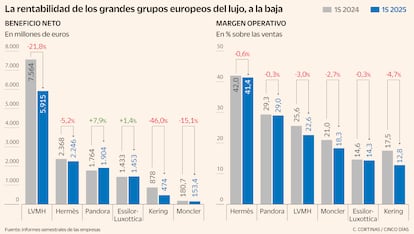
The first-half results have highlighted the complex situation facing major European groups specializing in luxury goods. Giants such as LVMH, Kering, EssilorLuxottica, Hermès, Pandora, and Moncler recorded a decline in their operating profit margins in the first six months of the year [see table], which they aim to offset with two major levers: price increases and cost reductions.
These companies have been navigating a perfect storm for months, fueled by global macroeconomic uncertainty. Factors such as the US government’s tariff policy, the weakness of the dollar against the euro, or a downturn in global tourist demand are elements cited to explain the contraction of their operating margins, down by almost two percentage points on average compared to the same period last year. Kering, with a drop of 4.7 points, and the sector giant LVMH, with a three-point decline, are the two groups that have seen their operating profit ratio on sales most eroded.
Of the six companies analyzed, four also reduced their half-year net profit: Kering (-46%), LVMH (-21.8%), Moncler (-15.1%), and Hermès (-5.2%); and only half improved their revenues, with Pandora, EssilorLuxottica, and Hermès growing between 6% and 7%.
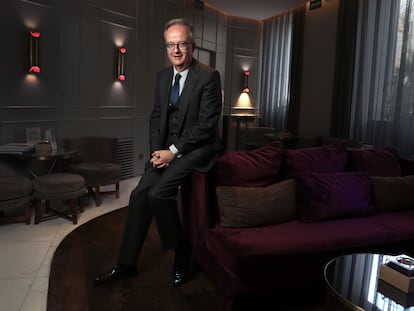
The latter (Hermès) is one of the companies faring better. It has the highest revenue growth, reaching €8.034 billion, and is among those that have most cushioned the margin decline, at below one percentage point. Despite this, its Executive Chairman, Axel Dumas, summarized, after presenting the half-year results, many of the problems currently plaguing these companies.
Most of the analyzed groups point to the decline in demand and, above all, in tourist spending, mainly in Europe, something in turn caused by macroeconomic turbulence in the United States and China, which are limiting the spending power of their travelers.
The annual sector report by consultancy Bain speaks of a downward trend in global consumption of luxury goods and services, with a loss of 50 million customers in the last two years, and a 2% decline in global sales of watches, jewelry, fashion, accessories, or beauty in 2024, the first in 15 years.
To this are added the tariff impacts, which are already being felt. Although LVMH or Kering have shown some relief regarding the 15% tariff that the US applies to the European Union, others do not hide their negative effects on the accounts.
He anticipated that the impact will be greater in the second half. In its case, the operating margin fell by 0.3 points.
The Danish jewelry group Pandora estimates an extra impact of €60 million on its margins by 2026 due to tariff policies.
He added to the equation the impact of the currency effect due to the weak dollar, and rising raw material prices.
In reality, all these large groups are implementing cost efficiency programs, or in other words, are seeking savings to weather this wave. Including the giant, LVMH.
She did not speak directly of cuts, but of “efficient” cost management that allows them to continue investing.
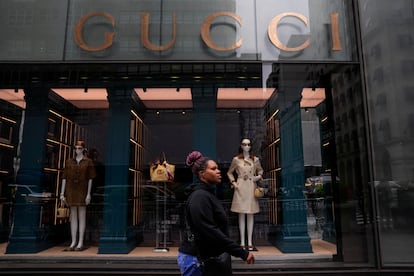
Kering, owner of Gucci, is indeed betting on tougher cuts. This year alone, it expects to carry out 80 net store closures, 30 more than initially announced, mainly from Gucci. It also points to a reduction in its advertising and promotion investment, and will also take measures in commercial and administrative expenses: