Editor’s Note
This article explores the remarkable provenance of Marlene Dietrich’s iconic ruby bracelet, tracing its journey from a 1930 film set to a modern auction house, revealing how legendary jewels become intertwined with cinematic history.
In the days when Marlene Dietrich was filming The Blue Angel (1930), she acquired a 73-ruby jarretière bracelet from Van Cleef & Arpels. The actress was photographed many times with that gigantic and dramatic piece. Images survive of her wearing the jewel during the filming of Alfred Hitchcock’s Stage Fright (1950) and at the 1951 Oscars. It is believed she kept it until her death. Nearly a century later, in May 2023, alarms went off in the Van Cleef & Arpels workshops when Christie’s announced the auction of interior designer Anne Eisenhower’s jewelry collection: the main piece was Dietrich’s legendary ruby bracelet. The decision of the Parisian jewelers was firm: the piece had to return home.
Alexandrine Maviel-Sonet, Director of Heritage and Exhibitions for the maison, had long had the jewel well identified. Part of her job is to know the history of the house inside out, document iconic pieces, track them around the world, and wait. At that Christie’s auction, no one bid higher than Van Cleef & Arpels’ envoy, and the bracelet was recovered in June 2023. It was presented to the public for the first time post-auction in Singapore in 2024.
She has a gift for navigating major auctions and private sales. The rest is knowledge, a trained eye, and receiving good information.

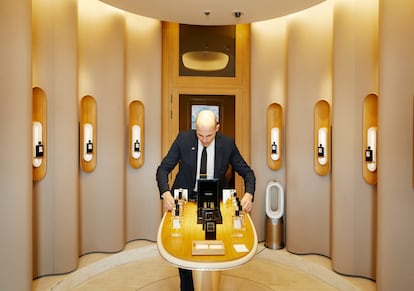
Downstairs is the maison’s perfume house, where the first Van Cleef store opened in 1906.
Maviel-Sonet defines her work as a blind search but with a certain strategy.
In the Van Cleef archives, each piece is accompanied by the drawings made in its day to establish its designs and movements, and even by the invoices of its first buyers. The head of the archive shows charcoal sketches that are almost a century old and attest to the innovative spirit of a jewelry house that was already patenting ingenious invisible clasps and finishes devised by the best artisans of its time.
Whenever the creative department starts a new collection, they have to dust off drawings and manuscripts so designers can study how certain technical challenges were resolved at the turn of the century, allowing the creation of pieces that seemed to have a pulse and life of their own.
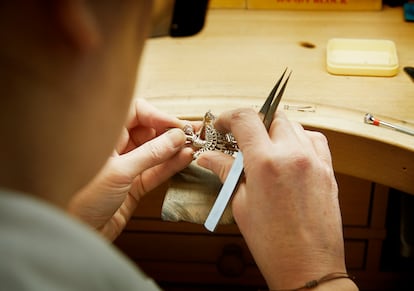
Van Cleef & Arpels is one of the few classic jewelry houses that still maintains its high jewelry workshops on the Place Vendôme, the Parisian square where the world’s best jewelers concentrated in the 19th century. Today, most brands keep their stores there but have moved their workshops to the outskirts. To enter, one must pass through armored doors and sign confidentiality agreements. We go to see about 50 artisans at work — they are called mains d’or (golden hands) — who master techniques of hidden and secret settings, true engineering marvels patented by Van Cleef. Here, polishing and setting are done in silence on old wooden tables, replicating a meticulous way of doing things characteristic of less hurried times.
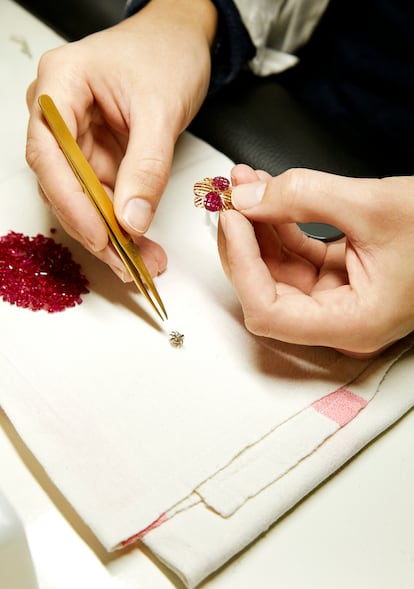
Among the most valued artisans are those who master the mystery set, one of Van Cleef’s best-known technical sophistications, patented in 1933. It is a gem-setting technique where no metal parts are visible. The effect is a cloud of diamonds or rubies that seem to float in the air without any support. It is achieved using a network of gold or platinum wires less than two-tenths of a millimeter wide that act as rails on which stones are placed one by one until the entire surface is covered. Only a handful of artisans in the world master this technique.