Editor’s Note
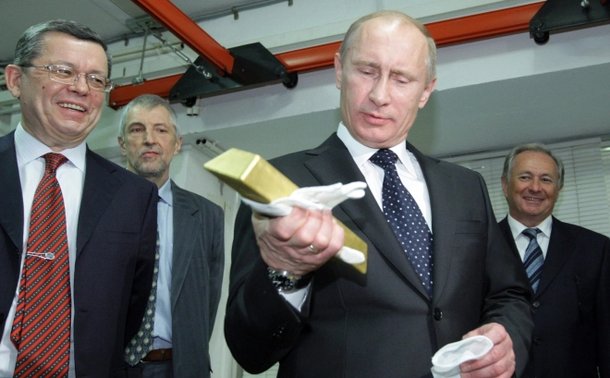
This article examines how gold has become a dual-purpose asset: a traditional safe haven for global investors and a critical financial shield for Russia, enabling it to mitigate Western sanctions and fund its military operations.
Gold is revealing its ‘two faces’ worldwide. Amid war and inflation anxiety, it has emerged as a safe-haven asset for investors and as ‘survival funds’ for Russia to evade Western sanctions and sustain its war.
The UK’s Telegraph reported on the 30th (local time) that “Russia’s gold, accumulated over nearly 20 years, has become a key pillar of its war economy despite sanctions, soaring prices, and economic hardship.”
According to the report, close associates of President Vladimir Putin and Russian mercenary organizations have gained control of gold mines across Africa, including the Central African Republic (CAR), Burkina Faso, and Mali, gaining notoriety for human rights abuses such as killing and torturing locals. Notably, the Wagner Group is known to have recently killed about a dozen local miners at the Ndassima mine, which it has occupied since 2021.
The Telegraph stated, “The gold reserves at this mine amount to $1 billion (approximately 1.47 trillion won),” adding, “Russia has been using gold as an alternative payment method to dollars and euros since being isolated from the Western financial network.”
The UK military policy research institute RAND Europe pointed out in a recent report that “Russia is using gold for international payments, weapons, and cash transactions.”
The US think tank Center for Advanced Defense Studies (C4ADS) revealed circumstances suggesting Russia provided Iran with gold bars worth $104 million (approximately 153 billion won) in exchange for support in building a military drone industry.
Authorities also suspect Russia mobilized gold for weapons transactions with North Korea.
Yuri Chikhanchin, head of Russia’s Financial Monitoring Service, acknowledged that “Russian companies are conducting international settlements using both gold and cryptocurrencies.” The Russian Central Bank announced last week that it would sell its gold reserves for the first time to cover the national budget.
Meanwhile, the global financial market is once again focusing on gold’s role as a ‘safe-haven asset.’ CNBC reported on the 28th, citing a Goldman Sachs survey, that “36% of over 900 institutional investors forecast the gold price to surpass $5,000 per ounce (approximately 7.3 million won) by the end of next year.” Additionally, 33% expected it to be in the $4,500-$5,000 range, with over 70% of all respondents anticipating further increases.
This year, the gold price has already surged over 58% compared to the beginning of the year, breaking through $4,000 per ounce (approximately 5.88 million won) for the first time in history on October 8.
CNBC analyzed that “the expansion of gold purchases by central banks, inflation and geopolitical risks, and concerns about a weak dollar have acted as upward drivers.”
For Russia, gold now functions as funds to evade sanctions and continue the war; for investors, it serves as a store of value in an unstable economy. Particularly, as reports continue to emerge that Russia is using gold for actual budget operations and weapons transactions, its character as a geopolitical risk asset, rather than a simple ‘precious metal investment,’ is becoming more pronounced.
Despite the rising gold price, experts emphasize the importance of ‘ethical investment.’ A representative from the international aid organization SwissAid pointed out:
Consequently, global investors who prioritize Environmental, Social, and Governance (ESG) principles view the transparency of gold’s distribution channels and supply chains as a key variable.
Experts advise that investors, too, should consider not only simple price forecasts but also ‘gold’s ethical supply chain’ and geopolitical risks when reviewing asset allocations such as gold ETFs or gold accounts. They also forecast that, in the long term, “the gold price is likely to fluctuate near its highs until tensions originating from Russia and the Middle East are resolved.”