Editor’s Note
This article examines Lao Feng Xiang’s substantial investment in a newly established, non-operational company, raising questions about valuation and strategic rationale. The inquiry from the Shanghai Stock Exchange highlights significant corporate governance and due diligence concerns that warrant investor attention.
On the evening of October 22, Lao Feng Xiang’s response to an inquiry letter from the Shanghai Stock Exchange (SSE) brought renewed focus to its plan to invest $24 million (approximately 1.7 billion yuan) for a stake in Maybach Luxury Asia Pacific Company (MAP). The SSE’s inquiry went straight to the core: MAP was only established in February this year and has not yet started operations, so why did Lao Feng Xiang’s assessment indicate an appreciation rate as high as 9,692,207.69% (a valuation premium of nearly 100,000 times)?
This acquisition, which has drawn market attention, presents a dual narrative. On one side, Lao Feng Xiang aims to leverage Maybach Luxury’s global presence across 75 countries and regions, with an average annual compound growth rate of 36.5% over the past four years, hoping to achieve a breakthrough in the high-end market through MAP’s plan to open 75 stores within six years. On the other side, industry insiders express concerns about the risks of buyout procurement for unsold inventory and the stability of brand licensing. An industry expert pointed out to the reporter:
This alliance between a time-honored gold shop and an ultra-luxury brand presents Lao Feng Xiang with questions regarding the rationality of the income approach valuation, the possibility of converting high-net-worth clients, and market challenges arising from cultural differences.
It is noteworthy that Lao Feng Xiang is a state-owned enterprise, with its actual controller being the State-owned Assets Supervision and Administration Commission of Huangpu District, Shanghai.
In its inquiry to Lao Feng Xiang, the SSE first questioned the necessity and rationality of acquiring a minority stake at a high premium when MAP has not yet commenced operations.
MAP was registered and established in Hong Kong, China, in February this year, with a registered capital of 10,000 HKD. Its business scope does not involve Maybach automobiles but focuses solely on Maybach luxury goods, including categories such as equestrian equipment, apparel, sporting goods, home goods, stationery, silverware, perfumes, and pet supplies.
In response, Lao Feng Xiang stated that according to the business plan, the Maybach luxury goods business has achieved an average annual compound growth rate of 36.5% over the past four years, with its business footprint covering 75 countries and regions globally, establishing an extensive network of 617 retail stores and sales channels, along with over ten flagship boutiques.
Within the Asia-Pacific region, six Maybach luxury high-end boutiques have already been opened. The average procurement amount per store from these boutiques to Maybach International Operations Limited (MIOL) over the past two years (2023-2024) exceeded $2 million. MAP plans to expand to 75 stores through agents within six years (2025-2030).
Regarding procurement volume, Lao Feng Xiang’s purchase amount from MAP over three years (2025-2027) will total no less than $13 million, all under a buyout procurement model. Lao Feng Xiang admitted:
Several senior figures in the luxury industry pointed out to the reporter that while the cooperation serves a mutual need—Maybach Luxury hopes to expand in the Chinese market, and Lao Feng Xiang seeks a high-end breakthrough—risks arising from differences in cultural concepts and operational thinking must be guarded against.
The SSE also inquired about the lack of installment payment terms in this equity investment transaction. Lao Feng Xiang responded that it was a mutually agreed arrangement after full communication on closing risks and negotiation of transaction security measures, which “avoids the risk of ‘closing failure but difficulty recovering partially paid installments,’ safeguarding the company’s interests.” With the cancellation of existing MAP shareholder equity as a precondition, it ensures LFXHK obtains the newly issued 28.17% voting shares without dilution.
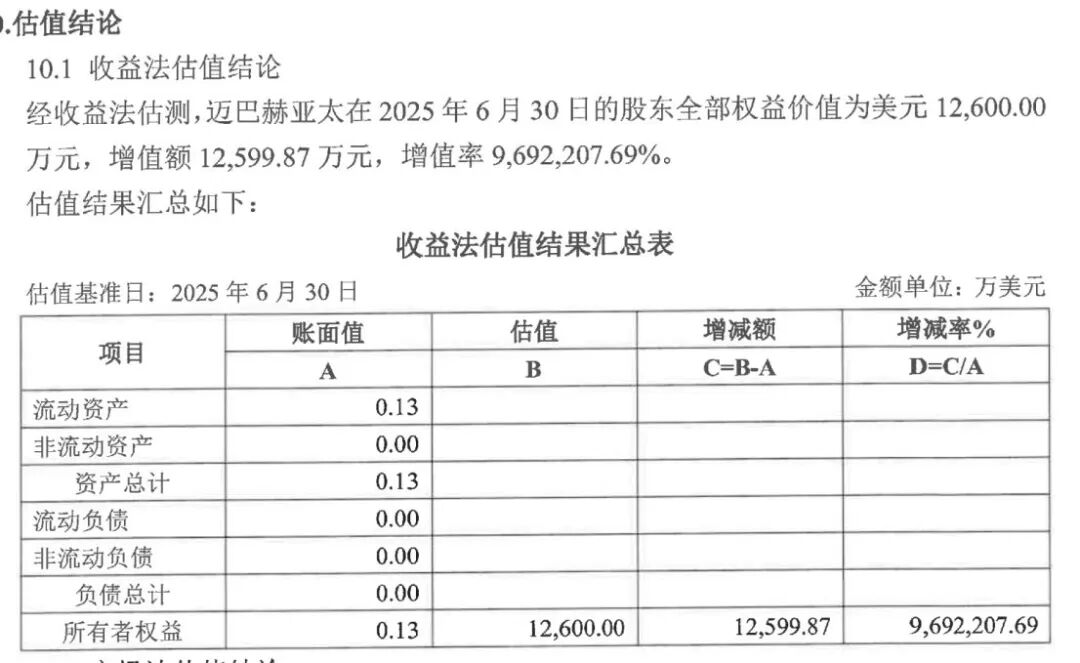
What has attracted the most market attention is that, despite MAP having no operational performance, Lao Feng Xiang’s assessment valued it at $126 million, with a shareholder equity book value of $1,300, resulting in an appreciation rate of 9,692,207.69%.
Why use the income approach for valuation, and is a nearly 100,000-fold valuation premium reasonable?
The “Valuation Report on the Total Equity Value of Maybach Luxury Asia Pacific Limited Involved in the Capital Increase by Shanghai Lao Feng Xiang Co., Ltd. Through Its Controlling Subsidiary” (hereinafter referred to as the “Valuation Report”) released on October 9 mentioned that, based on the income approach estimate, the total equity value of Maybach Asia Pacific as of June 30, 2025, was $126 million, with an appreciation of approximately $126 million and an appreciation rate of 9,692,207.69%; based on the market approach estimate, the value was $132 million, with an appreciation of approximately $132 million and an appreciation rate of 10,153,746.15%. There is a $6 million difference between the two methods, a variance rate of 4.76%.
In its reply to the SSE regarding the rationality of using the income approach, Lao Feng Xiang stated that Maybach entered the luxury goods business in 2009 and formally established Maybach International Operations Limited (MIOL) in 2013. After over a decade of development, it has grown into a global luxury group combining artistic value and commercial strength. MIOL adopts a hierarchical agency distribution model of “Headquarters — Regional Subsidiaries — Regional Master Agents — Dealers/Boutiques.”
Lao Feng Xiang believes that under this model, regional subsidiaries purchase goods from headquarters and sell them to regional master agents, obtaining stable profits from wholesale price differences. Master agents then complete retail sales through dealer networks or approved directly operated boutiques. “On one hand, this ensures the brand’s rapid replication capability globally; on the other hand, it achieves risk transfer through the tiered distribution mechanism, allowing MIOL headquarters and regional subsidiaries to avoid bearing retail-end inventory, rent, and operational costs, thereby maintaining high profit margins while effectively resisting uncertainties brought by retail market cyclical fluctuations.”
Lao Feng Xiang considers that MAP, in which it invests through LFXHK, is an enterprise with sustainable future economic growth, where expected returns can be quantified, the period of expected returns can be forecasted, and the risks associated with the expected returns closely related to discounting can be predicted. Therefore, its valuation company deemed the income approach applicable for valuing MAP.
To protect its investment interests, Lao Feng Xiang retained a bottom-line valuation adjustment clause in the “Investment and Shareholders Agreement” signed with MAP.
Luxury industry expert Zhou Ting told the reporter that Lao Feng Xiang’s high valuation may be anchored to four values of Maybach Luxury: “Maybach’s own luxury-level brand value based on the luxury car brand; the vast high-net-worth customer group influenced and represented by this brand; the future development space of Maybach Luxury based on the vast Asia-Pacific luxury market; and the development opportunities for Lao Feng Xiang in the gold and jewelry market after partnering with Maybach.” She also pointed out:
Additionally, MAP does not acquire the Maybach trademark but intends to obtain a usage license from its shareholder MIOL, which is also a significant risk point for Lao Feng Xiang. “There is a risk of failing to obtain the distribution authorization,” Lao Feng Xiang stated, adding that it has, according to the “Investment and Shareholders Agreement,” prompted MIOL to issue a letter of commitment regarding trademark usage authorization.