Editor’s Note
This article explores the nuanced dynamics behind the recent surge in gold purchases ahead of the Spring Festival. While a price correction has spurred consumer interest, it also highlights a deeper, more complex market divergence unfolding beneath the surface.

A price correction in gold has fueled a pre-holiday “gold rush,” yet a divergence has quietly been written into the underlying market dynamics.
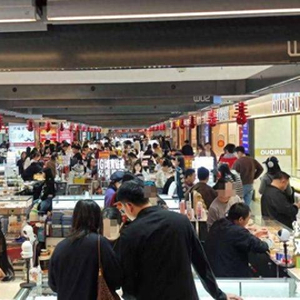
On the eve of the Spring Festival, the warm light inside the counters of Shuibei Jinzuo in Shenzhen interplays with the festive red decorations, while the sounds of calculator taps and price inquiries weave together the liveliest atmosphere before the holiday. As a national distribution hub for gold jewelry, this commercial district, which carries the trends of China’s precious metal consumption, is welcoming its annual consumption peak.
With a surge in customer traffic, small-weight gold jewelry and investment gold bars are selling hot. Citizens are rationally entering the market, taking advantage of the recent gold price correction, sketching a vivid picture of the Spring Festival “gold rush.”
In the view of this practitioner, current Shuibei gold consumers have shed the blindness of “chasing rallies and selling on dips.” “Not chasing highs, not trying to time the bottom, but entering the market based on needs when prices stabilize and correct to a suitable level” has become the mainstream consensus. Some consumers, after watching for half a month, purchased gold bracelets, stating frankly, “It’s a rigid-need purchase; as long as it’s cheaper than the peak, it’s not a loss.”
Compared to the previous blind bandwagon of “snatching gold” for investment in Shuibei, current gold consumers place more emphasis on actual needs and product value, entering the market only when prices are suitable and demand is clear. Behind this rational “gold rush” behavior lies a profound shift in consumption观念.
In stark contrast to the火热 of the gold market, Shuibei’s silver market, after experiencing a同步 price correction, has fallen into the尴尬 situation of “tight supply but no buyers.”
At the end of January, the silver market also experienced an epic plunge, falling over 36% in a single day, becoming the hardest-hit area in this round of precious metal price volatility. As of February 12, Shuibei silver price was reported at 27.8 yuan/gram, a significant drop from the 38.1 yuan price at the end of January. The下调 in spot price should have been an opportunity to激活 the market, but the reality is that silver counters are deserted.
This contrast between hot and cold made the aforementioned practitioner exclaim that it “refreshed her understanding,” sighing, “They are both precious metals, why is the difference so big?”

She told our reporter that the core issue behind the silver market’s冷清 lies in the reconstruction of market logic after the gold and silver plunge at the end of January, coupled with the集中爆发 of silver’s own multiple problems, which completely stripped consumers of their willingness to consume or invest. Among these, the超预期上涨 in premium is the most direct reason, directly offsetting all the benefits brought by the spot price correction.
According to her介绍, in the past, the market premium for silver was only a few毛钱 per gram, at most not exceeding one or two yuan. However, starting from November 2025, the silver premium began to疯涨, soaring all the way to 6 yuan, 10 yuan/gram. Some material suppliers even abandoned premium pricing, directly adopting a fixed-price sales model. Downstream merchants not only had to compete for stock but also had to accept the high premium.
This directly led to a严重脱节 between the actual selling price of silver and consumer expectations. The current silver spot price is only around 20 yuan/gram, but after adding the premium, the终端售价 reaches 28 yuan/gram.
Practitioners admit that “the spot price fell, but the actual selling price didn’t, and it’s even more expensive than before” has become the直观感受 of many inquiring consumers. Merchants also cannot provide a reasonable explanation for this price system,只能看着客户流失.
The混乱 in the supply system has exacerbated the困境 of the silver market. Shuibei practitioners further pointed out to our reporter that the Shuibei silver market is currently caught in a怪圈 of “tight supply but no one dares to buy,” rooted in the material suppliers’惜售 behavior.
When silver prices soared to $116/ounce at the end of January, many material suppliers回收了大量白银 at the high price of 34 yuan/gram. The subsequent单日暴跌 in silver caused significant losses for these suppliers. To avoid “cutting losses,” they chose to hold back supply and raise premiums, unwilling to sell at low prices even when supply is tight.
This puts downstream merchants in a dilemma: if their purchase price is too high,终端无人问津; if they don’t加价销售, they face losses themselves.
The inherent短板 of silver itself—namely, the lack of rigid demand at the retail end and its high price volatility—are the fundamental reasons it cannot compete with gold. Gold combines消费刚需 with避险属性, while silver demand is mainly concentrated in the industrial sector, with relatively weak consumption demand at the retail end. Especially in the Spring Festival consumption场景, no one chooses silver as a gift, and very few people囤白银 for保值. Only a少数消费者 purchase low-priced silver jewelry. The lack of rigid demand leaves silver先天不足 during the Spring Festival消费旺季.
Simultaneously, silver’s price volatility is far greater than gold’s. The 36% single-day drop at the end of January has severely质疑 its抗跌性 in the eyes of consumers. Even with a spot price correction, the high premium makes consumers feel that “it’s not划算 to try to time the bottom; if it falls again, the loss will be even worse.”
More critically, silver’s变现渠道 is far less通畅 than gold’s, becoming the final barrier for consumer entry. Most counters in the Shuibei market do not accept silver回收. Even if some counters do, they压至极低水平 the回收价. This creates顾虑 for consumers before purchase, directly打消了 their consumption and investment意愿.
Silver’s本就小众 customer base, after this溢价混乱 and price volatility, has seen its remaining few investors choose to持币观望. Everyone is waiting for material suppliers to扛不住 and降价, with no one willing to become the “bag holder” in the silver market.