Editor’s Note
This article highlights Richemont’s remarkable growth in South Korea, driven by sustained demand for luxury jewelry and watches. The figures underscore the resilience and expansion of the high-end market in the region.
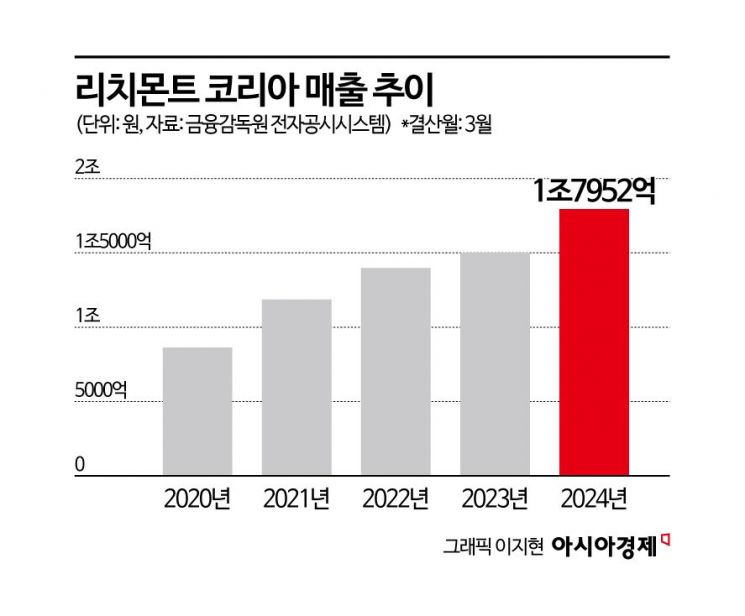
The Swiss luxury group Richemont has achieved record-breaking performance in the South Korean market. Driven by steady demand for high-end jewelry and watches from brands like Cartier and Van Cleef & Arpels, Richemont Korea’s annual revenue approached 1.8 trillion won. This represents an increase of approximately 1 trillion won compared to four years ago.
According to the audit report submitted by Richemont Korea on the 24th (covering April 1, 2024, to March 31, 2025), revenue for this period was 1.7952 trillion won, an increase of about 300 billion won (16.4%) compared to the previous year (1.5014 trillion won). Operating profit rose by 30 billion won to 130.2 billion won, and net profit reached 81.6 billion won.
Richemont Korea is the South Korean subsidiary of the Richemont Group. It operates high-end fashion and jewelry brands such as Cartier, Van Cleef & Arpels, Buccellati, Delvaux, and Chloé, as well as luxury watch brands including IWC, Jaeger-LeCoultre, Piaget, and Vacheron Constantin in the domestic market. The Richemont Group is considered one of the world’s top three watch and jewelry groups, alongside Switzerland’s Swatch Group and France’s LVMH.
Richemont Korea has been setting new record performances annually since the COVID-19 pandemic. After recording revenue of 864 billion won in 2020, it achieved 1.186 trillion won in 2021, 1.3979 trillion won in 2022, and 1.5014 trillion won in 2023. Last year, it is understood that the company recorded double-digit sales growth as more people sought jewelry that can be used for a long time instead of luxury bags.
As revenue increased, dividends sent to the headquarters also grew. Dividends sent to the headquarters last year were 53.46 billion won, but this time they surged by 38% to 73.8 billion won. However, donations slightly decreased from 570 million won to 499 million won.
Other luxury jewelry brands that announced annual results last year, such as Tiffany and Bulgari, also recorded their highest-ever sales in the South Korean market. Tiffany Korea recorded revenue of 378 billion won last year, a 7% increase from the previous year. Bulgari Korea recorded revenue of 419.1 billion won, a sharp 23% jump during the same period. The South Korean subsidiary of the Swiss luxury watch brand Rolex saw its revenue grow by 16% to 342.6 billion won last year.
The increase in sales for luxury watch and jewelry brands is attributed to a growing preference for these items. While in the past, many people sought luxury goods in bags, shoes, and clothing, recently, more consumers are purchasing jewelry that can be used for a lifetime. Oh Dong-joon, Managing Director of Damiani Group’s South Korean branch, explained the shift in consumer trends.
Consecutive price increases have also impacted the performance improvement. Brands cite rising gold prices, a key raw material, as the reason for the price hikes. Rolex raised prices twice last year, in January and June, for the first time. Cartier increased prices in May and October last year, while Bulgari did so in April and October. Other brands like Van Cleef & Arpels (May) and Tiffany & Co. (January, October) also raised prices, with increases ranging from 5% to 10%. However, due to high demand for luxury jewelry, news of price increases has sometimes led to long queues forming at department stores.
The upward trend in performance for luxury jewelry and watch brands is predicted to continue this year. This is because news of price increases is coming faster, while demand for purchasing luxury jewelry and watches persists. Cartier raised prices in February and May this year. Bulgari also increased prices in April and June. Tiffany & Co. raised prices twice in February and May, and Van Cleef & Arpels also increased prices twice in January and April this year. The watch brand IWC also raised prices this month, following an increase in March.