Editor’s Note
This article examines Cartier’s recent price increase, its second in just three months, and questions the business strategy behind such frequent adjustments in the luxury market.
The French luxury jewelry brand ‘Cartier’, popular for wedding gifts, raised its product prices by 6-7% on the 4th. Considering Cartier’s last price increase was in November last year, critics point out that the price hike cycle is excessively short. The problem is that there are other issues hidden behind Cartier’s audacious business tactics.
“Cartier Run (Cartier + Open Run).” As news spread that the French luxury jewelry brand ‘Cartier’ (Richemont Korea) would raise prices starting the 4th, consumers flocked to stores to purchase products beforehand. Online, numerous consumer reviews were posted, such as “I waited in line an hour before the department store opened, and then had to wait another 3-4 hours just to get in.”
Cartier’s price increase this time is 6% for jewelry and 7% for watches. Consequently, the price of the popular ‘Love Bracelet’ rose from ▲6.8 million won (small, gold) to 7.25 million won, and from ▲10.6 million won (classic, gold) to 11.2 million won. The price of the ring product ‘Clash de Cartier Ring’ increased from ▲3.6 million won (small, gold) to 3.82 million won, and from ▲4.93 million won (medium, gold) to 5.25 million won.
Of course, Cartier isn’t the only one raising prices. With the recent surge in gold prices, other luxury jewelry brands like ‘Tiffany’, ‘Fred’, and ‘Boucheron’ have also raised prices one after another since February. However, there is a point to note.
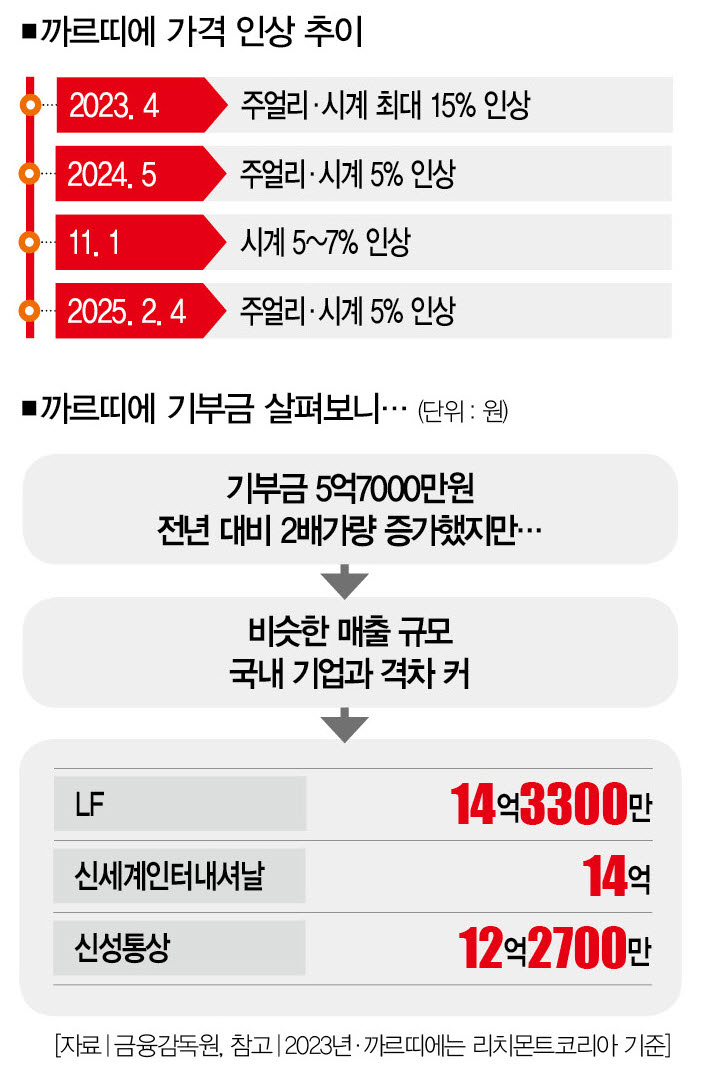
Cartier’s price hike cycles are becoming increasingly shorter. Cartier raises prices more than twice a year. After raising jewelry and watch prices by about 5% in April last year, it raised watch prices by 5-7% again in November. This means it has pulled out the price increase card again after just three months.
![프랑스 명품 주얼리 브랜드 ‘까르띠에’가 1년에 수차례씩 가격을 인상하고 있다.[사진|뉴시스]](https://cdn.thescoop.co.kr/news/photo/202502/305035_212925_3540.jpg)
This differs from the stance of Cartier’s global headquarters, Richemont Group, which stated it would “refrain from price increases as much as possible.” Reuters reported on November 8 last year (local time), citing Richemont Group executives, that “despite the recent sharp rise in gold prices, we will be cautious about price increases” and “(Richemont Group) has no plans to raise prices in the coming months.” This suggests Cartier is conducting audacious business in Korea, contrary to its global management stance.
The backdrop to Cartier’s audacity is Koreans’ intense love for luxury goods. The formula for luxury brands based in Korea has long been, “Even if we raise prices, those who will buy will still buy.” Especially now, beyond bags and clothing, luxury jewelry is leading consumption trends.
According to the Korea Customs Service, Korea’s jewelry imports increased by 4.5% from $1.12042 billion (approx. 1.6 trillion won) in 2023 to $1.17189 billion (approx. 1.7041 trillion won) last year. The main importing country was France (34.3% as of 2023), which holds a large number of luxury jewelry brands.
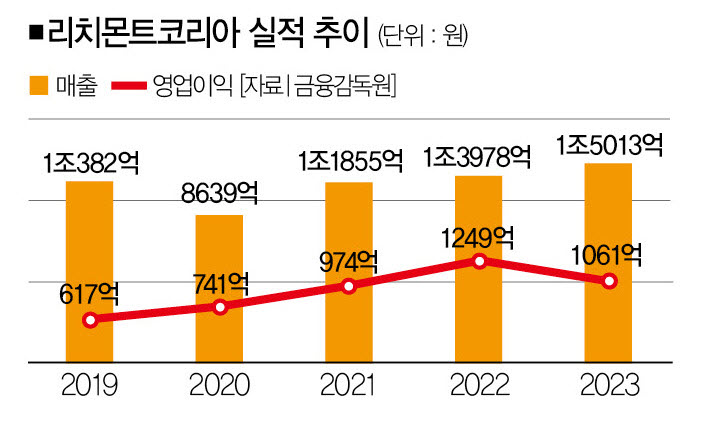
In this situation, Cartier, for which luxury jewelry is a mainstay, has no reason to lower its nose. Richemont Korea, which operates Cartier, also recorded its highest-ever sales last year (April 2023 ~ March 2024). [Note: Sales were 1.5013 trillion won, a 7.4% increase compared to the same period the previous year (1.3978 trillion won), while operating profit was 106.1 billion won, a 15.0% decrease. Although operating profit decreased, the operating profit margin was 7.0%, higher than the pre-pandemic 2019 figure (5.9%).]
![까르띠에가 한국에서 사회적 책임을 다하지 않는다는 비판이 나온다.[사진|뉴시스]](https://cdn.thescoop.co.kr/news/photo/202502/305035_212926_3621.jpg)
The problem is that while Cartier is achieving record-breaking sales through audacious business, it is neglecting its social responsibilities. For example, Cartier has failed to meet its mandatory employment quota for people with disabilities for several years. According to the ‘Act on Employment Promotion and Vocational Rehabilitation for Persons with Disabilities’, private companies with 300 or more regular workers must employ persons with disabilities for 3.1% of their total workforce.
The Ministry of Employment and Labor publishes a list of companies each year that fail to meet even half (1.55%) of the mandatory employment rate (3.1%) to encourage compliance. Last year, Richemont Korea had the second-lowest employment rate for persons with disabilities (0.14%) among 47 companies (with 1,000 or more regular workers) that violated the mandatory employment quota. With 1,393 regular workers, it was obligated to employ 43 persons with disabilities, but in reality, it employed only 2.
Donations made by companies under the name of social contribution also remain at a low level. Richemont Korea’s donations last year were 570 million won, about double the previous year’s figure (252.64 million won), but compared to domestic fashion companies with similar sales scales, it is still low.
Shinsegae International’s donations last year were 1.4 billion won (sales in parentheses: 1.3543 trillion won), LF’s were 1.433 billion won (1.9007 trillion won), and Sinsung Tongsang’s were 1.227 billion won (1.5425 trillion won), all about double that of Richemont Korea. This is why there are criticisms that “the luxury brand Cartier has lost its dignity in the Korean market.”
Richemont Korea, the operator of Cartier, stated, “We cannot respond regarding price increases or social contributions.” Can Cartier, which continues its audacious business, truly regain its dignity?
Reporter Lee Ji-won, The Scoop
[email protected]