Editor’s Note
This article examines how De Beers’ iconic 1947 “A Diamond is Forever” campaign transformed a luxury item into a universal symbol of commitment, highlighting the powerful intersection of marketing and cultural values.
Chemically, it’s 100% carbon. Commercially, it’s 100% marketing. That’s the true essence of a diamond in a nutshell. In the early 20th century, diamond rings were a luxury item worn only by the ultra-wealthy. It was De Beers’ famous advertising slogan that transformed them into a symbol of true love: “A Diamond is Forever.”
This massive marketing campaign, launched in 1947 by an American advertising agency, hit the mark. It successfully implanted the perception that ‘an engagement ring is a diamond’ in the public consciousness. From then on, presenting a diamond ring for a proposal became the established norm, replacing rubies or sapphires. In 1999, the American media outlet AdAge named “A Diamond is Forever” the slogan of the century.
But the protagonist of this brilliant marketing campaign and the world’s largest diamond producer (by value), De Beers, recently announced its performance for last year, and it’s struggling. Revenue ($3.3 billion) fell by 23%, and inventory has piled up to $2 billion worth, a level comparable to the 2008 financial crisis. To clear the massive inventory, the proud De Beers unusually slashed rough diamond prices by 10-15% last December. According to Bloomberg, customers still refused to trade, saying it was too expensive.
Its parent company, Anglo American, has been seeking to divest from De Beers since last year. Reflecting recent losses, it drastically lowered De Beers’ book value from $7.6 billion last year to $4 billion. However, the market still reacts that it’s too expensive. If there are no buyers, Anglo American may pursue an IPO for De Beers.
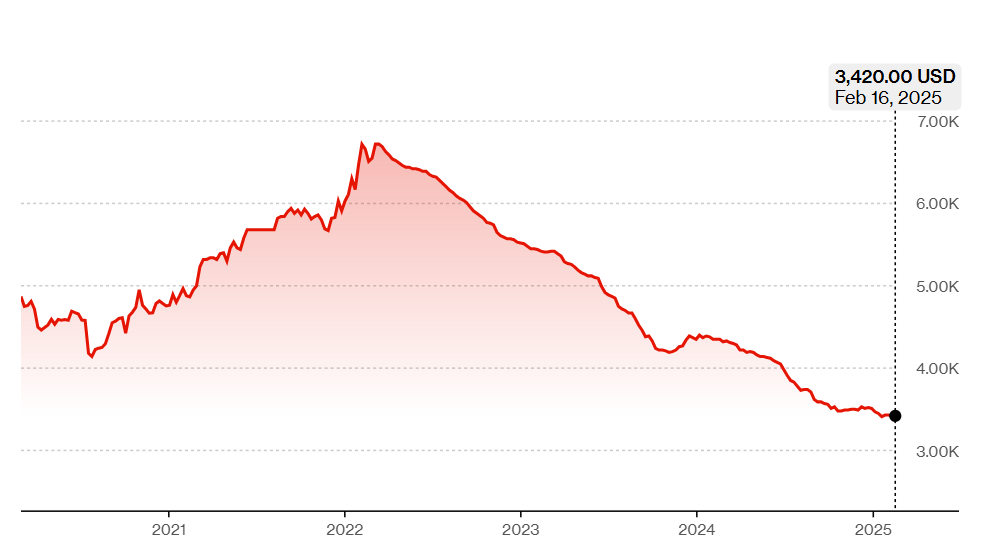
The rapid decline of this industry is well illustrated by diamond prices. The price of a 1-carat diamond is $3,420 (about 4.88 million won) based on the Bloomberg standard price. Compared to the previous peak in May 2022 ($6,720, 9.6 million won), it’s almost half. It continues to decline steadily with no sign of a rebound, making it difficult to gauge the bottom.
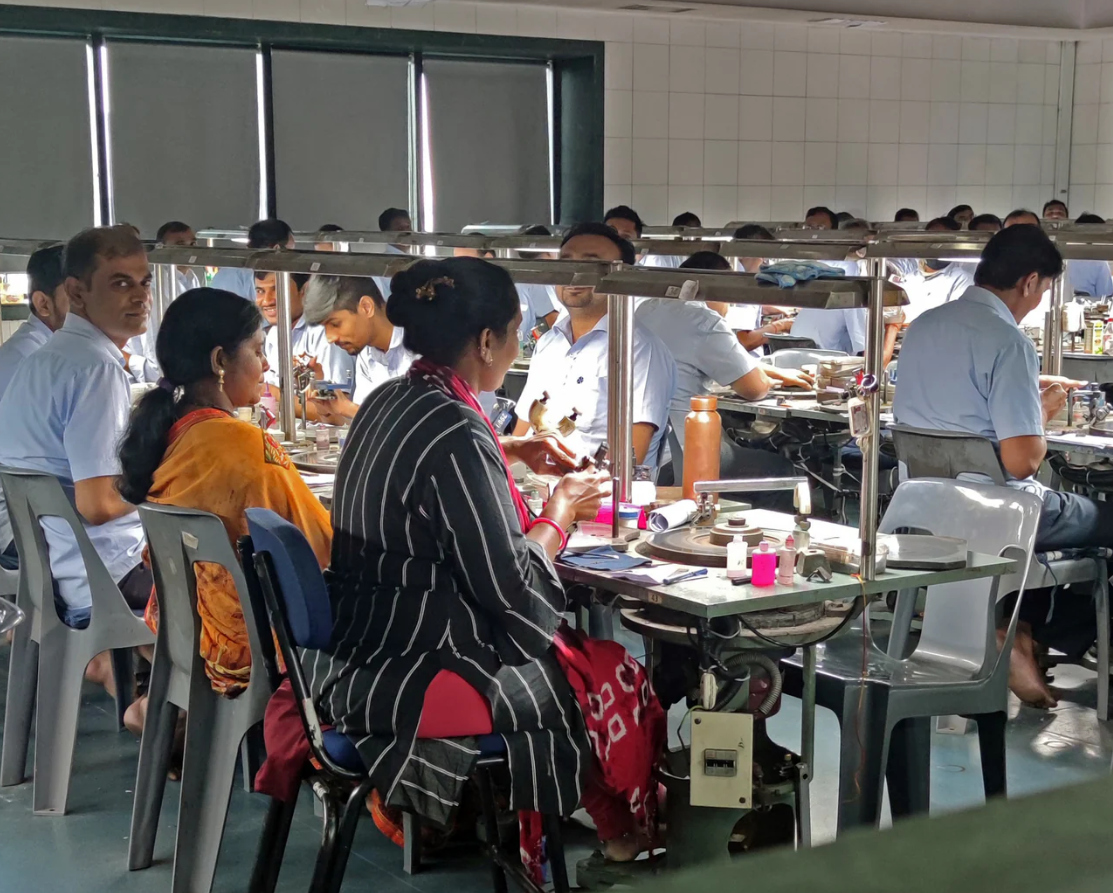
Surat, India, known as the global hub for diamond cutting and polishing, a ‘Diamond City’ that even opened the world’s largest diamond exchange building at the end of 2023, has now turned into a city of despair with diamond factories closing one after another, overflowing with unemployed workers. Heartbreaking news continues that 71 unemployed diamond workers have committed suicide in the past 18 months.
The falling diamond has even changed a regime. In the Botswana general election held last October, the ruling party suffered a crushing defeat, falling to fourth place. It was a humiliating defeat for the party that had been in power for 58 years since independence in 1966 and a surprising political turning point. Botswana, which had been considered one of Africa’s most prosperous and stable countries thanks to its vast diamond deposits, saw its unemployment rate soar to 27% due to the slump in the diamond market, and the regime was judged.
From 2021 to early 2022, the diamond market was booming. This was due to the ‘revenge spending’ craze right after the pandemic and postponed weddings being held all at once. In retrospect, it was a moment like a final flame. Suddenly, the party was over, leaving only chaotic debris: the effectively dead Chinese market and lab-grown diamonds priced at one-tenth of natural diamonds.
The collapse of the Chinese diamond market is astonishing. Diamond market analyst Paul Zimnisky analyzed that Chinese demand may have fallen by up to 50% last year. China lost its position as the world’s second-largest diamond buyer (first is the US), which it had maintained for the previous decade, to India last year.
What happened in China? Various analyses pour in, citing economic slowdown, consumption slump, and declining marriages. As Chinese wallets thinned, they became more practical. The impact of the number of marriages falling to a 45-year low (6.106 million) was significant. Simultaneously, the Chinese Communist Party’s crackdown on ‘showing off wealth content’ also plays a part. Last year, following instructions from Chinese authorities, social media companies took down content that ‘flaunted wealth and worshipped money’ and closed accounts. This poured cold water on already cooling consumer sentiment.
Most importantly, Chinese consumers have seen diamond prices fall over the past few years. Just as they avoid the sharply falling Chinese real estate market, they are also avoiding diamond purchases. It’s a typical sign of a bursting bubble. Instead, it is said that young Chinese are now enthusiastic about buying gold as an investment with store-of-value properties.
Cycles of boom and bust are familiar to the diamond market. Recently, it weathered the 2020 pandemic and the 2008 financial crisis. Historically, it endured the dark times of the Great Depression and war in the 1930s, shortly after the first diamond mine was discovered in South Africa in 1867. Diamond prices periodically crashed but soon drew an upward curve as if nothing had happened. After the slump passed, new wealthy individuals emerged again, and the sparkling diamond exuded charm to them.
In that sense, the collapse of the Chinese market is an obvious risk, but it’s something that can happen. Other rising countries, such as India or the United Arab Emirates, will fill that position. The bigger problem weighing on the industry is something else: the onslaught of lab-grown diamonds.
It was in 1953 that a Swedish laboratory first synthesized a diamond. It has only been about a decade since lab-grown diamonds, used only for industrial purposes for decades, have taken a place in jewelry due to technological advancements. Even experts cannot distinguish by eye what is natural and what is synthetic. They are not ‘fake’ diamonds because their chemical composition and physical properties are completely identical to mined rough stones. The only difference is that the manufacturing period, which takes over a billion years in nature, is only 2-3 weeks in a lab.
Diamonds of the same quality but cheaper. Many jewelry brands were enthusiastic about this game-changer. Even De Beers jumped into this market. While brands like Rolex still insist on only natural diamonds, luxury watch brands like Breitling have already switched 100% to synthetic diamonds. The share of synthetic products in the total diamond jewelry market was zero as recently as 2015, but it is now estimated to have grown to about 20%.
Of course, equipment that can distinguish whether a diamond is natural or synthetic in seconds is already available. And no matter how identical they look, they are distinctly different products. De Beers CEO Al Cook recently appeared on Bloomberg TV and said:
But no matter how distinct they are from natural stones, if the price difference is about tenfold, wouldn’t it be an attractive option for consumers? This is exactly what’s happening recently. When synthetic diamonds were first introduced to the jewelry market in 2015, they were priced at about 90% of natural products. Over the past few years, due to technological advancements and a surge in supply (mainly from China), prices have plummeted, and wholesale prices have already fallen to 5-10% of natural diamonds. However, retail prices are not that low, staying at about a quarter of natural diamonds. This means retailers are taking enormous margins on synthetic diamonds.
So, what kind of paradigm shift will this onslaught of cheap synthetic diamonds cause? Consulting firm McKinsey presented two scenarios in a report last year.
Scenario 1: If the current situation continues?
Synthetic diamonds will eventually become mainstream. Most people will choose cheaper synthetic diamonds of the same quality or larger synthetic diamonds for the same price. However, the niche high-end market will go separately. Natural diamonds will become a status symbol, like collecting classic cars or high-end vintage items. For companies like De Beers, this means the market shrinks, which is quite a gloomy story. If someone already owns a natural diamond ring, they might even be pleased. If they keep it well, it might become a family heirloom passed down through generations.
Scenario 2: If synthetic diamond prices fall much more drastically?
Martin Rapaport, chairman of the Rapaport Group, a prominent figure in the diamond industry, told The Economist: