Editor’s Note
The diamond industry in Surat, a global hub for cutting and polishing, faces significant uncertainty due to new U.S. tariffs. This report examines the potential impact on traders and the livelihoods of millions of workers.
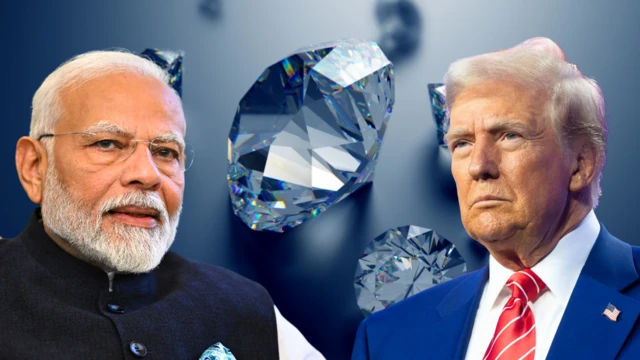
Traders in the diamond industry in Surat, Gujarat, are worried due to the tariffs imposed by US President Donald Trump.
Surat is known worldwide for diamond cutting and polishing, but now the people dependent on this industry are in trouble.
The 50% tariff imposed by the US has put traders in this region, as well as laborers, in a state of anxiety. More than 2.5 million workers associated with the diamond industry could be affected.
The impact of the US imposing a 50% tariff on India is being felt most in this region because Surat’s diamond industry relies on exports to the US.
Some people believe that if the tariff is not reduced, many traders will exit the diamond industry, many people will lose their jobs, and a severe recession will set in.
However, on the other hand, organizations associated with the diamond industry, such as the Surat Diamond Association and the South Gujarat Chamber of Commerce, believe that the US tariff will cause some slowdown, but the situation will stabilize over time.
They say that just as India needs the diamond industry, there is also a similar demand for diamonds in the US. Therefore, people and traders there also want a solution to this problem.
Traffic jams caused by two-wheelers are common in Surat’s markets in the morning and evening because diamond artisans are either going to work or returning from work at that time.
Many small factories in the city employ between 20 and 200 workers. In many factories, the number of workers goes up to 500. There are thousands of such factories in Surat.
In a diamond polishing unit located in Katargam, Surat, dust has settled on the tables, and the wheels used for polishing diamonds have not been used for several days.

Only six people are working in the empty rows of tables.
This is the situation in many small and large factories in Surat.
Twenty years ago, Shailesh Mangukiya started a diamond polishing unit with just one polishing wheel.
Gradually, the business grew, and the number of workers in the factory increased from three to 300. However, now only 70 people remain in his factory.
Speaking to BBC Gujarati, he said:
Last August, an average of two thousand diamonds were being processed every month in his factory, but this August, that number has dropped to just 300. Mangukiya fears that if this situation continues, the factory will have to be closed soon.
The recession caused by the tariffs has started to directly affect the workers.
Speaking to BBC Gujarati, worker Suresh Rathod said:

There are many artisans like Suresh Rathod who are being affected in this way.
At the office of Bhavesh Tank, Vice President of the Surat Diamond Polishers Union, many jewelers are currently coming with complaints that their salaries have been cut or they will be fired.
Speaking to BBC Gujarati, he said:
According to him, many factories had already shipped goods quickly before August 1st, which is why new orders are not coming now. The income of thousands of laborers is decreasing.
Exporters are also surrounded by uncertainties. Industry leaders have formed a Special Diamond Task Force, which will try to find a solution to this situation.
Nikhil Madraswala, President of the South Gujarat Chamber of Commerce and Industry, spoke to BBC Gujarati about this.
He says:
He said that many traders are looking for opportunities in markets like the Middle East and Europe, and some are even trying to send goods to the US via ‘bypass routes’.
However, according to him, there is now a need to search for new markets in different European countries.