Editor’s Note
This article highlights Richemont’s strong quarterly performance, driven by its core jewelry business, which has propelled it to the top of its sector in stock market gains this year. It marks a significant turnaround for the group, which was once considered a potential acquisition target.

The Swiss company once again delivered results exceeding expectations for the quarter from January to March, supported by 11% growth in jewelry, its core business. The Swiss group has achieved the best stock market performance in the sector since January 1st.
While the luxury sector is struggling, Richemont is taking its revenge. Once in a difficult position, the Swiss group was regularly cited in press articles as a potential target for Kering or LVMH.
The Swiss company now shows much better form than the two aforementioned French groups. This is largely due to the positioning of the owner of brands Van Cleef & Arpels and Cartier.
Richemont is a specialist in “hard luxury” (jewelry, watchmaking) as opposed to “soft luxury” (fashion, leather goods). As Deutsche Bank noted in April, this category of luxury products is less penalized than others by the disappearance of the so-called “aspirational” clientele, which is less wealthy than more traditional buyers and tends to opt for less expensive items.
Furthermore, “hard luxury” has more “pricing power,” notes HSBC.
explained the Sino-British bank in a recent note.
The icing on the cake: the CEO, Nicolas Bos. Arriving last year, this leader “blends creativity and executional rigor,” praises HSBC.
adds the bank.
All these strengths lead Richemont to achieve the best stock market performance among major luxury players this year.
Since January 1, 2025, Richemont has gained 20.3%, a performance much better than those of LVMH (-20.2%), Kering (-26%), Burberry (+0.7%), Salvatore Ferragamo (-11%), Prada (-10.5%), or Brunello Cucinelli (+5.8%). Even Hermès, the quintessential safe-haven luxury stock, often considered the sector’s top performer, is beaten (+12%).
The results published by Richemont this Friday, May 16, for the quarter from January to the end of March and its 2024-2025 fiscal year only confirm its good health.
For the last three months of its fiscal year ending in March, Richemont achieved revenue growth of 8% in reported figures and 7% at constant exchange rates and on a comparable basis, to 5.172 billion euros. For comparison, only Hermès recorded stronger growth than the Swiss group in luxury this quarter, and only by a hair (+7.2% at constant exchange rates).
Richemont was mainly driven by its main division, jewelry (72% of revenue), where growth reached 11% at constant exchange rates.
The Swiss group exceeded expectations, both in its overall growth and in jewelry. According to a consensus cited by Royal Bank of Canada, analysts had expected revenue growth of 6% at constant exchange rates and 9% for the jewelry division alone.
emphasizes Deutsche Bank. The “relative performance” of Richemont is thus “impressive,” appreciates the German bank.
For its entire 2024-2025 fiscal year, Richemont recorded growth of 4% at constant exchange rates, to 21.4 billion euros. The company generated a gross margin of 14.3 billion euros, representing 66.9% of revenue. Operating profit fell by 7% to 4.47 billion euros while the corresponding margin fell by 2.4 percentage points to 20.9%.
The company’s margins were penalized by negative currency effects and increases in raw material costs, such as gold.
Net profit increased by 16% to 2.75 billion euros. This latter improvement is explained by lower losses incurred on Yoox-Net-à-Porter, a distribution company whose sale Richemont finalized just after the close of its fiscal year, in April.
wrote Royal Bank of Canada in a note written before the market opening.
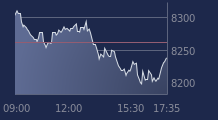
This is indeed (still) the case. The stock jumped 6.7% by late morning on the Zurich Stock Exchange.