Editor’s Note
This article explores the unique challenges in valuing colored gemstones, highlighting the absence of universal standards compared to diamonds and the resulting market complexities.

1. Lack of Unified Standards, Reliance on Appraiser’s ‘Eye’
Unlike diamonds, which have the globally recognized “4C” (Carat, Cut, Color, Clarity) standards facilitating market pricing, colored stones like emeralds and rubies lack absolute benchmarks. Their value can vary by hundreds of times based on factors like “color depth,” “origin (e.g., Colombian vs. Zambian),” and “treatment status (e.g., oiling, heating).” Consequently, many general appraisal shops, lacking advanced expertise, often only offer prices based on the “precious metal value (of the setting’s gold or platinum)” to avoid risk.
2. Leveraging Pearl Specialty Expertise
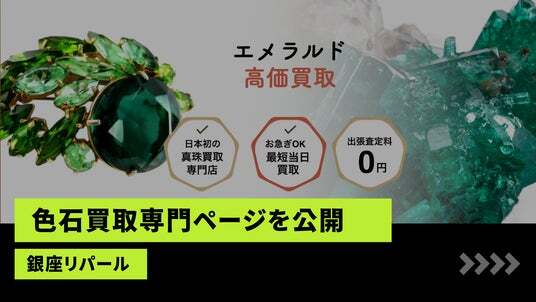
Ginza RePearl has specialized in pearls, which are known for significant individual variation and appraisal difficulty within the gemstone world. The appraiser’s skill in discerning a pearl’s value through its “interference color (deep hue)” and “luster” is directly applicable to evaluating the “hue, saturation, and luster” of colored stones. Capitalizing on this technical affinity, the company has established a dedicated page to formally strengthen its appraisal services for colored stone items, which are often brought in alongside pearls.
1. Disclosing ‘Evaluation Points’ and ‘Market Prices by Origin’ for Each Gemstone
The newly launched “Emerald Page,” for example, details how prices differ by origin (e.g., Colombian, Muzo mine) and how emerald-specific inclusions affect value. By making these often opaque appraisal criteria transparent, the information is organized to help customers understand “why this price is offered.”

2. Properly Appraising Items ‘Without Identification Certificates’ and ‘Design Value’
For older jewelry, identification certificates (gemstone IDs) are often lost. At RePearl, experienced appraisers can determine a stone’s authenticity and quality with just a loupe, so the lack of a certificate does not lead to price reductions. Additionally, beyond the stone’s intrinsic value, the “design” and “brand value” of the jewelry are also considered for a positive appraisal (design premium).
3. Handling Side Stones (Melee Diamonds) and Damaged Stones
Not only the main colored stone but also the surrounding small decorative diamonds (melee) are carefully appraised one by one. Furthermore, even if a product is incomplete, such as a ring with a missing stone or a deformed setting, the company extracts and purchases the value of the stone itself.