Editor’s Note
This article discusses the market impact of new US tariffs on gold bullion, which have triggered price volatility and concerns over global trade realignment. The headline has been updated for clarity.

The imposition of US tariffs on gold bullion has unleashed new turmoil in the market, with prices rising in New York as traders anticipate a significant reshuffling of global trade flows.
The US Customs and Border Protection (CBP) clarified that one-kilogram and 100-ounce gold bullion bars are subject to the reciprocal tariffs from the Trump era, and are not exempt as the industry initially believed, according to a letter obtained by Bloomberg. The decision was first reported by the Financial Times.
Gold futures in New York, backed by those forms of bullion, soared to a record high, leaving traders, analysts, and executives across the sector stunned. The measure could disrupt shipments from Switzerland and other key trading and refining hubs like Hong Kong and London, where prices are already trading at a steep discount compared to the US market.
Traders and analysts are trying to understand the scope and consequences of the decision, including whether CBP will treat the larger 400-ounce bullion bars that underpin London trade the same way, and what the levies will be for major gold-producing countries. The potential consequences for the market are so profound that some wondered if it could be a CBP mistake and suggested it could face legal challenges.
The decision came in response to an inquiry from a Swiss refinery, key to the smooth functioning of the global market. If prices in London and New York diverge, Swiss refineries can melt down the larger bullion bars traded in the British capital to deliver under US futures contracts, and vice versa.
Monthly US gold imports reached a peak of 43 tons in January of this year as traders rushed to ship the metal ahead of potential tariff imposition. US gold refineries produced an average of 22 tons per month last year, according to US Geological Survey data.
Traders had expected one-kilogram and 100-ounce bullion bars to be exempt from Trump’s tariffs, including the surprising 39% rate applied to Switzerland. However, in the letter sent on July 31, CBP clarified that these products are classified under customs codes covering semi-finished products subject to levies.
The Trump administration created confusion by establishing a complex web of import tariffs, with diverse motives and variable rates. Last month, US copper futures plummeted after the White House unexpectedly exempted refined metal, the most traded product, from a 50% tax.
Executives at two major Asian gold refineries, who did not wish to be named while dealing with sensitive information, stated they are suspending shipments to the US until there is more clarity.
One-kilogram bars are the most traded on Comex, the world’s largest gold futures market, and constitute the bulk of Switzerland’s bullion exports to the US.
Gold exports have become a point of friction in negotiations with the US, following increased shipments earlier this year that widened the US trade deficit with Switzerland.
The tax could worsen the problems for Swiss President Karin Keller-Sutter, after Trump imposed the highest tariff on Switzerland for a developed country. Keller-Sutter made an emergency trip to Washington on Thursday to influence the White House but left empty-handed after being denied a meeting with Trump.
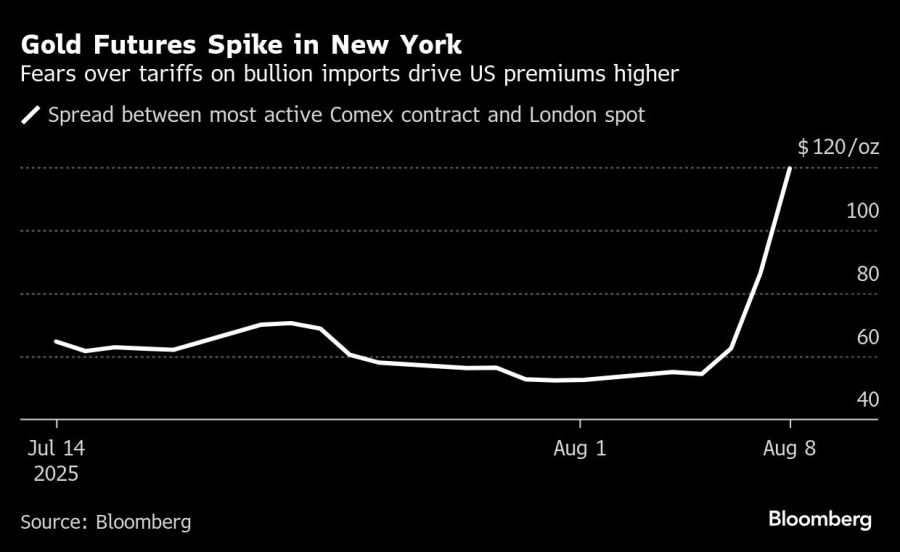
The new controversy adds to a turbulent year for gold and on Friday raised the premium for New York futures over international prices. December delivery contracts rose to a premium of more than $100 per ounce above the global benchmark for spot prices in London, as investors bet that tariffs will curb imports.
Imports and exports of all countries are classified using a complex system of codes used to establish the scope of any tax.