Editor’s Note
This article examines the Supreme Court’s recent scrutiny of tariffs imposed during the Trump administration, highlighting a legal challenge with significant potential implications for trade policy and executive power.
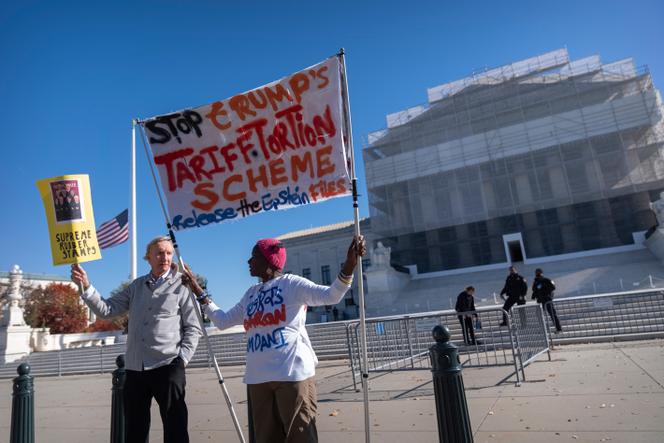
Supreme Court justices on Wednesday, November 5, cast doubt on the legality of tariffs implemented by President Donald Trump, a move that could shake a cornerstone of his economic and diplomatic policy. The hearing, which lasted nearly three hours, took place exactly one year after the election that returned the Republican to the White House, from where he launched an unprecedented protectionist offensive through tariffs.
These taxes on imported goods generate billions of dollars in revenue and have wrested promises of investment and more favorable conditions for American exporters from U.S. partners. The government is keen to prevent this structure from collapsing and is urging the nine Supreme Court justices – six conservatives and three progressives – to uphold them. The Court’s decision could be delivered relatively quickly, perhaps within several months.
The government is throwing its full weight into the battle to maintain these tariffs, which Donald Trump asserted on Tuesday were a
Treasury Secretary Scott Bessent was present at the hearing, an Agence France-Presse journalist noted.
Arguing on behalf of the executive branch, legal counsel John Sauer laid out his arguments at full speed. He notably contended that repealing the tariffs
from other countries.
Several justices expressed skepticism, particularly regarding the use of the 1977 International Emergency Economic Powers Act (IEEPA), invoked by the Republican president to unilaterally decree several rounds of tariffs on the grounds that the U.S. trade deficit, though chronic for decades, constituted a
He thus arrogated the power to increase or reduce them at his discretion.
But this law does not mention the power to impose tariffs, only the power to
stated progressive Justice Sonia Sotomayor.
Conservative Chief Justice John Roberts observed that the IEEPA text
noting that this seemed to confer
on the president.
Since his return to the White House in January, the head of state has made tariffs a major lever of his economic and diplomatic policy. He boasts that through this pressure tactic, he can not only reindustrialize the country and reduce its chronic trade deficit but also – by imposing taxes on Mexico, Canada, and China – curb the fentanyl crisis, a powerful opioid that kills tens of thousands of Americans from overdose each year.
Before the case reached the Supreme Court, several federal courts had declared these tariffs – distinct from those targeting specific sectors like automobiles or steel – illegal. They nevertheless remained in effect pending a ruling from the nation’s highest court.
Small business owners and Democratic states brought the case to court, arguing that the president could not thus encroach on Congress’s prerogatives to impose taxes affecting the lives of both businesses and American consumers.
The twelve involved Democratic states pointed out,
exhorting the Court not to allow him to
Businesses’ attorney, Neal Katyal, argued,
He expressed particular surprise that Swiss products were subject to a 39% surcharge.
Justice Samuel Alito, appointed by a Republican president, questioned,
allow the U.S. president
The Court must also rule on other questions concerning the extent of presidential powers, particularly regarding the removal of heads of independent agencies, especially at the Federal Reserve (Fed, central bank).