Editor’s Note
Recent U.S. employment data has shifted market expectations, suggesting a potential delay and reduction in the scope of Federal Reserve rate cuts. While a pause in December is possible, analysts caution this would not necessarily signal the end of the easing cycle.

The employment data adds pressure to the Fed: the market delays the rate cut and reduces its scope. The institution could pause in December, a move that would not imply the end of the rate-cutting cycle.
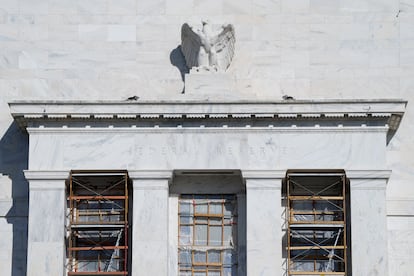
The headquarters of the Federal Reserve in Washington, currently under construction. Elizabeth Frantz (REUTERS)
Gema Escribano
Madrid –
21 Nov 2025 – 05:30 CET
The statistical machinery of the U.S. government is starting up again after the shutdown, but the return to normality will be slower than markets would like. After a month and a half without key references to gauge the economy’s pulse, managers are following each data point with a mix of impatience and nervousness. The September employment report—which should have been published on October 3—has not helped to clear up doubts either. Besides offering outdated data, it presents contradictory signals: although 119,000 jobs were created, exceeding the 51,000 forecast, this is the lowest figure for a September since the pandemic. At the same time, the unemployment rate rose to 4.4%, its highest level since October 2021.
Faced with these seemingly discrepant signals, federal funds futures (benchmark interest rates in the U.S.) experienced strong fluctuations within minutes. First, they focused on employment, then on unemployment: the probability of a cut in December fell below 30% to stabilize at 40%. In any case, far from the 98.8% estimated a month ago, when the third reduction of the year was taken for granted, a move that also explains the worst tone in the stock markets.
Adding to this uncertainty is the limitation of available data. The Department of Labor canceled the October payroll report, so we will have to wait for the November data, which will be known on December 16, six days after the Fed meeting. Thus, the institution will only have the September figures to make decisions. These data, besides being outdated, are resilient enough to tip the balance in favor of keeping rates unchanged. The market is preparing for the next reduction in the price of money to come, at the earliest, at the January meeting.
But the scope is limited: federal funds futures give a 50% probability to a cut at the start of the year but do not contemplate additional reductions in their main scenario.
Other economic signals add nuances to the outlook.
Just a few weeks ago, when fears of a greater economic cooling gained strength, analysts at the Dutch bank anticipated a cut by the end of the year and two more in the first meetings of the next year.
Analysts at MUFG believe that if the Fed omits the cut next December 10, it would be a temporary pause and not the end of the rate-cutting cycle. The minutes of the last meeting showed that, although several members warned about inflationary pressures, the majority considered it appropriate to continue monetary easing in the long term. This nuance reinforces the idea that, in the short term, prudence will continue to guide monetary policy. Unlike the ECB, focused solely on price stability, the Fed has a dual mandate: contain inflation and ensure the health of the labor market.
A hasty rate cut could be counterproductive for price stability, but inaction also has risks. Besides further slowing economic growth in an environment of tariffs and restrictions, it could trigger a shock in the markets. In recent months, the frenzy over artificial intelligence, the strength of corporate results, and expectations of lower rates have helped prolong the party in the stock markets. Investors will have to continue monitoring economic indicators to gauge the Fed’s strategy.
In this context of statistical uncertainty, trade tensions, and mixed economic signals, the central bank’s room for maneuver is narrowing. Until the flow of data normalizes, the market will set the pace, attentive to every figure to anticipate whether the December pause will be a mere parenthesis or the prelude to a more demanding 2026. Making forecasts for next year also seems complicated. Fed Chairman Jerome Powell has resisted pressures from the White House, but his term expires in May. The central bank’s caution in lowering rates has served as an anchor of financial stability amid political noise and information scarcity.