Editor’s Note
Recent breakthroughs in materials science have yielded a synthetic diamond that surpasses natural diamond in hardness, challenging long-held assumptions and potentially reshaping the diamond industry. This article explores the implications of this scientific leap.
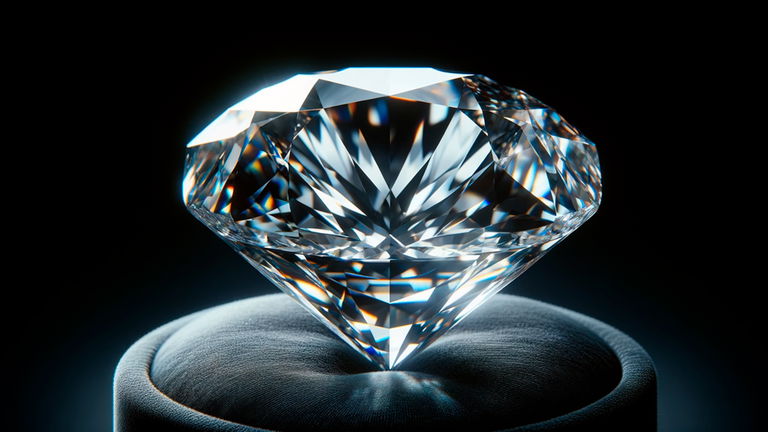
Until now, natural diamond was considered the hardest known material on our planet, although an even harder one has been found in space. On Earth, it remains unsurpassed by any other natural or synthetic substance. However, recent scientific advances have just taken an unexpected 180-degree turn on this belief, creating for the first time a synthetic diamond that surpasses natural diamond in hardness, thus potentially disrupting the diamond market from now on. Researchers have succeeded in synthesizing a diamond with a hexagonal crystal structure, known as lonsdaleite, through a complex process involving high pressure and extreme temperatures. The industrial importance this could have is incredible, and although there were already radical ways to create diamonds, the truth is that the situation has improved exponentially thanks to this change.
The team of researchers behind this advance published their research in Nature Materials. They used graphite, another high-hardness material, as a starting point to synthesize this new type of diamond. Under extreme conditions, reaching temperatures above 1,500 °C and intense pressures, they managed to form a diamond with a hexagonal internal structure, instead of the usual cubic one, resulting in a truly substantial increase in hardness and thermal stability compared to natural diamond.
Therefore, one can only rejoice at the technological leap these scientists have achieved by building their own diamonds with record-breaking hardness.
For decades, natural diamonds have been unbeatable in terms of hardness, reaching about 110 gigapascals (GPa). However, this synthetic hexagonal diamond clearly breaks the existing barrier, registering a resistance of up to 155 GPa, according to the tests performed. This represents a crucial advance, confirming that the creation of ultra-hard materials is at an inflection point that can revolutionize everything.
Diamond, beyond its obvious aesthetic appeal for use in jewelry, is crucial in various industrial applications due to its extreme hardness and ability to withstand high temperatures. It is frequently used in cutting tools, drill bits, specialized machinery, and even for advanced data storage.
The improvement in mechanical and thermal properties offered by this new synthetic diamond could open the door to even more demanding and specialized industrial applications, but without depending on a scarce product whose capacity to find natural diamonds is very difficult because there are no specific techniques—except for some novel ones—to find them.
In short, although more work is needed to produce these hexagonal diamonds on a large scale, this scientific discovery marks a before and after in the creation of super-resistant synthetic materials. The development opportunities from now on will be very powerful and allow us to dream of different uses that were impossible until now, such as the moment when they managed to fuse graphene with diamonds.