Editor’s Note
The rise of lab-grown diamonds, chemically identical to their mined counterparts, is reshaping the gemstone market. This article explores the economic and environmental implications of this technological shift, challenging long-held perceptions of value and luxury.
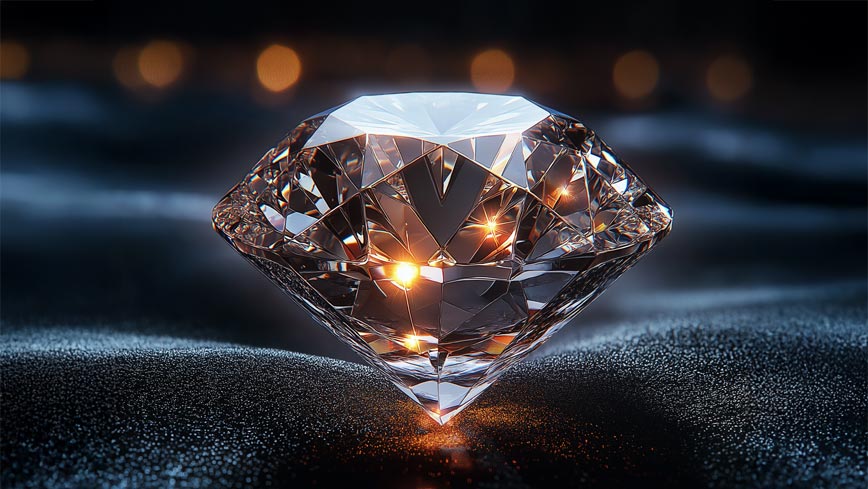
On one side, nature. It takes millions of years to bring a diamond to the surface. Its extraction is costly and causes lasting damage to the environment. On the other side, humans, capable of producing it in a laboratory in a few weeks, at a lower cost and with reduced environmental consequences. And we are not talking about pale imitations. Synthetic diamonds have the same carbon structure as natural diamonds and are indistinguishable from them to the naked eye, even for specialists. Created in 1954 by the American company General Electric, synthetic diamond production was initially intended for industrial use before truly taking off from the 2010s onwards, driven by technological advances.
Now, these lab-grown stones are no longer confined to industry: they have forcefully entered the jewelry market. At first glance, for traditional players, there is no immediate danger. The production of mined diamonds stands at about 110 million carats, while that of synthetic diamonds fluctuates between 6 and 7 million, barely 6% of the market, but this is a constantly rising figure.

The consequences are twofold. Price! Unlike gold, diamonds do not have a unified reference price. Their value is based on four criteria, the 4 Cs: cut, clarity, color, and carat weight. As a result, a natural one-carat diamond sells for between 2,000 and 25,000 euros depending on its quality. A lab-grown diamond sells for between 800 and 2,500 euros, representing a price difference of 60 to 90%. This more affordable alternative exerts direct pressure on the prices of natural diamonds. Since 2016, they have lost more than 9% of their value and their production is declining. It’s not a collapse, but the blow is severe for the traditional market.
So, why not more? Because the massive arrival of lab-grown diamonds has opened new horizons. In jewelry, it’s the famous engagement ring. In India, the world’s most populous country, demand has shifted towards diamonds, which have become the most popular choice. But this is also the case elsewhere. Diamonds have also strengthened their uses. Their exceptional properties – hardness, thermal conductivity – make them a key material for industry: cutting tools, abrasive wheels, high-end electronics… Synthetic diamonds are becoming dominant. They are even finding their place in biotechnology and medicine, notably as semiconductors or for high-precision medical applications. Therefore, cultured diamonds are, in part, still a complementary rather than a competitive offering, but for how long? The movement is underway.

Above all, this transformation is redrawing the geography of supply. Except for Canada and Russia, the supply of natural diamonds is almost exclusively in Africa: Botswana, Angola, Democratic Republic of Congo, South Africa, Namibia. It is a vital source of activity, jobs, and foreign exchange, even though, let’s not be naive, it is often a source of corruption. In Botswana, diamond sales represent 80% of exports, 50% of government revenue, and 30% of GDP. The development of lab-grown diamonds is a catastrophe for all these often fragile countries, because the supply of synthetic diamonds is located elsewhere, in China, the United States, India, closer to the demand.