Editor’s Note
This article explores how blockchain technology, specifically through an Ethereum-based network, can enhance transparency and trust in the jewelry supply chain by providing a secure, immutable ledger to combat fraud and inefficiency.

This article examines the potential of blockchain technology to revolutionize the jewelry supply chain by enhancing trust, transparency, and efficiency. Utilizing Ethereum, we developed a blockchain network tailored to the industry’s needs. Blockchain operates as a secure, immutable ledger, ensuring data integrity and transparency while preventing fraud and tampering due to its decentralized nature. Ethereum’s key features, including nodes, addresses, and smart contracts, make it an ideal platform for this application. The system incorporates robust security measures, addressing vulnerabilities such as reentrancy attacks and unauthorized access. Performance tests on networks demonstrated the solution’s viability, with Layer 2 optimizations reducing transaction costs. The system also uses IPFS (InterPlanetary File System) to store certificate templates in order to improve scalability and data accessibility. Six primary participants in the supply chain, from miners to customers, engage with the blockchain, ensuring full traceability and transparency. Certificates are dynamically generated by retrieving transaction hashes from the blockchain. The certificate template is stored on the InterPlanetary File System (IPFS), and when needed, the relevant data is populated into the template in real-time to produce the certificate. While challenges remain in terms of industry-wide adoption and regulatory compliance, the solution’s potential to enhance transparency and efficiency positions it as a significant advancement for the jewelry supply chain within the Industry 4.0 framework.
The jewelry supply chain is a complex network, spanning the globe from raw material extraction to the hands of consumers. It involves numerous steps, from mining precious metals and gemstones to crafting exquisite jewelry. Intermediaries like wholesalers and retailers play roles in distributing these products. The industry’s complexities arise from the unique properties of gemstones and metals, complex designs, and the involvement of various craftsmen. Global operations introduce geographical challenges, requiring extensive supply networks and adherence to diverse laws and ethical standards.

This complex process demands precision at every level to meet modern customer expectations for authenticity, quality, and ethical sourcing. Addressing challenges like fraud, transparency, and counterfeiting is crucial, emphasizing the need for a robust system in the jewelry supply chain.

This work is motivated by the challenges faced by the jewelry industry and rise of Industry 4.0. The introduction of blockchain technology becomes imperative as it serves as a cornerstone for the transformation towards a more connected and technologically advanced industry. As an innovative solution, blockchain promises to revolutionize the jewelry sector by establishing a secure and transparent digital ledger. This not only verifies the authenticity of jewelry and traces the origin of materials but also aligns with the principles of Industry 4.0 by promoting data-driven decision-making and supply chain transparency.
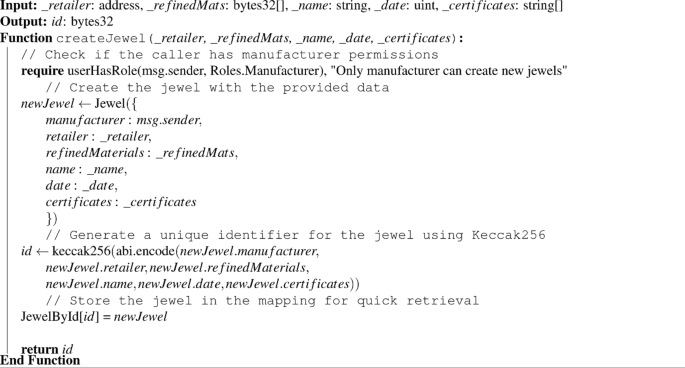
The decentralized nature of blockchain minimizes the risk of fraud, ensuring the reliability and tamper-proof nature of information- a crucial step towards realizing the vision of Industry 4.0 within the jewelry supply chain. In essence, integrating blockchain aligns the industry with the values of Industry 4.0, creating a more transparent, trustworthy, and efficient system that meets the expectations of both businesses and consumers in this digital transformation.
Several researchers have explored the use of blockchain technology, to create a secure and distributed ledger that enhances data transparency and security. Abeyratne et al. proposed a blockchain system concept to improve manufacturing supply chain transparency, traceability, and process integrity. The potential advantages of blockchain in addressing trust and transparency concerns, lowering operational expenses, and facilitating effective collaboration among supply chain partners have been discussed. However this system has certain limitations in terms of the extent to which they enhance the visibility of supply chains, the level of detail in the data they capture, the level of engagement they facilitate with stakeholders, and their ability to integrate with existing processes and systems.