Editor’s Note
This article outlines the projected growth of the Boron Doped Diamond Electrode market, which is forecast to expand significantly from 2026 to 2035. The data and analysis presented are based on industry reports and market research.
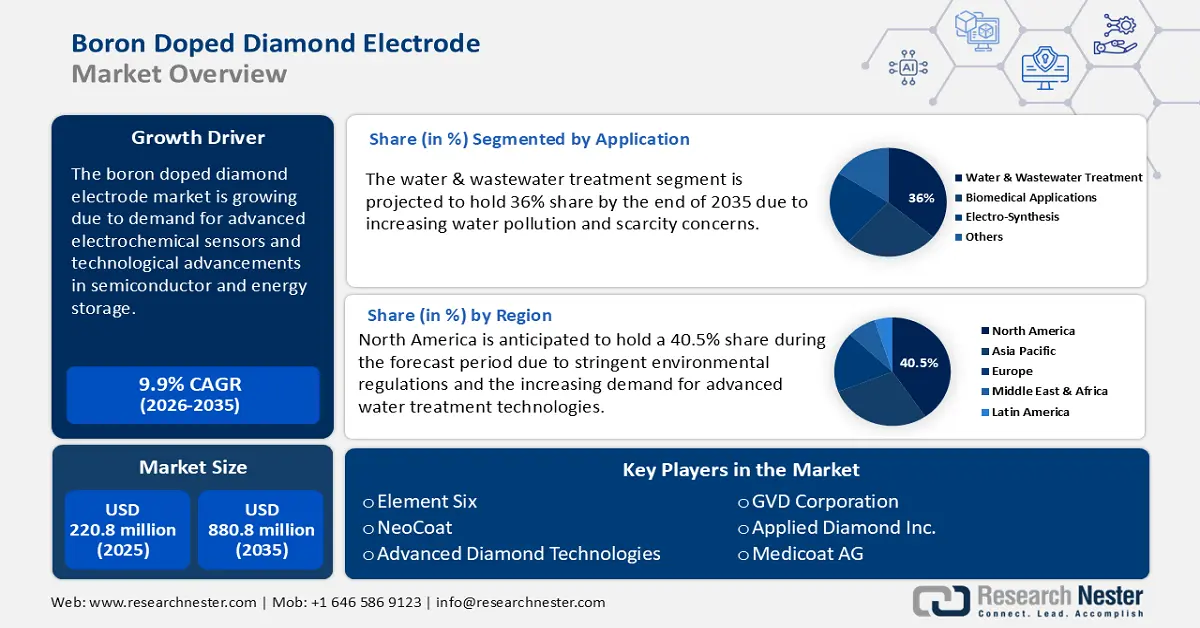
The Boron Doped Diamond Electrode market was valued at USD 220.8 million in 2025 and is expected to reach USD 880.8 million by the end of 2035, growing at a CAGR of 9.9% during the forecast period from 2026 to 2035. The size of the boron doped diamond electrode industry in 2026 is estimated to be USD 290.9 million.
The global boron doped diamond electrode market is characterized by a multifaceted and complex supply chain consisting of ultra-high purity carbon substrates, boron sources, and procurement of advanced chemical vapor deposition (CVD) systems. Japan leads the commercialization of CVD diamond technology, driven by significant public and private sector investments aimed at technological advancement. From January to November 2023, China’s water conservation projects created 2.6 million jobs, a 9.1% increase year-on-year, of which 2.1 million were rural workers. Wages totaled CNY 50.5 billion, with CNY 38.1 billion paid in rural areas. This sector completed 17,881 rural water resource projects, benefiting 82.1 million residents, and over CNY 4 billion was used to maintain 98,800 existing rural projects. In the United States, the Department of Energy (DOE) has classified specific critical materials essential for renewable energy innovation, some of which may be related to components used in BDD electrode manufacturing.
Technologically, boron doped diamond electrodes are widely utilized in the environmental sector, particularly for degrading persistent pollutants such as per- and polyfluoroalkyl substances (PFAS). With 100 low-carbon treatment facilities expected to be constructed by 2025, the recommendations of this plan in January 2024 combine wastewater treatment with carbon emission control. The plan also includes improving and expanding 45,000 km of wastewater treatment networks and adding 12 million cubic meters per day of wastewater treatment capacity. While precise Producer Price Index and Consumer Price Index data are lacking, the industry is focusing on improving cost-effectiveness and scalability, reflecting a trend towards more affordable and commercially viable BDD technology.
The boron doped diamond electrode market is witnessing remarkable growth driven by rising demand for high-performance electrochemical sensors in medical, environmental monitoring, and industrial wastewater treatment sectors. BDDEs offer excellent chemical inertness, a wide potential window, and low background current, making them suitable for precise detection in harsh environments. In environmental monitoring, BDDEs help identify trace pollutants to aid in regulatory compliance. In 2020, approximately 335,000 facilities were permitted, of which over 700 municipalities have combined sewer overflows, which can be a significant source of pollution during heavy rainfall.
Boron doped diamond electrodes, with their superior thermal and chemical stability, are widely used in semiconductor manufacturing, battery development, and fuel cell technologies. Companies like Element Six and Applied Diamond are integrating BDDEs into high-voltage electronic devices and electrochemical cells to enhance device efficiency and lifespan. The Indian semiconductor market was valued at approximately USD 38 billion in 2023 and is expected to grow to USD 109 billion by 2030. The government has approved the Semicon India program with a total investment of INR 76 trillion (approximately USD 1.2 trillion) to build a national semiconductor and display manufacturing ecosystem. Taiwan produces about 90% of the world’s most advanced semiconductors and over 60% of the global semiconductor output.
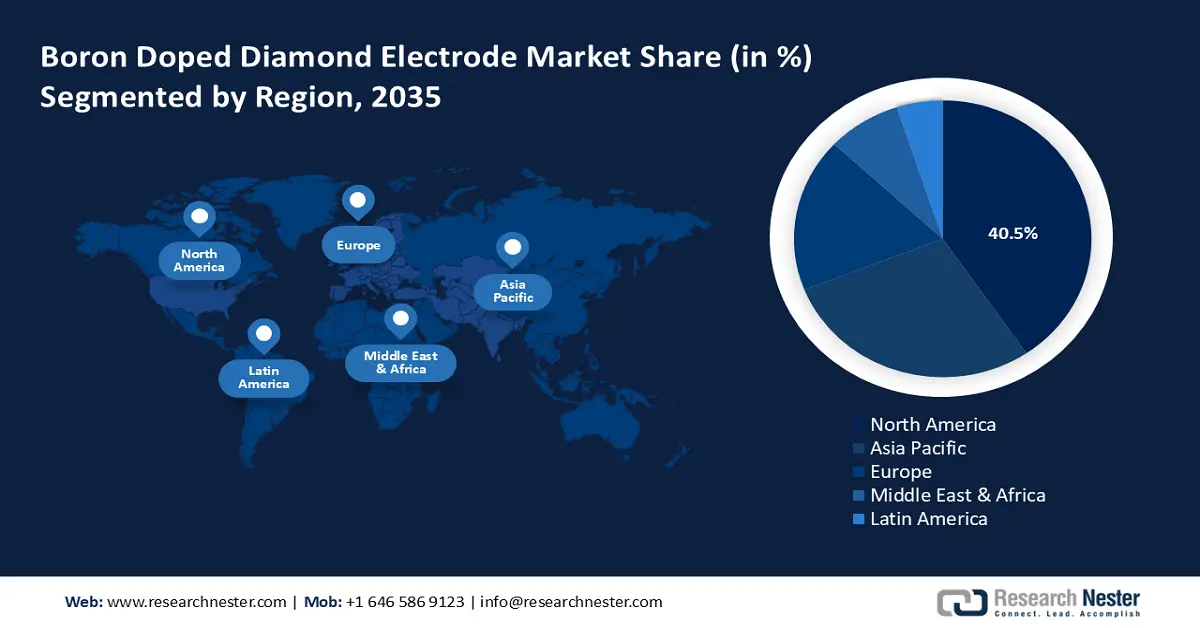
Globally, with the enforcement of stringent environmental standards, industries are compelled to adopt advanced solutions for pollution control and sustainable operations. BDDE-based solutions are preferred for chemical oxidation processes and electrolytic water purification systems. Programs like the historic Bipartisan Infrastructure Law (BIL) enacted in 2021 provide states nationwide with USD 11.7 billion in Drinking Water State Revolving Fund (DWSRF) to improve drinking water infrastructure and enhance disaster prevention capabilities. A total of USD 1.75 million in small-scale investments is being made to strengthen the resilience of drinking water systems. Large-scale infrastructure improvement projects (totaling USD 9.98 million in support) to enhance the resilience of drinking water systems are also being promoted. These regulatory enhancements ensure sustained demand for robust, efficient, and environmentally friendly electrode technologies.
Semiconductors enable the precise integration of boron into diamond, enhancing conductivity, electron transfer, and electrochemical stability for efficient sensing, water treatment, and advanced applications. India’s semiconductor market was approximately USD 38 billion in 2023 and is expected to grow to USD 45-50 billion in 2024-2025 and USD 100-110 billion by 2030.
| Date | Company | Location | Investment | Output Capacity |
|---|---|---|---|---|
| Jun 2023 | Micron Technology | Sanand, Gujarat | INR 2251.6 Cr | ATMP facility, phased ramp-up |
| Feb 2024 | Tata Electronics (TEPL) in collaboration with Taiwan’s Powerchip Semiconductor Manufacturing Corp (PSMC) | Dholera, Gujarat | INR 91000 Cr | 50,000 wafers/month |
| Feb 2024 | CG Power & Industrial Pvt Ltd in collaboration with Renesas & Stars | Sanand, Gujarat | INR 7600 Cr | 15 million chips/day |
| Feb 2024 | Tata Semiconductor Assembly and Test Pvt Ltd (TSAT) | Morigaon, Assam | INR 27000 Cr | 48 million chips/day |
| Sep 2024 | Kaynes Semicon Pvt Ltd | Sanand, Gujarat | INR 330.7 Cr | 6.33 million chips/day |
| May 2025 | HCL-Foxconn Joint Venture | Jewar, Uttar Pradesh | INR 3700 Cr | 20,000 wafers/month (36?M units/year) |
| Aug 2025 | SicSem Private Limited | Bhubaneswar, Odisha | INR 206.6 Cr | Annual production of 60,000 wafers, ATMP capacity: 96 million units/year |
| Aug 2025 | 3D Glass Solutions Inc. | Bhubaneswar, Odisha | ?1,943 credit | Glass panels: 70,000/year, ATMP: 50 million/year |
| Aug 2025 | CDIL (Continental Device) | Mohali, Punjab | ?117 credit | 158 million/year |
| Aug 2025 | ASIP (Advanced Systems in Package Technology) | Andhra Pradesh | ?468 credit | 96 million/year |