Editor’s Note
After a prolonged market downturn, the world’s leading auction houses are signaling a recovery. As this report details, both Sotheby’s and Christie’s project significant revenue growth for 2025, fueled by a strong New York season. This rebound suggests renewed confidence and activity in the high-end art market.
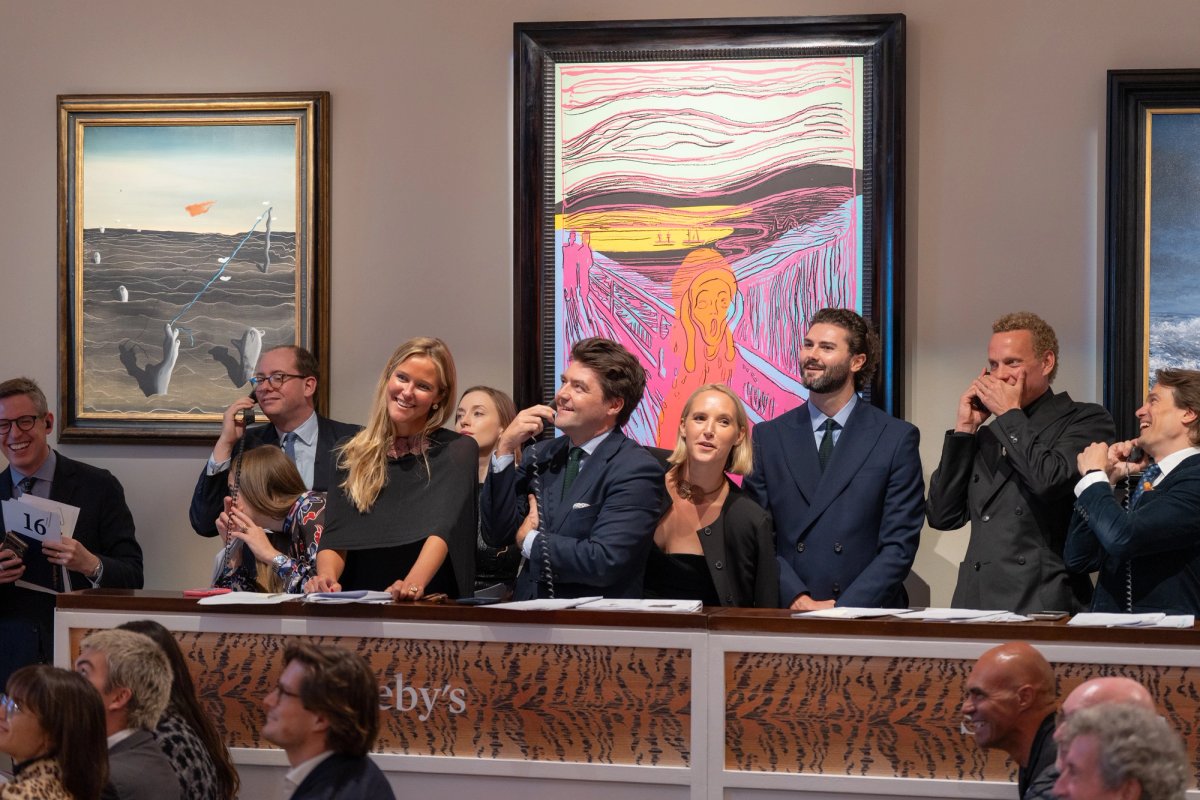
Following two years of a down market and declining sales, the world’s two leading auction houses, Christie’s and Sotheby’s, have both reported upticks in total projected revenue for 2025. Sotheby’s finished the year on top, with projected global sales of $7bn—a 17% increase on last year ($6bn). Christie’s will turnover $6.2bn overall, a 6% boost year-on-year. A stellar November season in New York, during which Sotheby’s broke the record for the most expensive work of Modern art sold at auction—$236.3m for Klimt’s Portrait of Elisabeth Lederer (1914-16)—proved a welcome shot in the arm. Christie’s report notes that the second half of 2025 marked a 26% increase in overall sales compared to the same period last year, a trend mirrored at Sotheby’s.
Both houses have grown their private sales business in recent years, due in part to an uncertain climate that has prompted risk-averse consignors to sell prized work away from public scrutiny. This year’s improved auction results have seen private sales at both houses either gently decline or remain stable compared to last year, accounting for 24% of total revenue at Christie’s and 17% at Sotheby’s. Christie’s, despite not claiming as many headline-grabbing auction records as Sotheby’s, states in its report that the top three sales this year were made privately. Revenue from private sales at both auction houses has grown exponentially since the pandemic, particularly at Christie’s.
The growth of luxury has also been a defining trend for auction houses over the past decade, and this year, both Sotheby’s and Christie’s saw healthy boosts to their sales of handbags, watches and jewellery. Turnover for this category is up 22% at Sotheby’s, to $2.7bn, and 17% at Christie’s, to $795m. Notably in December, Sotheby’s held its first ever Abu Dhabi Collectors’ Week, which made $133.4m from sales of cars, real estate, watches, jewellery and handbags.
Christie’s category breakdown of auction sales shows a 6% increase in 20th and 21st century art, by far the most valuable, at $2.8bn. The department that saw the greatest increase year-on-year was Old Masters, up 24% to $182m, no doubt boosted by the record-breaking sale of Canaletto’s view of Venice for £31.9m in London this July. Of all the categories at Christie’s, only the joint “Asian art/world art” categories saw a decline at auction, of 6%. The auction house’s report also notes a 3% decrease in spend from Asia Pacific-based buyers.
Sotheby’s, which for the past few years has released its year-end results in January, rather than December, has not yet revealed its detailed sales totals, including category and regional break downs.