Editor’s Note
The retail platform market is poised for significant growth, driven by omnichannel strategies, AI personalization, and retail media. This evolution is creating unified ecosystems that enhance customer experience and operational agility.
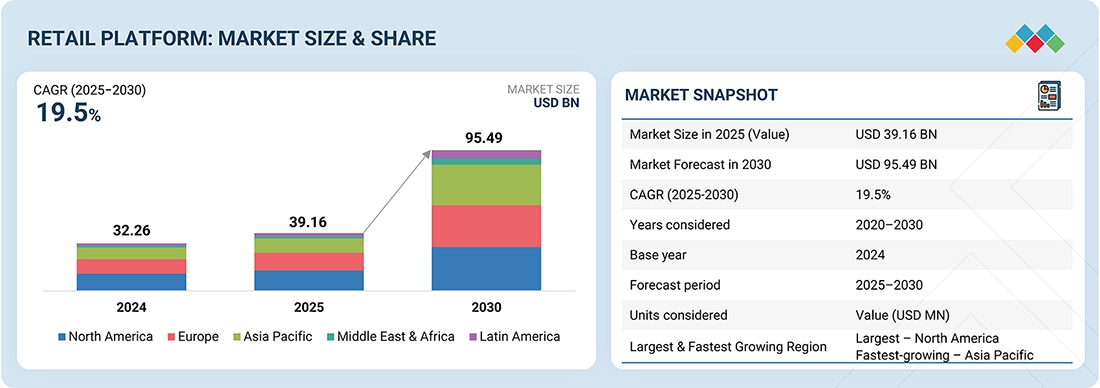
The retail platform market is expanding rapidly, with its size projected to grow from around USD 39.16 billion in 2025 to USD 95.49 billion by 2030, at a CAGR of 19.5%. Retailers are entering a new era where intelligent, connected platforms seamlessly integrate storefronts, supply chains, and customer experiences into a unified ecosystem. Driven by omnichannel adoption, AI-powered personalization, and retail media growth, these platforms deliver real-time insights, operational agility, and consistent cross-channel experiences. Advanced analytics, automation, and modular architectures enhance scalability, streamline workflows, optimize inventory and customer interactions, and enable stakeholders to boost efficiency, loyalty, and new revenue opportunities.
- By region, North America is estimated to dominate the market share by 35.29% in 2025.
- By platform, the Sales & Commerce platform segment is projected to hold the largest market share in 2025.
- By deployment mode, Cloud deployment is expected to dominate the market in 2025 and grow at a CAGR of 18.8% during the forecast period.
- By retail store type, the online retail store segment is expected to lead the retail platform market during the forecast period.
- By industry vertical, the beauty & cosmetics segment is expected to record the highest CAGR of 23.6% during the forecast period.
Leading players in the retail platform market, such as Oracle, Salesforce, and Shopify, employ both organic and inorganic strategies, including product innovations, partnerships, and strategic investments. Companies form alliances to address the growing demand for scalable, personalized, and data-driven retail solutions.
Companies like Watershed, Clarity AI, Normative, and Persefoni among others, have distinguished themselves among startups and SMEs by securing strong footholds in specialized niche areas, underscoring their potential as emerging market leaders.
The retail platform market is experiencing accelerated growth, fueled by increasing demand for intelligent, scalable, and experience-driven solutions that enhance omnichannel commerce, personalized customer engagement, and operational efficiency across retail enterprises. Retailers and brands are increasingly adopting cloud-native commerce platforms, AI-powered insights, and composable architectures to modernize supply chains, unify customer experiences, and deliver seamless, data-informed interactions across digital and physical touchpoints.
The impact on retailers stems from evolving technology trends and market disruptions. Core retail segments serve as primary adopters of retail platforms, while target applications span e-commerce, omnichannel operations, and customer engagement use cases. Changes in platform adoption and innovation cycles directly reshape operational models and shopping experiences. This influence cascades across industries, driving retail ecosystem growth, guiding technology investment flows, and enhancing overall retailer performance, ultimately fueling revenue growth within the retail platform market.
Drivers
Rising social commerce influence
Rising adoption of generative AI and unified commerce in retail platforms
Restraints
Escalating platform fees
Opportunities
Predictive AI drives scalable growth and competitive differentiation for retail platforms
Multimodal search interfaces
Challenges
Inadequate cybersecurity measures
Digital public infrastructure (DPI) accelerates digital transformation by providing foundational platforms such as digital identity systems, payment gateways, and data-sharing frameworks. These infrastructures enhance service delivery, reduce costs, and expand access, especially in underserved regions. India’s Aadhaar demonstrates DPI’s impact on financial inclusion and welfare. By fostering interoperability and collaboration between public and private sectors, DPI enables scalable solutions, supports startups, and speeds product development. It also improves customer experiences across finance, healthcare, and e-commerce. Ultimately, DPI promotes efficiency, inclusion, and resilience, helping organizations adapt to market demands and strengthen competitiveness in a digital economy.
Escalating platform fees pose a significant restraint on market growth, particularly for small and medium-sized retailers. As platform providers increase their service charges, the total cost of ownership for retail platforms rises, potentially limiting adoption and squeezing profit margins for retailers.