Editor’s Note
The diamond industry faces an identity crisis as lab-grown gems reshape its foundations of exclusivity and value. This article explores how a shift from mines to laboratories is challenging the sector, and why a high-profile celebrity moment has offered a timely spark.
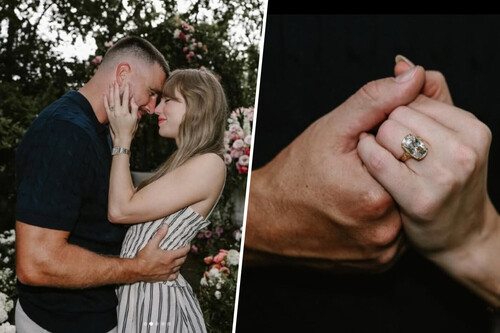
The diamond industry is not having an easy time. The once exclusive, powerful, and multi-billion dollar industry has been turned upside down by the boom in “cultured” gems, shaking something even more important than prices: its identity. By replacing African mines with Chinese laboratories, the sector has seen its image of exclusivity—one of the pillars on which it built its business decades ago—weakened. Taylor Swift’s engagement has served to revitalize it.
Beyond its value, the engagement has served to revitalize the message of sophistication and luxury that De Beers so successfully cultivated in its day. Taylor Swift is much more than the queen of pop. She is a veritable walking industry capable of altering the US GDP with her tour and an influencer with over 280 million followers on Instagram alone (add 32.5 million on TikTok) seeking inspiration. Therefore, the photo she shared yesterday of her engagement is much more than gossip news. Her engagement to Travis Kelce has put trend hunters worldwide on alert, who are already scrutinizing the engagement ring.
Beyond jewelers and designers, Swift’s legion of fans, or the gossip press, there is a group that has probably followed the engagement news with almost as much fascination as the singer: the global diamond industry. The reason is very simple. Mired in a deep existential crisis (perhaps the greatest in its entire history) affecting both its prices and its public image, the ring that Kelce just placed on Swift’s left ring finger reinforces the value that made diamonds a multi-billion dollar business: exclusivity.
De Beers, the titan of the sector, the company that convinced generations of lovers that a romance is only authentic if sealed with a rock, is not at its best; and diamond prices have experienced a deep fall in recent years, nearing lows not seen in this century. Behind this deep crisis are several factors. Some explain it by the ‘puncture’ of the Chinese market. Others point simply to a cultural change: we marry less, which equals fewer engagement rings and wedding bands, compounded by the fact that the sector already enjoyed a boom between 2021 and 2022, when the US market grew thanks to all the weddings postponed during the pandemic. However, there is another factor that largely explains the sector’s drift in recent years, one that affects both prices and the very identity of diamonds: synthetic stones.
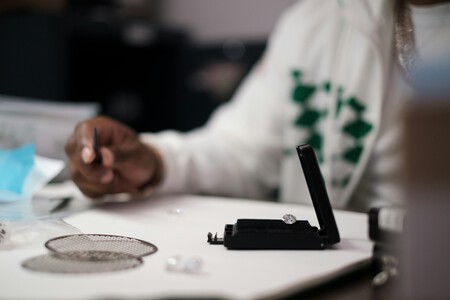
Also known as “lab-grown diamonds,” they are not new. Their origins can be traced back to the mid-last century. However, in recent decades their production has been refined so much and, above all, they have achieved such market penetration that they have become a serious competitor for natural diamonds. Serious and dangerous. The latter (natural stones) come from mines after forming over millions of years under extreme conditions. The former (synthetic) are created in laboratories in days. And the reality is that experts cannot tell them apart with the naked eye.
The expected result was that lab-grown diamonds have been gaining space in jewelry stores, affecting market prices, putting traditional companies on guard, and, above all, shaking the foundations on which the business was built. They compete with mined gems but can be mass-produced in record time and at a speed that has led to voices in the industry warning of the risk of overproduction. Not only that. Some manufacturers have decided to bet on “cultivated” diamonds, considering them more ethical.
As a result, synthetic diamonds have carved out a considerable niche in the market. In a recent article, The Wall Street Journal pointed out, citing analyst Paul Zimnisky, that they already represent more than a fifth of global diamond jewelry sales. That’s not bad considering that just a few years ago, in 2016, they accounted for less than 1%.
When it comes to engagement rings, their market penetration is even greater. Data from the wedding-focused website The Knot shows that more than half of the engagement rings sold last year in the US included at least one lab-grown diamond. Again, that’s many, many more than before the pandemic. Growth since 2019 is estimated at nearly 40%.
This landscape has been marked by a plunge in prices. Both synthetic and natural stones. Zimnisky calculates that since 2016, the retail price of a one-carat lab-grown diamond has fallen by nearly 86%. During the same period, mined stones have also lost value, though much less: a gem of the same size would now cost around 40% less than nine years ago.