Editor’s Note
This article introduces Billie Hughes, a second-generation gemologist carrying on her family’s legacy at the Lotus Gemology laboratory in Bangkok. We explore her unique role within this renowned family enterprise.
VOLET 1: In the Thai Gem World with Billie Hughes
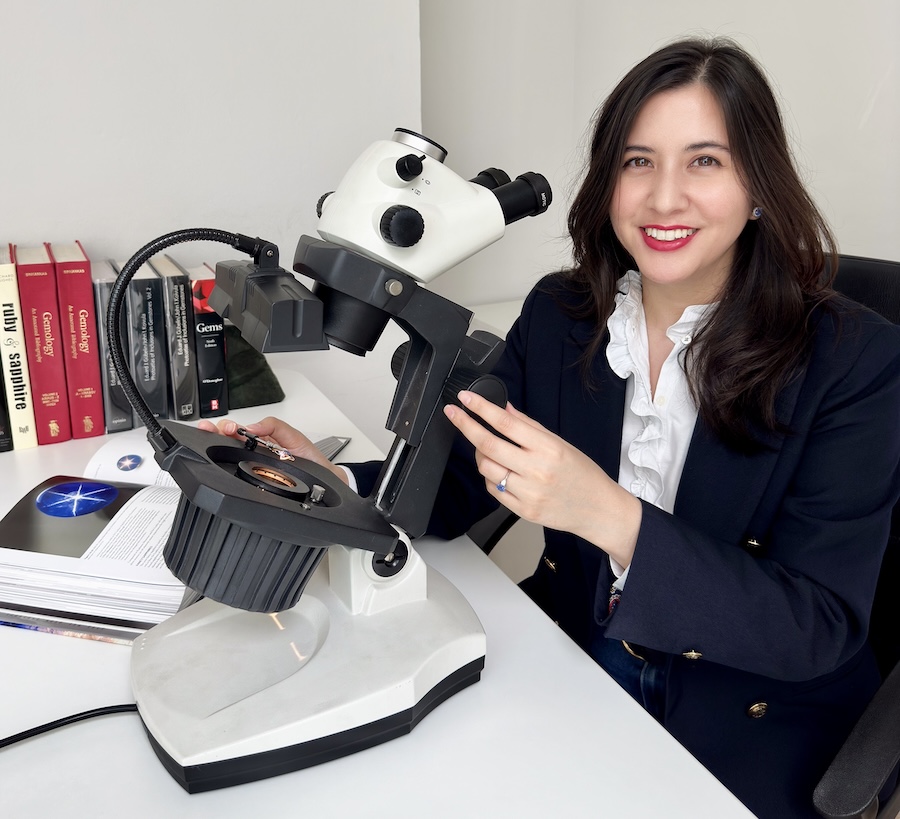
Billie Hughes is the daughter of the famous gemologist Richard Hughes and his wife and adventure companion, Wimon, authors of the bible on ruby and sapphire.
Billie found her place in this family team, in the “Lotus Gemology” laboratory set up with her parents 10 years ago in Bangkok.
We interviewed her.
“I am a gemologist at the Lotus Gemology laboratory. My specialty is therefore the study, research, and expertise of gemstones, everything that falls under the purview of a gemological expertise laboratory. We identify the material. We test the stones that clients bring us to ensure that the nature of this material matches what they claim or hope for.”
“For example, if it’s a blue stone, we determine if it’s a blue sapphire or not. We then determine if it’s a natural or synthetic (man-made) stone. Finally, we determine if the stone has undergone treatment, such as heat treatment or fracture filling with oil.”
“Our role as laboratory gemologists is also to determine the origin of the stone. We finally publish a report summarizing our findings. Some of these tasks involve detecting new origins when new deposits are discovered. Or identifying new treatments.”
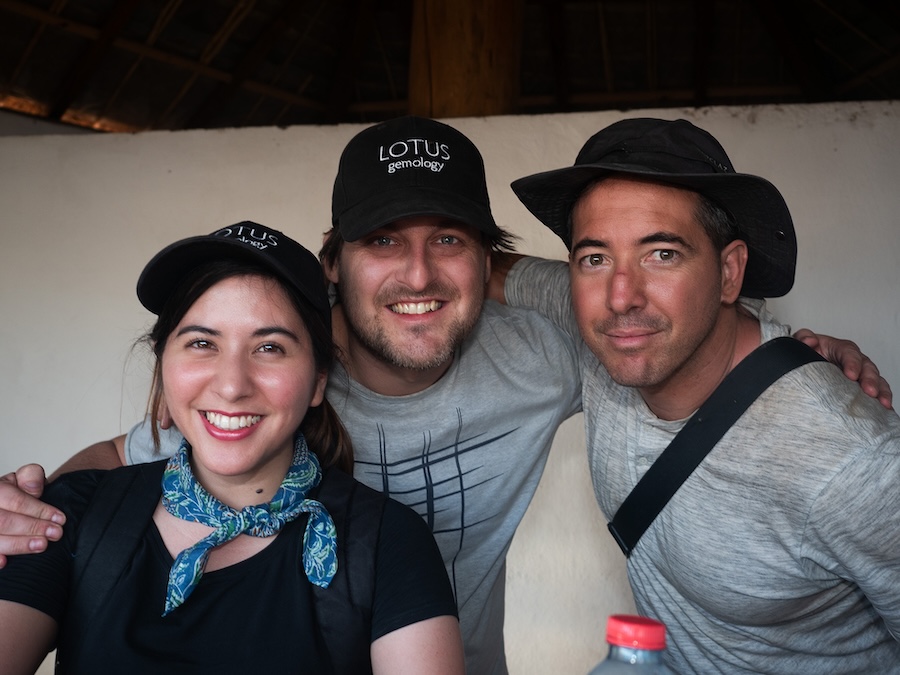
(De gauche à droite) Billie Hughes (Lotus Gemology), Simon Dussart (Asia Lounges, Le Fiancé), and Guillaume Soubiraa (Colorline) au marché des pierres à Ilakaka, Madagascar.
“In order to fulfill our mission well, we conduct our own research to be informed about what is happening in the market. These market novelties require us to be constantly attentive.”
“Yes, the daily priority remains the expertise of the stone. Secondly, there are the experiments we conduct. For example, the one I conducted on low-temperature heat treatment of ruby and sapphire, including Madagascar blues. I also experimented with heat treatment of Burmese rubies. As mentioned earlier, we are very attentive to everything that arrives on the market. Thirdly, we participate in events such as auctions, like those of Gemfields last November, here in Bangkok, for Zambian emeralds. Very useful for staying in touch with the market. Because, let’s remember, these auctions are for rough stones; they will therefore be transformed before arriving in laboratories like ours. Knowing them upstream gives us a great advantage when we see them cut later.”
“Finally and most importantly, an essential facet of research, which you know well, is going into the field to collect samples directly from production sites, like when we came to see you in Madagascar. We then study them in the lab as reference samples.”
“We keep in mind that anything is possible. One must be cautious, but overall, the samples we collect, regardless of their source, prove to be reliable.”
“In our database, we take notes on how we obtained this or that sample. We have, for example, stones from Gemfields, directly from their mines. Working in trust with them, the samples are considered highly reliable. That is obviously not enough. We constantly cross-check the analyses we perform to verify their reliability. We can also note that such a stone was extracted from a mine in a certain locality.”
“Or that we bought this stone in a market near the mine in such a country or that it was provided to us by such a dealer. Everything is recorded on how things were obtained and the year they were obtained. We can trace everything back this way, and over time, by cross-referencing information, we refine our results. With time and the multitude of information we collect, we are able to ensure a high level of reliability.”
“I would say it’s a small part although it is a stone whose popularity is growing rapidly. I have more clients bringing them to me now. I think it’s also due to the different recent rough auctions here; it sparks increased interest. Our daily bread is really ruby and sapphire. That’s our specialty as a laboratory. That’s why we are known, because we have published a number of works on ruby and sapphire.”
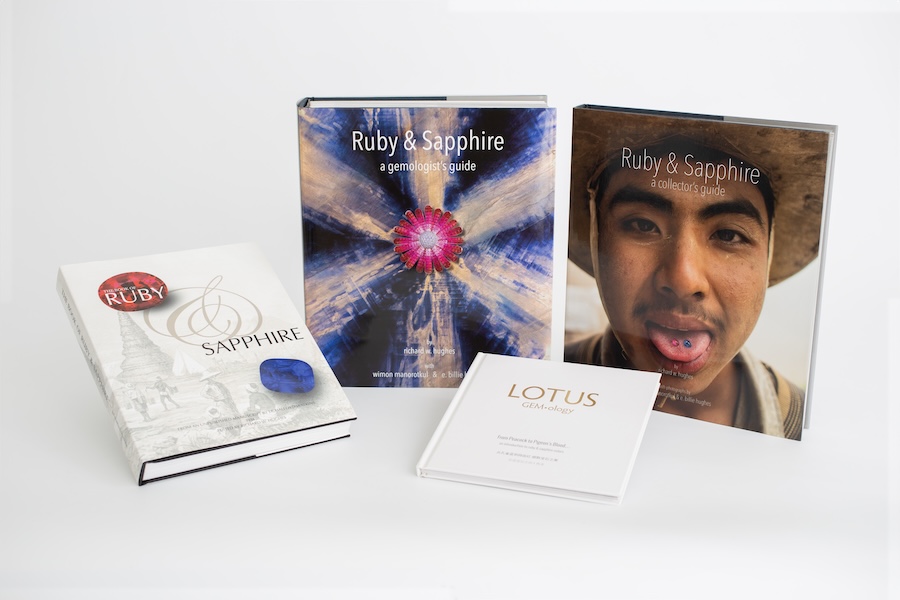
Livres de Lotus Gemology; Photo de Ronnakorn Manorotkul/Lotus Gemology.
“The public knows us for that. So they send us a lot of them. But it’s also certainly the main colored stone on the Bangkok market. It’s the world capital of ruby and sapphire. Most of the world’s important rubies and sapphires pass through Bangkok. So I would say that ruby and sapphire represent the majority of the market here.”