Editor’s Note
This article highlights the growing imperative for businesses to adopt responsible procurement practices. As global supply chains expand, so too does their social and environmental footprint. Effective management now requires a holistic view of the entire product lifecycle, from sourcing to end-of-life, to mitigate risks and build a sustainable future.
In recent years, alongside the expansion of global supply chains, the impact of corporate activities on society and the environment has become increasingly significant. This includes social issues such as human rights and labor, as well as environmental problems like climate change. Therefore, it is crucial to strengthen management by viewing the entire supply chain—from the procurement of raw materials to production, use, disposal, and recycling—identifying and analyzing potential risks, and appropriately resolving issues.
DNP is committed to “responsible procurement” with suppliers and business partners (hereinafter referred to as “Business Partners”) both domestically and internationally. This ensures that social responsibilities are fulfilled throughout procurement activities.
DNP has established policies related to supply chain management and the green procurement of raw materials, advancing initiatives aimed at building a sustainable supply chain.
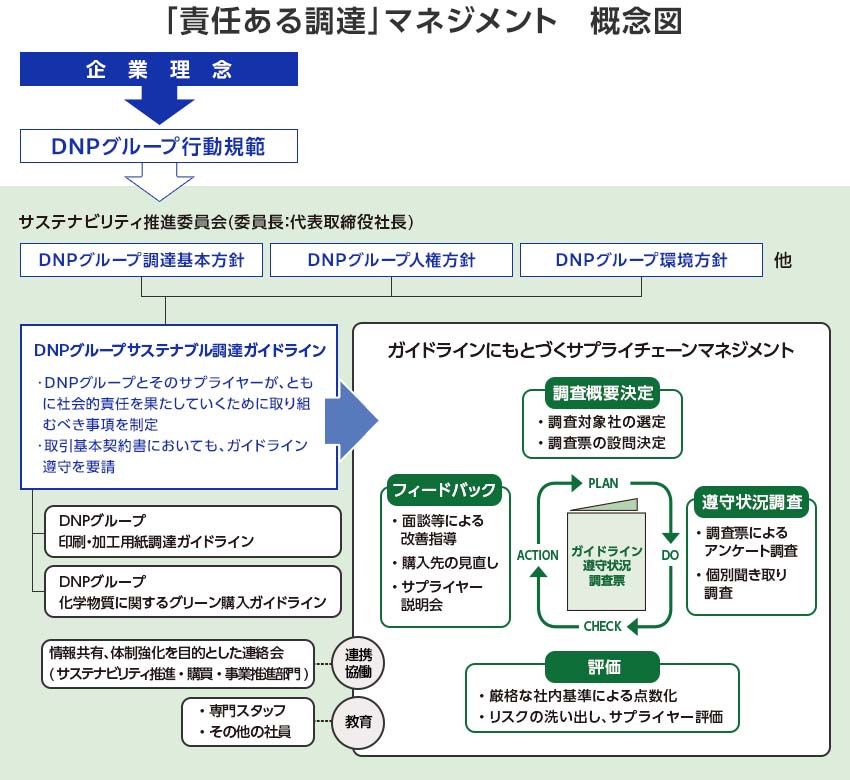
To enhance the effectiveness of supply chain management, DNP has established a Sustainable Procurement Guideline. Particularly for high-importance themes such as the procurement of printing/processing materials and chemical substances, individual guidelines have been set. These guidelines consist of items that must be addressed together with Business Partners to fulfill social responsibilities.
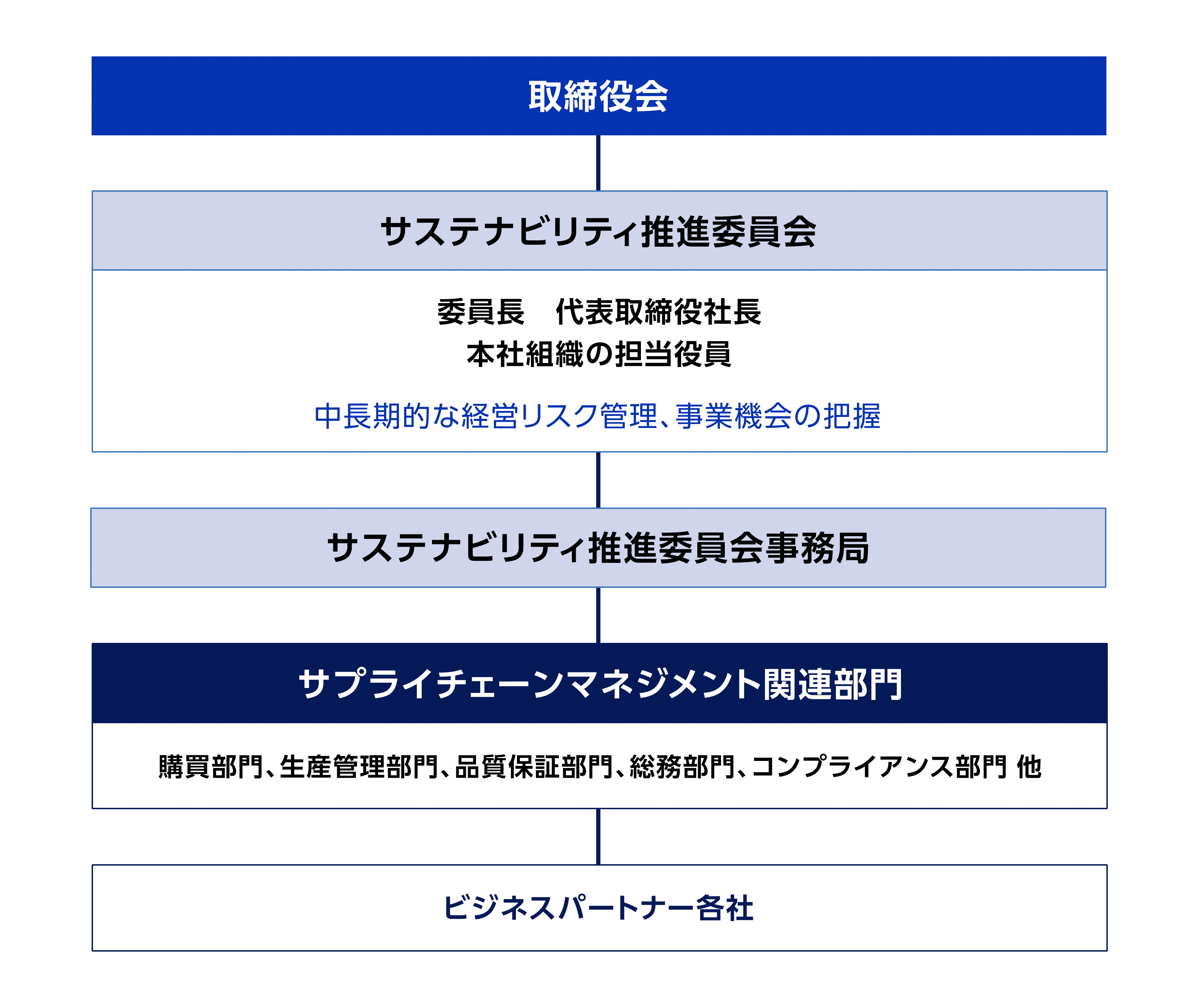
DNP has established a Sustainability Promotion Committee, with the Representative Director and President serving as the committee chair. This committee confirms the implementation of responsible procurement across the entire supply chain, addressing social issues such as human rights and environmental problems like climate change. It promotes various activities to establish guidelines and enhance their effectiveness.
Based on fundamental considerations for supply chain management, DNP sets priority standards and target values and engages in continuous activities.
Target Values for FY2024
① Average score of Sustainable Procurement Guideline surveys for major suppliers →
② Compliance rate of Printing/Processing Materials Procurement Guideline →
*Suppliers accounting for 90% of annual purchase value, suppliers critical for business continuity are targeted (①)
① By FY2030: Average score of 90 points or above
② By FY2030: Achievement rate of 100%
① Domestic: 83 points
② 99.5% ← →
Through management based on the Sustainable Procurement Guideline with each Business Partner, DNP identifies risks and works on improvements. We implement the PDCA cycle and continuously strengthen supply chain management.
DNP has defined the “DNP Group Sustainable Procurement Guideline” as a mandatory item to be addressed with Business Partners. This is to identify risks predicted to impact the supply chain—such as legal compliance, respect for international regulations, human rights/labor, occupational safety and health, environment, fair trade/compliance, product safety/quality, information security, and business continuity planning—and to ensure the sustainable development of both DNP and its partners.
To further enhance its practicality, we inform Business Partners about this guideline and related in-house policies, conduct periodic surveys and evaluations of compliance status, provide feedback on results, and implement measures such as individual interviews and engagement.
Item / Question Item / Details / Requested Matter
Management System Framework / Management system, supply chain management
Compliance Matters / Legal compliance, respect for international regulations / Compliance with laws and rules
Human Rights and Labor / Forced labor, child labor, working hours, wages, discrimination, freedom of association, collective bargaining rights
Occupational Safety and Health / Labor safety, occupational hazards/diseases, health management
Environment / Greenhouse gas emission reduction, biodiversity conservation, resource recycling, chemical substance management
Fair Trade and Compliance / Prevention of bribery, intellectual property, import/export management, responsible mineral sourcing
Product Safety and Quality / Quality management, provision of product/service information
Information Security / Cyber attacks, personal information, confidential information management
Business Continuity Planning / Business Continuity Plan (BCP) formulation
Promotion Matters