Editor’s Note
This article highlights a significant step in India’s scientific self-reliance, detailing the development of indigenous, 3D-printed weather stations. This innovation promises to improve urban weather forecasting by addressing critical data gaps at the local level.
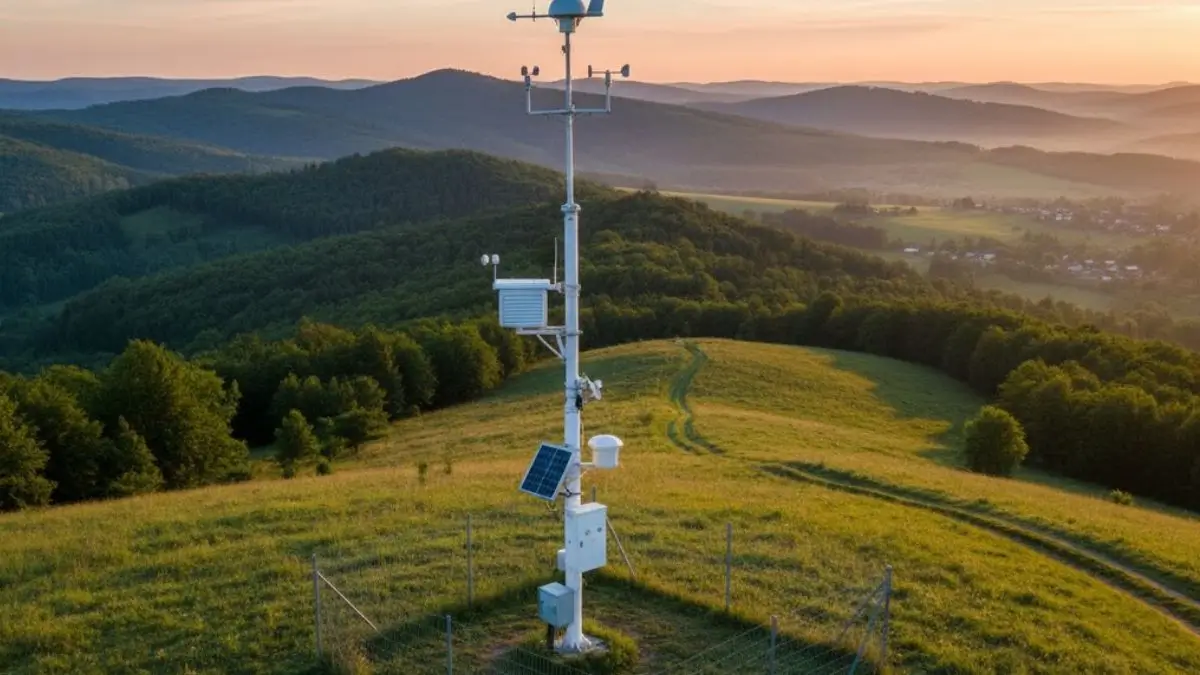
Indian scientists have achieved a major technological feat by developing an Automatic Weather Station (AWS) using 3D-printing technology. These indigenous stations will specifically strengthen last-mile weather data collection in urban areas. The first installations will begin in Delhi from February 2026, enhancing weather forecasting and climate monitoring capabilities.
Scientists led by the Indian Institute of Tropical Meteorology (IITM) have developed 3D-printed Automatic Weather Stations under Mission Mausam. Their first phase will be installed in Delhi starting February 2026.
This is a fully indigenous and first-of-its-kind technological development.
Due to being manufactured via 3D-printing, fast production and customization according to specific regions are possible.
Automatic recording of temperature, humidity, wind speed/direction, and rainfall.
Real-time data transmission, requiring no human intervention.
Solar-powered, reducing operational and maintenance costs.
Promotes Make in India by reducing dependence on imports.
A ₹2,000 crore National Weather Modernization Programme.
Leadership: Ministry of Earth Sciences.
Goal: To strengthen weather observation, forecasting, and climate services.

Special emphasis on urban meteorology, as climate risks are increasing in cities.
Primary cities: Delhi, Mumbai, Chennai, Kolkata.
A dense observation network will improve local and short-term forecasts.
Reduced cost and faster deployment.
Precise design of complex components is possible.
Rapid scale-up to fill data gaps across the country.
Reduced import dependency increases self-reliance.
Proper site selection and calibration are essential for reliable data.
In the initial phase, AWS will be co-located with manual observatories.
Full-scale operations will begin after cross-verification of data.
Regular maintenance protocols will be implemented.

An Automatic Weather Station is an automated system that continuously measures meteorological parameters—such as temperature, humidity, wind, and rainfall—and transmits them in real-time. It is extremely useful for rapid warnings, local forecasting, and climate studies.