Editor’s Note
This article highlights Jinju City’s dual achievements in governance, from its top-tier integrity rating to its strategic pivot toward aerospace-led growth. As municipalities worldwide balance transparency with economic development, Jinju’s approach offers a case study in aligning administrative credibility with forward-looking industrial policy.
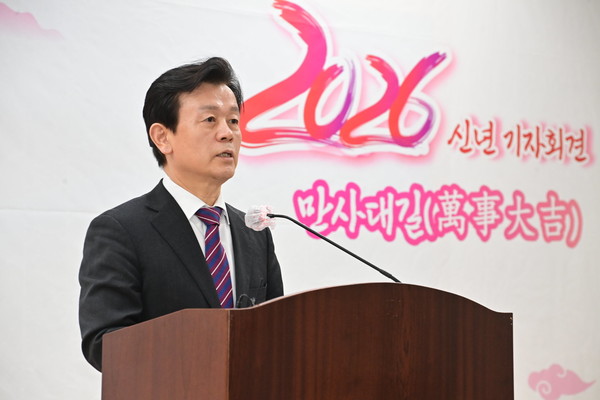
Jinju City (Mayor Jo Gyu-il) officially announced its future growth strategy centered on the aerospace industry and the direction of municipal administration to improve citizens’ quality of life at the 2026 New Year press conference held in the City Hall briefing room on December 31.
Mayor Jo Gyu-il said at the press conference, first introducing the city’s major administrative achievements over the past year.
To revitalize the stagnant original downtown, a Youth Hub House and an Imagination Remake Center will be built in the Seongbuk and Jungang districts, and a Youth Meomum Center and JAR Eoullim Center in the Manggyeong and Gangnam districts, all to be completed in 2026.
The city plans to create the Wolasan Forest Jinju and Jinyangho Park, Manggyeong Park area as a Green Tourism Belt; Mangjinsan Beacon Mound, Jinjuseong Fortress Hoguk Maru, and Yudeung Creation Center Bitmaru as a Patriotic Tourism theme; Somangjinsan Yudeung Park, Namgang Yudeung Exhibition Hall, Bitmaru, and the Yudeung storage facility Bitdamso as a Yudeung (Lantern) Tourism theme.
Building on the successful launch and operation of the ultra-small satellite ‘Jinjusaet-1B’, the city will establish a space environment test facility and a ground station (satellite antenna), and launch ‘Jinjusaet-2’ in 2027 to build an integrated satellite industry ecosystem encompassing development, operation, and data utilization.
The city will continue public transportation innovation with measures like the nationwide-first metropolitan transfer discount system for all transportation modes, the 100-won bus fare system for children and youth, and the introduction of Hamo Call Bus implemented in 2025.
To allow elderly people facing difficulties in daily life to spend their later years comfortably where they live, integrated medical and nursing care will be implemented, and the Ribbon Center, a complex cultural space for the new middle-aged, is scheduled to open in the first half of the year.
The city is forming and operating its own TF for the second relocation of public institutions to Jinju Innovation City, and plans to secure location bases for relocating institutions using areas like the Munsan public housing district and strengthen consultations with related agencies.
Mayor Jo Gyu-il said in conclusion, expressing his ambition, “We will make 2026 a stepping stone toward a prosperous Jinju and turn the vision of a central city in the southern region and happy citizens in a prosperous Jinju with a 1-million population living zone into reality.”