Editor’s Note
This article outlines a mayoral candidate’s policy vision for transforming Jinju into an aerospace hub. The announcement sets the stage for the upcoming local elections, focusing on economic revitalization and new industry investment.
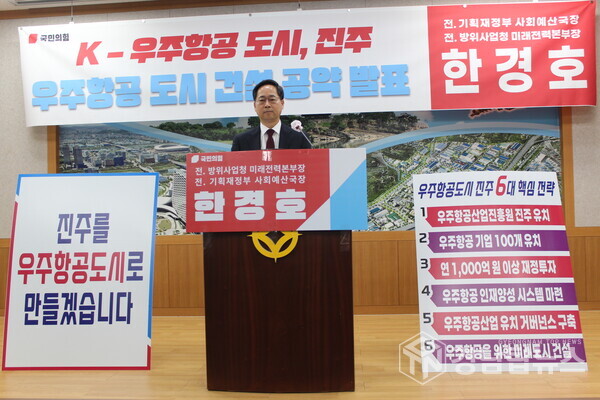
Han Kyung-ho, a candidate for mayor of Jinju, held a policy press conference on the 21st to officially announce his candidacy for the June 3 local elections. He revealed policy concepts and financial investment plans to transform Jinju into a substantive aerospace city.
Candidate Han diagnosed regarding his motivation for running. He presented the aerospace industry as the key driving force to break through these issues. Mentioning his experience handling aerospace policy at the Defense Acquisition Program Administration (DAPA), he explained the current state of Jinju’s aerospace city initiative, stating,
The candidate cited two main reasons for the stalled aerospace city identity. First, he mentioned
stating that a lack of cooperation or conflicts with local National Assembly members and the mayor of Sacheon have hindered securing central government support and achieving results in attraction competitions. He then pointed to issues with utilizing the Ibanseong-myeon Rotary Wing Test Center and the low occupancy rate of the National Aerospace Industrial Complex, arguing that aerospace policies have not translated into tangible outcomes.
On this day, Candidate Han presented six core strategies to make Jinju a substantive aerospace city.
The first strategy involves attracting the ‘Aerospace Industry Promotion Agency’ to Jinju. He announced plans to form a dedicated task force (TF) to jointly attract the Korea Institute of Aviation Safety Technology (KIAST) and specialized institutions for aerospace AI/SW certification testing. He explained that this would create an aerospace infrastructure city that comprehensively performs research, testing, certification, and quality assurance functions by linking with existing institutions like the Korea Testing Laboratory (KTL), the Defense Agency for Technology and Quality, the Defense Technology Security Research Institute, and the test center.
The second strategy is to attract 100 aerospace/defense companies and create 10,000 quality jobs. He pledged to achieve 100% occupancy of the National Aerospace Industrial Complex within three years and to create rental industrial complexes for small and medium-sized enterprises and a dedicated knowledge industry center for aerospace startups. He also presented a plan to strategically foster the Advanced Air Vehicle (AAV) industry to expand central government R&D investment.
Third, he revealed plans to expand financial investment in the aerospace sector. Candidate Han explained that Jinju City’s current annual budget related to aerospace/defense is approximately 28 billion won, which includes national and provincial funds. He proposed a structure where national and provincial funds are secured at around 70 billion won, and the city bears about 50% (35 billion won), aiming to invest over 100 billion won annually in the aerospace field. Regarding this, he stated,
explaining that funds could be adjusted through restructuring projects focused on facility establishment.
The fourth strategy is to establish an aerospace talent development system. He announced plans to strengthen the supply system for master’s and doctoral-level high-level personnel in cooperation with Gyeongsang National University and to expand industry-academia-research cooperation systems. To address the shortage of production personnel, he explained they would respond by combining customized corporate education and training with the utilization of foreign labor.
The fifth strategy is to establish ‘Aerospace Industry Attraction Governance’ based on cooperation between Jinju and Sacheon. The concept is to form an Aerospace Industry Attraction Committee involving National Assembly members, the mayor of Sacheon, the mayor of Jinju, aerospace companies, and experts to enhance negotiation power with the central government and urban competitiveness.
The sixth strategy is to create a future city where aerospace personnel want to stay. He announced plans to develop the station area and Jeongchon area into a future city encompassing transportation, residence, education, and culture, taking advantage of the 2029 opening of the Southern Inland Railway KTX.
During the Q&A session, when asked about the scale of aerospace companies and jobs, Candidate Han replied,
Regarding companies’ relocation intentions, he explained that surveys indicate some companies are considering moving to Jinju, and stated that if research, testing, certification, and support functions are concentrated, the competitiveness for attracting companies will increase.
Candidate Han Kyung-ho stated,
and added,