Editor’s Note
This article explores a potential shift in construction methods in Madhya Pradesh, where the government is considering adopting 3D printing technology. Proponents argue it could accelerate project timelines and reduce environmental impact, as highlighted by a recent ministerial visit to IIT Madras to observe the technology in practice.
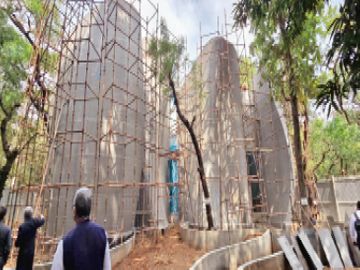
The method of building construction in Madhya Pradesh (MP) may soon change. The government is now preparing to adopt 3D printing-based construction technology. This will lead to faster completion of construction work and will also not harm the environment. Public Works Department (PWD) Minister Rakesh Singh took an initiative in this direction by visiting the Indian Institute of Technology (IIT) Madras.
There, he saw buildings and structures built using 3D printing. The PWD Minister said that work on 3D buildings is underway at 4 places in the country.
However, it will not be implemented in all construction works immediately. Pilot projects will be launched first. For this, engineers of the department will be given special training and coordination will be established with technical institutes and start-ups.
… This technology uses special concrete, fiber, and cement compounds.
The process of constructing buildings with 3D printing is completely digital. First, the building’s design is prepared on a computer. Then this design is fed into a 3D printer machine. The machine extrudes a concrete-like material through a special nozzle, building up walls and the structure layer by layer. This allows the structure to be ready in just a few days. Cost is reduced because less brick, shuttering, and labor are required.
Special concrete mixture. Cement-based compounds. Fiber-reinforced strong materials. In some cases, recycled construction materials. This material is formulated so that it can be easily printed from the machine and also gains strength quickly.
Benefits for the environment – Trees will be saved from being cut, pollution and construction waste will be reduced, dependence on brick kilns will decrease.
MP is also preparing to adopt this technology. In the future, its use could be in schools, hospitals, temporary houses, public buildings, and large events like Simhastha 2028.
: Initial machines are expensive. Engineers require special training. Safety standards and regulations are yet to be finalized. Use in tall buildings is currently limited.
.. PWD will now work rapidly on this technology. Designs will be prepared keeping in view large events like the Simhastha Kumbh to be held in Ujjain.